Key Highlights
Cloud-based architecture becomes the dominant offering, providing scalable multi-tenant platforms that synthesize real-time data from field sensors, global positioning systems, and satellite networks.
Software-driven automation packages yield measurable productivity gains, with real-time field configuration adjustments increasing harvest productivity by 20%.
Shortages in technical agricultural expertise limit complete infrastructure deployment, forcing software providers to combine applications with structural consulting and training services.
Precision farming, livestock monitoring, aquaculture, and smart greenhouse segments lead enterprise software integration across developed and emerging economies.
Why This Matters Now
Traditional agricultural frameworks are failing to manage volatile environmental conditions and complex global supply chain disruptions without structural data interventions. Corporate agricultural operations can no longer operate using siloed databases while food security mandates require precise, auditable tracking from seed to distribution. This immediate operational necessity forces chief technology officers and institutional investors to overhaul legacy agricultural IT setups and inject capital directly into unified software architectures.
Corporate technology buyers who delay cloud migration face immediate operational bottlenecks, input waste, and localized resource inefficiencies. Software-driven automation platforms are no longer an optional utility for large-scale operations; they are a baseline requirement for economic survival. Enterprise platform vendors capable of integrating real-time telemetry with satellite-based analytics are capturing massive customer acquisitions as farms undergo urgent digital transformation initiatives.
Market Overview
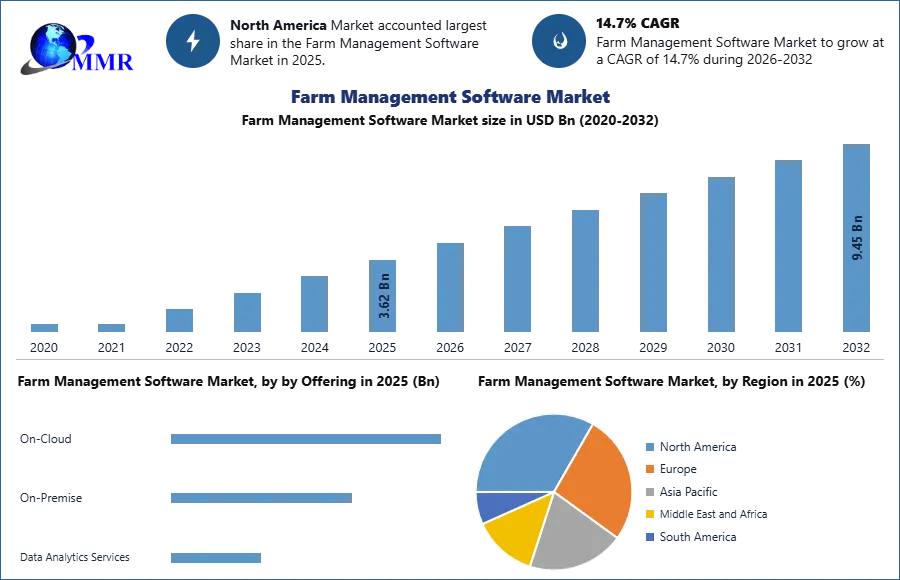
The global farm management software market Size was valued at US$ 3.62 billion in 2025 and is projected to expand to US$ 9.45 billion by 2032. This rapid growth represents a compound annual growth rate (CAGR) of 14.7% throughout the forecast period spanning from 2026 to 2032. What changed is the fundamental approach of the agtech boardroom: software is no longer treated as a simple back-office logging tool but as a central automation system.
This transition is happening now because disconnected farm operations create massive visibility gaps, resulting in misallocated resources and degraded crop quality. Farm management software addresses this structural challenge by delivering a single platform that connects data from machinery, personnel, and environmental sensors. The primary beneficiaries are large-scale commercial growers, livestock enterprises, and vertical greenhouse operations that require automated coordination across diverse geographic zones.
Key Trends Driving Growth
Artificial intelligence and machine learning adoption are redefining how commercial agricultural enterprises predict yield performance and mitigate operational risks. Advanced platform architectures ingest satellite-based vegetation indexes and in-field sensor feeds to automate machinery settings on the fly. This real-time automation minimizes human error during critical production windows and prevents raw product loss by optimizing harvesting speed based on localized terrain data.
Simultaneously, enterprise connectivity developments allow decentralized machinery fleets to maintain persistent communication with central corporate offices. Connected workflow software updates allow fleet managers to sync real-time analytics directly from corporate dashboards to autonomous field units, maximizing equipment uptime. The modernization of these networks enables precise tracking of fleet logistics, fuel consumption patterns, and equipment wear cycles before mechanical failures disrupt field operations.
Get Free Sample: https://www.maximizemarketresearch.com/request-sample/30111/
Segment Insights
On-Cloud Solutions (Dominant Offering): Commands the highest market demand due to its superior system elasticity, reduced initial capital requirement, and seamless real-time integration with Internet of Things equipment.
Data Analytics Services (High-Growth Segment): Expands rapidly as agricultural firms require advanced predictive algorithms to parse high-density data transmitted between hardware equipment and field managers.
On-Premise Deployment: Experiences slower relative adoption rates, restricted primarily to large agricultural enterprises with existing legacy servers that face regional network connectivity constraints.
Precision Farming Applications (Dominant Application): Secures the largest share of application investments as growers deploy global positioning systems and satellite imagery to orchestrate targeted crop interventions.
Livestock, Aquaculture, and Smart Greenhouses (Emerging Opportunities): Witness accelerating software integration as specialized operators deploy automated sensor tracking to manage environmental parameters and animal health metrics.
Regional Growth Story
North America maintains structural leadership over the global farm management software landscape, propelled by high-density corporate farming structures and mature cloud computing infrastructure. The United States market continues to expand as agricultural enterprise buyers integrate predictive ground speed applications and advanced autosteering software into large machinery fleets. Robust regional data center networks allow tier-one software providers to scale real-time analytics platforms without encountering data processing delays.
The Asia-Pacific region represents the most rapid long-term deployment pipeline, supported by targeted government digital infrastructure investments across China and India. Rapid regional population growth strains traditional food production methods, forcing the implementation of automated smart greenhouse technologies and precision aquaculture systems. Regional technology providers are focusing on developing localized, high-accessibility mobile software interfaces to bridge technical knowledge gaps among mid-sized farm managers.
Competitive Landscape
The competitive ecosystem is anchored by established industrial technology leaders executing targeted platform expansions and software enhancements to fortify market positioning. Key global industry participants include Trimble, John Deere, Raven Industries, and Topcon Agriculture. These entities are actively competing on platform integration capabilities, user-interface simplicity, and open application programming interface ecosystems.
Market activities demonstrate a clear competitive trend: hardware-entrenched manufacturers are transitioning into software-first platform providers to secure recurring software-as-a-service revenue models. Platform providers are prioritizing enterprise-level automation updates that can optimize mid-range equipment fleets, expanding their addressable market to small and medium-sized operations. Technology providers that successfully integrate precision autosteering software with cloud analytics packages are gaining significant pricing power over vendors that offer isolated software utilities.
Recent Developments
Global technology developers introduced the Harvest Automation Ultimate Tech Package for 2026 combines, which integrates predictive ground speed and satellite vegetation data to boost harvest productivity by 20%.
Infrastructure updates focused on driverless tillage workflows were released to maximize field uptime and eliminate operational overlap by syncing real-time fleet analytics across remote offices.
Agtech developers expanded cloud-based precision agricultural platforms to deliver value-line steering software to mid-range tractors, targeting an equipment efficiency gain of 30% for mid-sized farms.
Specialized data analytics services launched new API configurations designed to consolidate data flows from multiple third-party hardware manufacturers into a single cloud dashboard.
Strategic Implications
The convergence of machine learning with automated field machinery means Chief Information Officers can no longer treat agtech purchases as isolated hardware upgrades. Corporate technology strategists must design unified data architectures capable of processing continuous, multi-source inputs from edge sensors and satellite imagery simultaneously. Failing to establish a clean data pipeline across the enterprise prevents predictive analytics engines from delivering actionable operational insights.
Furthermore, addressing technical knowledge barriers requires software vendors to reshape their implementation methodologies. Because field operators frequently lack deep data engineering expertise, platforms must deliver simple, automated configurations rather than complex manual dashboards. Software procurement cycles must favor systems that offer built-in training modules and automated machine calibration to ensure rapid user adoption and protect capital investments.
Future Outlook
The evolution of the farm management software market will depend on the deep integration of autonomous machinery with predictive regional climate modeling systems. Future agtech platforms will operate as self-correcting ecosystems, where software automatically triggers targeted drone applications and adjusts autonomous irrigation schedules based on real-time weather changes. This shift will transition farm management from reactive physical oversight to centralized, software-driven asset management.
As data collection capabilities expand, a distinct performance divide will separate technologically advanced agricultural firms from traditional operations. The future of global agricultural production belongs exclusively to digital leaders who leverage cloud-managed, AI-optimized platform ecosystems to maximize unit economics per acre, while laggards will remain structurally vulnerable to rising input costs and fragmented, manual operational structures.
Analyst Perspective
“The global farm management software landscape has moved beyond basic record-keeping into the era of continuous, machine-driven automation,” states Yash Ghosalkar, Analyst at Maximize Market Research.
About Maximize Market Research
Maximize Market Research Pvt. Ltd. (MMR) is a global market research and consulting company that provides reliable, data-focused, and practical business insights. The firm serves a wide range of industries, including healthcare, pharmaceuticals, technology, automotive, electronics, chemicals, personal care, and consumer goods. Through market forecasts, competitive analysis, strategic consulting, and industry impact assessments, MMR helps organizations understand changing market conditions, identify growth opportunities, and make informed business decisions for long-term success.
2nd Floor, Navale IT Park Phase 3
Pune Banglore Highway, Narhe
Pune, Maharashtra 411041, India
+91 9607365656
sales@maximizemarketresearch.com
