Key Highlights
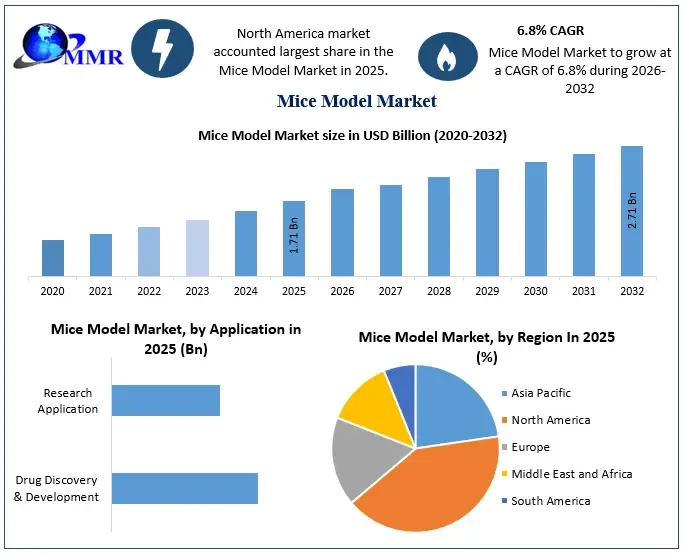
Market Valuation: The mice model market reached USD 1.71 Billion in 2025 and is projected to scale to USD 2.71 Billion by 2032.
Growth Trajectory: The industry is expanding at a robust CAGR of 6.8% through the 2026–2032 forecast period.
Dominant Segment: Inbred mice remain the market leader due to their genetic uniformity, providing the consistency required for reproducible research.
Fastest-Growing Segment: Oncology (cancer research) continues to lead the end-use market, fueled by substantial global research funding.
Technology Driver: CRISPR gene-editing technology is fundamentally accelerating the development of humanized mice models, narrowing the translational gap to clinical trials.
Why This Matters Now
Pharmaceutical and biotechnology decision-makers face a critical bottleneck: the high failure rate of drugs in clinical trials. As the complexity of new drug candidates increases—particularly in personalized medicine—the need for high-fidelity, human-relevant preclinical models has never been greater. The ability to de-risk development pipelines early through sophisticated, humanized mouse models is no longer a luxury; it is a competitive necessity. Firms that fail to leverage these advanced models risk prolonged time-to-market and increased R&D spend.
Market Overview
The global Mice Model Market Size represents the cornerstone of modern drug discovery and therapeutic development. Valued at USD 1.71 Billion in 2025, the market is set to reach USD 2.71 Billion by 2032, expanding at a CAGR of 6.8%. This growth reflects the transition from simple, commodity-based testing toward high-precision, genetically tailored preclinical models. As biopharmaceutical pipelines swell, the requirement for robust, reliable, and standardized in-vivo models is becoming the definitive engine for market expansion.
Key Trends Driving Growth
The most transformative trend in the mice model landscape is the integration of CRISPR-based gene editing. Previously, developing custom models was a slow, labor-intensive process with significant room for error. CRISPR has turned this into a high-precision operation, enabling the creation of mice that precisely mimic specific human mutations. This has effectively “humanized” preclinical testing, significantly narrowing the gap between rodent model performance and human clinical outcomes.
Simultaneously, the surge in personalized medicine is forcing a departure from “one-size-fits-all” drug development. Research now requires models that reflect the specific genetic profiles of niche patient populations. This shift mandates a more nuanced preclinical strategy, where pharmaceutical companies use mice models to validate drug efficacy for individual patient genotypes. This demand for highly customized, specialized models is a primary contributor to the steady, accelerated growth of the sector.
Segment Insights
Dominant Segment (Model Type): Inbred mice continue to dominate the market share. Their genetic identity ensures uniformity, which is vital for reproducibility in pharmacological experiments. For researchers needing to isolate genetic variables, inbred models remain the gold standard.
Fastest-Growing Segment (End-Use): The oncology segment commands the largest market share. The massive influx of research capital directed toward cancer diagnostics and therapeutics—particularly for high-prevalence cancers like breast and lung—drives an unrelenting need for specialized tumor-bearing and immune-engrafted models.
Regional Growth Story
North America maintains its position as the global leader in the mice model market. The region’s dominance is anchored by high R&D expenditures and a proactive, collaborative ecosystem between academic institutions and private biopharmaceutical firms. As healthcare systems grapple with the rising prevalence of both chronic and infectious diseases, the imperative to develop targeted therapies is driving continuous investment into domestic preclinical infrastructure.
Elsewhere, the global market is characterized by intense competition in technology adoption. The ability to provide highly customized humanized mouse systems is becoming a strategic asset, with leading laboratories and service providers setting the standard for quality and ethical compliance.
Competitive Landscape
The competitive landscape is defined by technological capability and the ability to reduce infrastructure barriers for pharmaceutical partners. Recent activity signals a shift toward commercializing turnkey preclinical services. For example, The Jackson Laboratory’s recent launch of its 2026 HuPK Preclinical Services program lowers the barrier to entry for firms looking to adopt humanized mouse systems, indicating a move toward wider, more accessible market penetration for specialized models.
Strategic moves by major institutions and commercial entities reveal a clear trajectory: the commoditization of advanced research models. Those who provide not just the animal model, but the integrated preclinical platform—including antibody-based pipeline testing—are gaining significant pricing power and locking in long-term R&D partnerships with global pharmaceutical leaders.
Recent Developments
The Jackson Laboratory (March 2026): Launched the 2026 HuPK Preclinical Services program, designed to lower infrastructure barriers and drive commercial adoption of proprietary humanized FcRn platforms.
University of Florida (August 2025): Successfully commercialized an mRNA-based oncology system in tumor-bearing mouse models, creating an immediate, high-growth demand for immune-engrafted humanized systems.
Technology Deployment: The shift toward CRISPR-based genome editing has matured into a standard, high-throughput capability for commercial model providers, enhancing both speed and target accuracy for researchers.
Strategic Implications
For R&D leaders, the focus must be on integrating humanized models early in the discovery pipeline to minimize downstream clinical failure. The transition to personalized medicine demands that preclinical departments move beyond traditional testing and adopt genetically modified models that reflect the target patient population. Procurement and strategic planners must prioritize partnerships with providers that offer scalable, standardized humanized model platforms to ensure both reproducibility and cost-efficiency.
Future Outlook
The winners in the next seven years will be those organizations that effectively operationalize the synergy between CRISPR precision and high-throughput preclinical service delivery. Firms that rely on legacy, generic models face the dual risks of delayed pipeline velocity and increased late-stage attrition.
Analyst Perspective
“The mice model market is currently undergoing a decisive transition from standard rodent testing to high-precision, humanized preclinical modeling. Driven by the advancements in CRISPR technology and the growing imperatives of personalized medicine, the industry is providing the tools necessary to de-risk drug development pipelines. Companies that integrate these sophisticated systems early in the discovery phase are positioning themselves to significantly outperform competitors in the high-stakes race toward new therapeutic breakthroughs.” — Ankita Kagawade, Analyst.
About Maximize Market Research
Maximize Market Research Pvt. Ltd. (MMR) is a global market research and consulting company that provides reliable, data-focused, and practical business insights. The firm serves a wide range of industries, including healthcare, pharmaceuticals, technology, automotive, electronics, chemicals, personal care, and consumer goods. Through market forecasts, competitive analysis, strategic consulting, and industry impact assessments, MMR helps organizations understand changing market conditions, identify growth opportunities, and make informed business decisions for long-term success.
2nd Floor, Navale IT Park Phase 3
Pune Banglore Highway, Narhe
Pune, Maharashtra 411041, India
+91 9607365656
sales@maximizemarketresearch.com
