Key Highlights
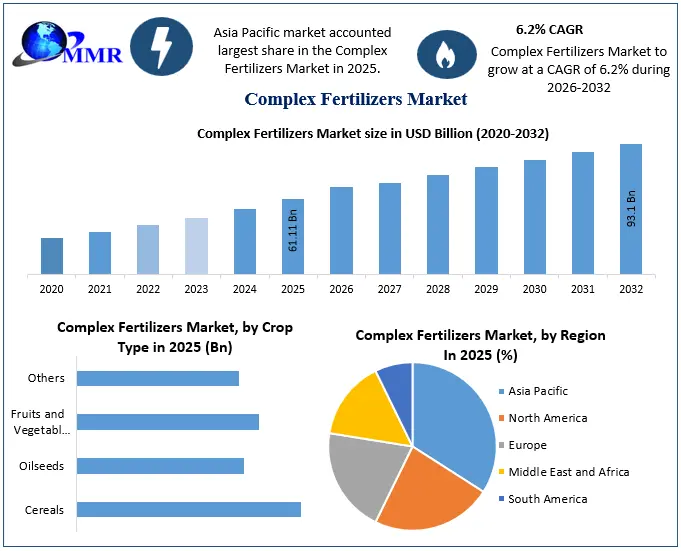
The global market reached USD 61.11 billion in 2025 and is projected to scale to USD 93.1 billion by 2032, driven by structural pressures on arable farmland.
Cereals represent the dominant crop type segment, necessitating high-volume consumption of balanced and phosphate-rich blends to stabilize macro-yields.
Incomplete formulations like Diammonium Phosphate and Monoammonium Phosphate secure high market shares due to intensive usage in primary grain production.
The Asia Pacific region leads international consumption volumes, fueled by massive population growth and government precision agriculture initiatives.
Supply chain reliance remains stark, underscored by a 33% year-over-year surge in European Union fertilizer imports from Russia during 2024.
Why This Matters Now Agronomists and agrochemical procurement executives are facing a structural crisis as the planet has lost a third of its arable land over the past three to four decades due to severe erosion and pollution. This rapid degradation of farmable soil turns nutrient management from a seasonal operating decision into a critical baseline requirement for global food security. Agrochemical manufacturers cannot rely on historical application volumes when crop commodity pricing volatility and shifting rural labor pools disrupt old purchasing cycles. To protect structural margins, multinational chemical companies are shifting capital investments toward specialized, high-efficiency chemical blends that maximize crop output per square meter.
Market Overview The global Complex Fertilizers Market was valued at USD 61.11 billion in 2025 and is projected to grow at a compound annual growth rate (CAGR) of 6.2 percent, reaching USD 93.1 billion by 2032. Complex fertilizers are chemical mixtures that combine multiple primary plant nutrients—primarily nitrogen (N), phosphorus (P), and potassium (K)—within a single uniform granule or fluid solution. The industry categorizes these products into incomplete formulations, which deliver two primary elements like Diammonium Phosphate (DAP) or Monoammonium Phosphate (MAP), and complete formulations, which provide fully balanced NPK structures. Industrial production and distribution are shifting rapidly to address uneven global consumption levels, where developing nations are lagging significantly behind advanced economies in nutrient application efficiency.
Key Trends Driving Growth The rapid integration of digital precision farming technologies fundamentally changes how industrial farmers acquire and deploy crop nutrition chemistry. Modern agricultural operations utilize GPS systems, commercial drones, and real-time soil sensors to map exact soil nutrient deficits across large-scale farm holdings. This technological shift increases demand for tailored multi-nutrient complex formulations that can be adjusted to specific crop requirements, replacing less effective bulk commodity fertilizers.
Simultaneously, major sovereign states are reshaping the marketplace through direct agricultural subsidies and structural policy transformations. Governments across the Asia Pacific region and Africa are actively funding balanced fertilization programs to prevent long-term soil degradation and secure regional grain self-sufficiency. These state-backed financial incentives provide a reliable baseline demand for certified chemical blenders.
Additionally, the accelerating rural-to-urban population migration is reducing the available agricultural labor pool, forcing a shift toward high-efficiency inputs. Farm operators are managing larger acreage with fewer staff, creating a strong preference for complete, multi-nutrient single-application formulas over multi-step blending processes. This labor dynamic encourages the adoption of labor-saving granular and fluid complex systems.
Segment Insights
Dominant Crop Segment: Cereals hold the dominant share of the global complex fertilizers market. The vast scale of international staple crop production for wheat, rice, and corn requires massive volumes of NPK and specialized phosphate-based compounds to secure predictable seasonal yields.
Fastest-Growing Segment: Incomplete fertilizers, led by high-phosphorus formulations such as Diammonium Phosphate (DAP) and Monoammonium Phosphate (MAP), command a significant, fast-evolving share due to concentrated application during primary seeding phases. Meanwhile, complete NPK compounds like NPK (10-26-26), NPK (12-32-16), and NPK (15-15-15) are growing quickly because they offer multi-nutrient convenience in single-pass applications.
Regional Growth Story The Asia Pacific region accounted for the largest share of the global complex fertilizers market in 2025 and is projected to maintain its leading position through 2032. Exploding regional population growth and urgent food security mandates drive this dominance. The governments of China and India are increasing public investments in advanced agricultural inputs to maximize productivity across restricted arable land bases. For instance, India’s Ministry of Agriculture has expanded official field trials for precision NPK briquette deep placement technology to mitigate structural nutrient loss.
North America holds the second-largest share of the global market, supported by high commercial farm consolidation and advanced digital farming adoption. The regional market benefits from extensive logistics networks and high-income commercial growers who utilize advanced agronomic data to guide their bulk chemical procurement.
In Europe, procurement dynamics are highly sensitive to geopolitical trade dependencies and shifting tariff frameworks. Despite ongoing international sanctions and increased political scrutiny, European Union imports of Russian fertilizers surged by 33 percent year-over-year to reach a value of 2.2 billion euros in 2024. This trade flow highlights Western Europe’s deep reliance on external nutrient feedstocks to support its core agricultural output.
Competitive Landscape The global industry structure exhibits a high degree of consolidation, with three multi-national corporations exercising substantial control over international production capacity, distribution infrastructure, and pricing power:
Nutrien Ltd.: The world’s largest integrated crop input provider, operating a global retail network that includes over 1,500 farm hubs. The company has invested more than USD 85 million into crop nutrition research and development alongside over USD 100 million into its proprietary digital precision agriculture platform, which currently manages over 60 million acres globally.
Yara International ASA: A global player operating in more than 60 countries, focusing heavily on climate-smart crop nutrition systems like its YaraMila product line. The organization is positioning itself for long-term regulatory compliance by establishing early investments in low-carbon clean ammonia assets and green shipping infrastructure.
The Mosaic Company: A primary producer focused on high-performance phosphate and potash-based complex formulations. The group relies on integrating specialized biological additives into its standard chemical portfolios to improve nutrient uptake efficiency and preserve long-term soil biology.
Recent Developments
Nutrien Ltd. initiated a USD 300 million capital investment project to upgrade its specialized NPK complex fertilizer manufacturing plant in Louisiana, directly targeting expanding commercial farming demand across the United States Midwest.
In South America, EuroChem opened a new USD 1 billion phosphate fertilizer manufacturing complex in Minas Gerais, Brazil, designed to structurally lower the nation’s 85 percent reliance on imported agricultural inputs.
The Dangote Group announced a major industrial expansion project in Nigeria to double its urea production capacity from 3 million to 6 million metric tons per year, aiming to replace African import reliance by 2028.
Strategic Implications The massive 1 billion dollar capital investment by EuroChem in Brazil demonstrates a major effort by international chemical suppliers to regionalize production assets near primary agricultural basins. By establishing large-scale domestic processing plants, manufacturers reduce ocean freight exposures and gain significant local pricing power over imported materials. This industrial localization shifts competitive dynamics, allowing regional operations to capture higher margins during global logistics disruptions.
Nutrien’s 300 million dollar upgrade in Louisiana confirms that the North American market is transitioning toward premium, specialized chemical assets rather than simple capacity additions. This expenditure is aimed at optimizing production flexibility, enabling the plant to adjust NPK ratios rapidly based on real-time precision farming data from the Midwest. This integration of industrial chemical manufacturing with digital farm management software builds high customer retention and insulates margins from basic commodity price cycles.
Furthermore, Nutrien’s corporate structure highlights the long-term benefits of the completed merger of equals between Agrium Inc. and PotashCorp. This structural combination paired the world’s largest crop nutrient production portfolio with an expansive retail network. This model allows the combined entity to manage its internal capacity utilization efficiently, shifting product volumes through its own 1500 retail centers to maintain pricing stability when global spot prices fluctuate.
Future Outlook The global complex fertilizers market will see standard commodity blending operations increasingly replaced by smart, data-driven multi-nutrient systems tied directly to digital precision farming infrastructure. Agrochemical producers who fail to integrate automated nutrient-delivery technologies like India’s deep-placement briquette systems will face shrinking margins as commercial growers shift their capital toward verified, high-yield formulations.
Analyst Perspective “The complex fertilizers market is transitioning from simple volume distribution to high-efficiency chemical precision,” said Ankita Kagawade, Analyst at Maximize Market Research. “With arable land declining globally due to erosion, agriculture can no longer tolerate high nitrogen runoff or poor phosphate absorption. The current multi-million-dollar capital investments in regional production sites, such as EuroChem’s facility in Brazil and Nutrien’s plant upgrades in the United States, prove that market leaders are repositioning supply chains to deliver customized, locally mixed solutions right next to major farming basins.”
About Maximize Market Research
Maximize Market Research Pvt. Ltd. (MMR) is a global market research and consulting company that provides reliable, data-focused, and practical business insights. The firm serves a wide range of industries, including healthcare, pharmaceuticals, technology, automotive, electronics, chemicals, personal care, and consumer goods. Through market forecasts, competitive analysis, strategic consulting, and industry impact assessments, MMR helps organizations understand changing market conditions, identify growth opportunities, and make informed business decisions for long-term success.
2nd Floor, Navale IT Park Phase 3
Pune Banglore Highway, Narhe
Pune, Maharashtra 411041, India
+91 9607365656
sales@maximizemarketresearch.com
