Key Highlights
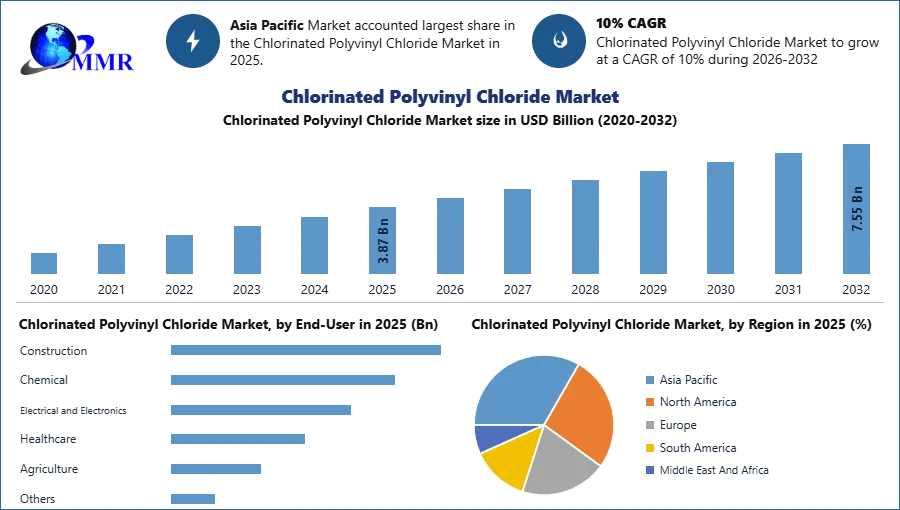
The global CPVC market valuation expanded to USD 3.87 billion in 2025 and is projected to hit USD 7.54 billion by 2032 due to accelerating thermoplastic adoption.
Pipes and fittings represent the dominant application segment, leading the industry volume consumption across hot and cold water distribution networks.
Fire sprinkler systems constitute the fastest-growing application market, propelled by tightening international commercial building codes and safety regulations.
The construction sector remains the premier downstream channel, drawing large-scale volumes for residential, commercial, and heavy industrial building infrastructure.
Structural volatility in upstream vinyl chloride monomer and chlorine feedstocks continues to challenge stable manufacturer margin preservation.
Why This Matters Now Procurement executives and industrial piping system design engineers face immediate margin constraints as severe price volatility in upstream vinyl chloride monomer (VCM) and chlorine feedstocks destabilizes traditional contract terms. Standard plumbing specifications are shifting rapidly because legacy metallic materials can no longer match the total lifecycle value and chemical inertia of advanced high-temperature thermoplastics. Industrial buyers must adapt to these shifting feedstock conditions or risk severe project delays in major municipal water and commercial construction initiatives. As manufacturing facilities alter their formulations to meet strict environmental standards, choosing the correct engineering polymer dictates both immediate installation costs and long-term asset reliability.
Market Overview The global Chlorinated Polyvinyl Chloride (CPVC) Market was valued at USD 3.87 billion in 2025 and is projected to grow at a compound annual growth rate (CAGR) of 10 percent, reaching USD 7.54 billion by 2032. CPVC is produced through a free radical chlorination reaction, adding chlorine molecules to standard polyvinyl chloride (PVC) in either a water slurry or a specialized fluidized bed system. This chemical synthesis is initiated by intense ultraviolet light, altering the molecular backbone to give the material significantly higher temperature performance limits alongside improved fire and corrosion resistance. Introduced for potable water plumbing systems in 1959 and expanded to automated fire sprinkler installations in 1985, this high-temperature plastic pressure piping material is vital for modern industrial process piping and civil infrastructure.
Key Trends Driving Growth Accelerating global investments in residential, commercial, and industrial construction projects serve as the foundational driver for specialized thermoplastic demand. Rapid urbanization across developing international hubs requires massive networks of durable plumbing systems capable of handling hot and cold potable water without scale buildup or degradation. This ongoing urban migration changes corporate procurement patterns, funneling immense capital into lightweight, non-corrosive alternative materials that reduce installation labor times.
Concurrently, international building regulatory boards are enforcing strict fire safety codes, mandating automated fire suppression systems in commercial and multi-family residential structures. CPVC exhibits an inherent resistance to combustion and flame spread, making it an ideal choice for integrated fire sprinkler configurations. This regulatory pressure provides a highly secure, high-margin sales channel for advanced polymer formulators globally.
Additionally, the expanding global chemical processing and manufacturing footprint creates substantial demand for robust industrial coatings and transport lines. Modern pharmaceutical, food processing, and specialty chemical facilities require transport infrastructure that resists intense acid concentrations and high operational temperatures. CPVC-based coatings and heavy-duty pipes satisfy these performance requirements, allowing plant operators to extend equipment lifecycles and limit unexpected plant shutdowns.
Segment Insights
Dominant Application Segment: Pipes and fittings held the largest share of the global chlorinated polyvinyl chloride market in 2024. Building mechanical contractors select CPVC piping systems for residential and industrial applications because they provide superior thermal limits, extended longevity, and excellent chemical resistance compared to traditional baseline PVC.
Fastest-Growing Application Segment: Fire sprinkler systems are projected to expand at the highest rate throughout the forecast period. The material’s natural flame retardancy, combined with easier assembly compared to traditional metal systems, makes it the preferred solution for fire suppression installation companies and safety consultants.
Secondary Industrial Application Segment: Adhesives and industrial coatings form a vital technical niche, delivering strong corrosion barriers for storage tanks, processing equipment, and structural assets exposed to severe chemical environments.
Regional Growth Story The international geographic landscape is characterized by a major division between high-volume infrastructure deployment in emerging economies and specialty technical fabrication in advanced industrial countries. Emerging economic zones focus heavily on municipal water distribution and residential housing construction, generating massive volume contracts for basic pipe and fitting profiles.
The United States and European hubs focus their market activity on advanced fire sprinkler integration, power cable casing, and high-purity industrial chemical manufacturing lines. However, European chemical producers face distinct operational constraints compared to other regions. Strict environmental regulations regarding chlorine processing and byproduct management increase baseline compliance costs across European facilities. This legislative framework forces local chemical companies to invest heavily in advanced manufacturing technologies to limit toxic emission byproducts during the ultraviolet initiation phase.
Conversely, manufacturing hubs across East Asia capitalize on massive local feedstock availability and large domestic construction markets to optimize asset utilization. These regional operators utilize high capacity rates to drive down unit production costs, altering international export flows and challenging Western chemical suppliers in the global commodity piping sector.
Competitive Landscape The international industry structure features concentrated competitive behavior among leading multi-national chemical corporations that control primary synthesis technology and proprietary compounding recipes. The Lubrizol Corporation maintains a major position in the marketplace, directing its corporate strategy toward continuous product innovation and global supply footprint expansion. Key industry participants shaping global production capacity and competitive dynamics include:
Lubrizol Corporation
Sekisui Chemical Co., Ltd.
Kaneka Corporation
Kem One
Shandong Gaoxin Chemical Co., Ltd.
Novista Group
Sundow Polymers Co., Ltd.
DCW Limited
Meghmani Finechem Limited
Recent Developments
Global chemical manufacturers are increasing capital expenditure toward upgrading free radical chlorination lines to improve chlorine absorption efficiency and reduce energy consumption during ultraviolet light activation.
Leading polymer compounding entities have entered into formal distribution agreements with regional pipe extruders to guarantee a steady flow of certified resin compounds into major infrastructure projects.
Strategic Implications The concentration of market influence within entities like the Lubrizol Corporation signals that long-term competitive success depends entirely on controlling proprietary compounding technologies. Pure commodity chemical producers cannot easily replicate the high-impact formulations required to pass rigid international health and plumbing certifications. This technical barrier protects the pricing power of premium market leaders, allowing them to maintain stable margins even when baseline raw material inputs fluctuate.
The shift toward long-term distribution agreements with localized pipe extruders shows a structural effort to minimize international supply chain vulnerabilities. By integrating resin supply directly with regional manufacturing assets, global polymer firms lock in high capacity utilization rates and shut out low-cost import competition. This structural alignment guarantees that regional construction booms translate directly into predictable volume contracts for established chemical groups.
Furthermore, the operational focus on upgrading ultraviolet chlorination methods reflects a clear acknowledgment of international sustainability pressures. Chemical manufacturers are utilizing modern fluidized bed systems to maximize yield per unit of chlorine input, directly lowering toxic byproduct generation. Investing in these cleaner, high-efficiency production technologies allows global suppliers to insulate their asset base against future carbon reduction mandates and tightening environmental oversight.
Future Outlook The global chlorinated polyvinyl chloride market will increasingly reward highly integrated chemical manufacturers who possess proprietary compounding capabilities and direct partnerships with regional infrastructure extruders. Producers who fail to optimize their raw material supply chains against VCM and chlorine price volatility will face significant margin erosion as industrial buyers enforce rigid price-performance standards.
Analyst Perspective “The CPVC sector is moving past standard commodity usage into highly engineered industrial applications,” said Ankita Kagawade, Analyst at Maximize Market Research. “While traditional PVC continues to face volume pressure in basic low-temperature environments, the superior thermal performance and natural fire resistance of CPVC are locking in high-value contracts across commercial construction and fire protection fields. Manufacturers who invest in advanced ultraviolet water-slurry chlorination technologies will successfully counter raw material cost spikes while satisfying strict global safety compliance demands.”
About Maximize Market Research
Maximize Market Research Pvt. Ltd. (MMR) is a global market research and consulting company that provides reliable, data-focused, and practical business insights. The firm serves a wide range of industries, including healthcare, pharmaceuticals, technology, automotive, electronics, chemicals, personal care, and consumer goods. Through market forecasts, competitive analysis, strategic consulting, and industry impact assessments, MMR helps organizations understand changing market conditions, identify growth opportunities, and make informed business decisions for long-term success.
2nd Floor, Navale IT Park Phase 3
Pune Banglore Highway, Narhe
Pune, Maharashtra 411041, India
+91 9607365656
sales@maximizemarketresearch.com
