Key Highlights
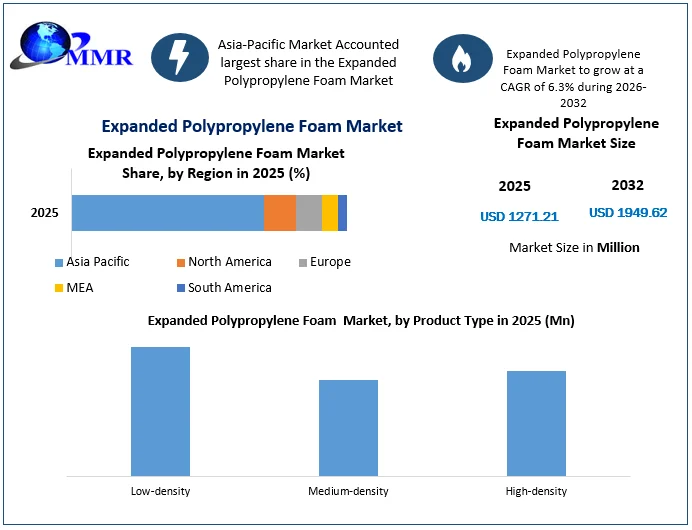
The global EPP market valuation expanded to USD 1,271.21 million in 2025 and is projected to scale to USD 1,949.62 million by 2032 due to accelerating thermoplastic substitution.
The automotive sector represents the dominant end-use industry, commanding a 42.68 percent share of total global volume in 2025.
Low-density EPP foam serves as the dominant product type segment, expanding via a 6.3 percent CAGR driven by custom electronic protective packaging.
The protective packaging end-use sector is expanding its market position rapidly, projected to secure a 27.83 percent volume share by 2032.
Structural volatility in upstream crude oil and polypropylene feedstock pricing remains a critical constraint on consistent manufacturer margin preservation.
Why This Matters Now Procurement executives and automotive component designers face immediate structural cost pressures as intense volatility in crude oil downstream derivatives directly destabilizes polypropylene (PP) monomer baseline pricing. Automotive manufacturing groups cannot rely on legacy heavy materials when strict carbon reduction deadlines necessitate rapid vehicle light-weighting to extend electric vehicle (EV) battery ranges. This structural change moves massive capital into engineered foam beads capable of providing multiple shock impacts while lowering aggregate component weights. Understanding the regional capacity expansions and supply chain consolidation patterns allows procurement directors to secure stable material contracts and insulate their downstream assembly margins from abrupt international distribution failures.
Market Overview The global Expanded Polypropylene Foam Market was valued at USD 1,271.21 million in 2025 and is projected to grow at a compound annual growth rate (CAGR) of 6.3 percent, reaching USD 1,949.62 million by 2032. Expanded polypropylene foam is an engineered closed-cell thermoplastic material that delivers high energy absorption, multiple impact resistance, thermal insulation, and exceptional chemical inertia. The material is synthesized by expanding raw polypropylene beads using physical gas or specialized foaming technologies, yielding lightweight structural foams that are completely non-toxic and recyclable. Downstream consumption is fundamentally linked to advanced manufacturing sectors, including automotive chassis and interior trim assembly, industrial protective electronics transit casing, and stable food handling containment.
Key Trends Driving Growth The extensive engineering shift within the automotive industry from heavy metallic components to high-performance thermoplastics serves as the primary engine for market volume growth. Vehicle manufacturers utilize advanced polymers like EPP to replace legacy glass and metal assemblies across complex trim parts, floor structures, hood elements, door panels, and bumper cores. This material substitution allows automotive OEMs to maximize energy efficiency while boosting structural crash durability under stringent vehicle safety compliance metrics.
Concurrently, the rapid proliferation of electronic and hybrid vehicles creates specialized high-value demand for lightweight structural elements. Next-generation electric drivetrains require strict thermal insulation and impact protection to secure battery cell matrices from sudden external deformation or temperature spikes. EPP foam matrices satisfy these technical demands, presenting a reliable protective housing material that reduces battery pack weights without sacrificing flame retardancy.
Additionally, the accelerating international logistics and global manufacturing trade infrastructure fuels massive demand for resilient protective packaging solutions. Modern heavy and light consumer durables require high-cushioning materials during transit to minimize transit breakages and consumer product returns. EPP’s chemical stability and non-toxic profile are similarly driving its integration into commercial food logistics and reusable medical equipment transit.
Segment Insights
Dominant End-Use Industry Segment: The automotive sector represents the premier downstream volume market, accounting for 42.68 percent of total industry volume in 2025. The global focus on lightweight vehicle architectures and energy-efficient component integration drives high consumption rates across passenger car bumpers, seating cores, and safety panels.
Dominant & Fastest-Growing Product Segment: Low-density EPP foam held the largest market share in 2025 and is projected to sustain a 6.3 percent CAGR through 2032. High-impact packaging applications for consumer electronics, custom industrial machinery, and delicate medical devices are accelerating the adoption of low-density foam configurations.
Expanding Downstream Segment: The protective packaging application sector is structurally expanding its footprint, projected to command 27.83 percent of the total market volume by 2032 as compliance demands mandate reusable and non-toxic materials.
Regional Growth Story The Asia Pacific region commands absolute leadership in the global expanded polypropylene foam market, establishing a 56.26 percent share of total volume demand in 2025. This regional concentration is projected to expand to 58.84 percent of global volume by 2032. Rapid industrialization, abundant raw material availability, and competitive labor pools in nations like China, India, Indonesia, and Malaysia fuel this aggressive growth. China continues to operate as a premier exporter of consumer durables and automotive parts, with exports accounting for roughly 29.38 percent of its gross domestic product (GDP) in 2025, which stabilizes a major internal consumption loop for high-performance protective transit foams.
North America and Europe operate as high-margin specialty formulation markets, characterized by strict safety codes and intensive EV battery infrastructure development. However, European producers face intense operating cost constraints due to volatile petrochemical feedstock supply lines. These cost challenges encourage European manufacturing entities to divested commodity lines, redirecting capital into closed-loop circular economy recycling networks to reuse industrial polymer scrap.
Competitive Landscape The international market structure is characterized by rapid consolidation as major chemical entities sell off non-core foam lines to focus on specialty polymer synthesis. Leading global players maintain control through advanced material branding, cross-industry automotive alliances, and extensive retail distribution lines. Key market participants driving international supply include:
JSP Corporation
BASF SE
Kaneka Corporation
DS Smith
Engineered Foam Packaging (EFP)
Mitsui Chemicals
Knauf Industries
Recent Developments
13 March 2025: Engineered Foam Packaging (EFP) deployed USD 31.5 million to expand operations in Bishopville, South Carolina, adding 200,000 square feet to its manufacturing facility to elevate output for protective and cold-chain packaging lines.
17 March 2025: BASF SE established a formal technical partnership with JSP Corporation to co-develop advanced EPP foam configurations engineered for automotive interior parts to improve cabin energy absorption.
20 May 2025: Mitsui Chemicals launched a low-density, flame-retardant EPP foam grade designed to optimize thermal insulation and fire safety compliance inside next-generation EV battery enclosures.
17 March 2026: Knauf Industries finalized a major structural consolidation by entering a binding agreement to acquire the Neopolen EPP foam business from BASF SE, including its core manufacturing asset in Schwarzheide, Germany.
Strategic Implications Knauf Industries’ acquisition of BASF’s Neopolen business signals a significant consolidation of production capacity within Europe. By taking over the Schwarzheide plant, Knauf secures immediate manufacturing scale and regional pricing power over standard EPP beads, while BASF strategically frees up capital from specialized commodity processing. This transaction indicates that European market competition will increasingly center on vertically integrated foam fabricators who can control production costs in a high-energy operational environment.
The partnership between BASF and JSP Corporation highlights the changing nature of automotive chemical procurement, where Tier-1 suppliers require collaborative research and development to hit strict vehicle crash metrics. Combining BASF’s polymer formulation capabilities with JSP’s bead molding assets ensures faster commercialization of energy-absorbing structural parts. This technical integration prevents lower-tier chemical competitors from undercutting premium suppliers on price alone.
Concurrently, Mitsui Chemicals’ deployment of a flame-retardant EPP grade for electric vehicles proves that the EV transition is shifting the material’s target market from commodity packaging into high-margin safety applications. By optimizing chemistry for battery module insulation, polymer companies embed themselves directly into the multi-year development cycles of major global automotive platforms. This specialization reduces exposure to commodity packaging volatility and locks in multi-year procurement contracts.
Future Outlook The global expanded polypropylene foam market will increasingly reward vertically integrated foam molding specialists who can deploy specialized, flame-retardant low-density grades directly adjacent to major electric vehicle and consumer electronics hubs. Chemical groups that do not establish closed-loop recycling capabilities to counter raw material price spikes will see structural margins erode as competitors utilize advanced, zero-waste manufacturing assets.
Analyst Perspective “The expanded polypropylene foam market is moving past standard protective packaging into highly technical safety functions,” said Ankita Kagawade, Analyst at Maximize Market Research. “The ongoing consolidation of European production assets, such as Knauf Industries’ acquisition of the Neopolen line from BASF, demonstrates that absolute manufacturing scale is vital to withstand fluctuating upstream polypropylene prices. As electric vehicle adoption increases the demand for specialized battery thermal insulation, chemical suppliers who co-develop fire-retardant grades next to major automotive assembly facilities will lead the industry’s margin performance.”
About Maximize Market Research
Maximize Market Research Pvt. Ltd. (MMR) is a global market research and consulting company that provides reliable, data-focused, and practical business insights. The firm serves a wide range of industries, including healthcare, pharmaceuticals, technology, automotive, electronics, chemicals, personal care, and consumer goods. Through market forecasts, competitive analysis, strategic consulting, and industry impact assessments, MMR helps organizations understand changing market conditions, identify growth opportunities, and make informed business decisions for long-term success.
2nd Floor, Navale IT Park Phase 3
Pune Banglore Highway, Narhe
Pune, Maharashtra 411041, India
+91 9607365656
sales@maximizemarketresearch.com
