Key Highlights
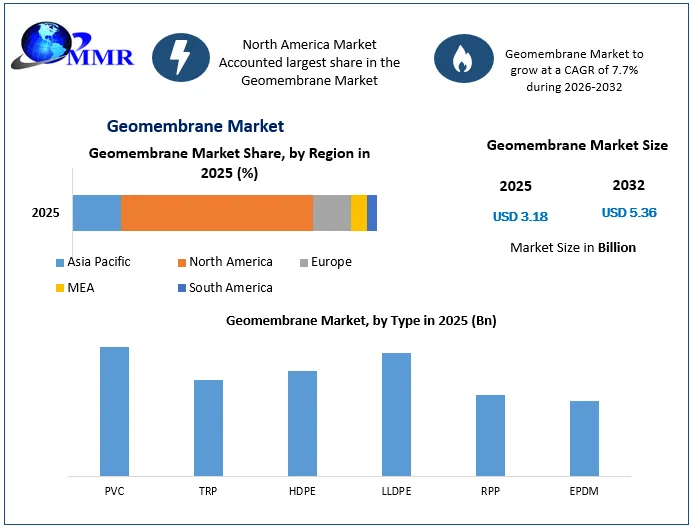
Global market valuation rising from USD 3.18 billion in 2025 to USD 5.36 billion by 2032, registering a stable 7.7% CAGR.
High-density polyethylene (HDPE) remains the dominant material segment, anchored by superior chemical and ultraviolet radiation resistance.
High installation and procurement complexities continue to act as a primary barrier to entry for smaller, short-term infrastructure assets.
Market dynamics are shifting toward custom formulation sheets with specialized thickness configurations to meet precise project specifications.
Average pricing for standard HDPE geomembrane variants moves within a baseline of USD 0.25 to USD 2.50 per square foot.
Why This Matters Now
Chemical manufacturers, procurement executives, and heavy industrial operations are facing an unprecedented tightening of environmental liability frameworks worldwide. Traditional soil-containment and basic concrete barrier methods can no longer reliably isolate hazardous waste streams or prevent toxic leachate from penetrating fragile regional water tables.
As global regulatory bodies transition from reactive environmental cleanup policies to proactive containment enforcement, industrial operations must integrate advanced polymer barriers directly into their operational capital deployment plans. This shift converts geomembranes from a standard construction procurement line-item into a critical tool for regulatory risk mitigation and corporate liability management.
Market Overview
The global geomembrane market size is experiencing an extensive transformation, driven by an industrial push to insulate natural ecosystems from industrial contamination. Historically utilized for basic agricultural water storage, these thin, continuous sheets of high-performance polymers have evolved into highly engineered, impermeable barrier systems. Valued at USD 3.18 billion in 2025, the market is on a steady trajectory to reach USD 5.36 billion by 2032, expanding at a CAGR of 7.7% over the forecast period.
This sustained demand is deeply tied to capital expenditure deployments across the global mining, sewage treatment, municipal waste, and civil engineering sectors. Because these sheets are formulated to resist aggressive chemical breakdown, puncture, and extreme thermal variation, they have become an uncompromisably vital element of modern environmental protection infrastructure.
However, the capital profile of these assets remains a challenge for rapid market penetration. The considerable upfront investment required for raw polymer procurement, coupled with the specialized welding equipment and certified labor necessary for field installation, can restrict immediate adoption in capital-constrained markets. This reality splits the procurement landscape, creating a distinct division between long-term, high-performance enterprise assets and low-cost alternative linings.
Key Trends Driving Growth
Strict corporate environmental mandates and tightening government regulatory frameworks are reshaping downstream consumption patterns across the industrial spectrum. Modern engineering projects require continuous containment verification, driving polymer manufacturers to invest heavily in material science innovations. This research has successfully produced specialized high-performance geomembranes featuring enhanced ultraviolet (UV) radiation stabilizers, increased puncture resistance, and improved flexibility across uneven surfaces.
Simultaneously, the industrial push for circular economy frameworks has sparked a major transition in manufacturing feedstocks. Material suppliers are adjusting their compounding methods to incorporate recycled structural polymers without sacrificing the tensile strength or chemical resistance of the final liner.
This technology evolution is opening up new applications for geomembranes in high-stakes environmental remediation, including full landfill closures, hazardous mining tailing containment, and the structural rehabilitation of contaminated brownfield sites. Furthermore, as global weather volatility creates severe water scarcity challenges, agricultural and municipal sectors are purchasing high-capacity reservoir liners to prevent valuable freshwater loss from seepage.
Segment Insights
High-Density Polyethylene / HDPE (Dominant Segment): Holding the dominant position in 2025, HDPE is the primary corporate choice due to its chemical resistance, which allows it to handle aggressive acids and hazardous industrial liquids without structurally breaking down.
Polyvinyl Chloride / PVC: This segment maintains steady demand in specialized civil engineering projects that require flexible sheet configurations and rapid thermal welding across complex, irregular terrains.
Linear Low-Density Polyethylene / LLDPE: Positioned as a key material choice for applications requiring extreme material elongation and flexibility, LLDPE is heavily utilized in large-scale agricultural reservoir projects and decorative containment basins.
Ethylene Propylene Diene Monomer / EPDM: Highly valued for its thermal stability and weathering resistance, EPDM represents a premium specialty segment chosen for long-term outdoor water management assets.
Regional Growth Story
The United States continues to drive significant procurement volume, supported by strict Environmental Protection Agency (EPA) containment rules and ongoing investments in municipal waste infrastructure. In Germany and across Western Europe, market momentum is heavily influenced by green infrastructure policies that mandate advanced containment systems for both industrial waste streams and chemical storage installations.
China and India are experiencing rapid consumption growth, led by massive public investments in regional transportation networks, sewage treatment infrastructure, and large-scale mining operations. These domestic capacity expansions are forcing regional material suppliers to scale up their production lines to keep pace with localized infrastructure requirements.
Concurrently, mature chemical manufacturing hubs like Japan and South Korea are focusing their production capabilities on high-margin, specialty grade geomembrane sheets. These premium products are specifically engineered to withstand the highly corrosive, high-temperature wastewater generated by chemical processing and electronics manufacturing plants.
Competitive Landscape
The competitive landscape of the global geomembrane industry is consolidating as tier-one polymer manufacturers leverage specialized product differentiation to capture high-margin enterprise accounts. Top-tier providers are moving away from marketing basic, commoditized plastic sheets. Instead, they are positioning themselves as comprehensive containment solutions partners by offering custom material formulations, tailored thickness profiles, and certified field installation supervision.
This integrated strategy grants manufacturers superior pricing power and helps protect their market share from low-cost import flows. Competition is intensifying around material performance metrics, specifically long-term UV resistance, multi-axial elongation limits, and chemical compatibility with complex hazardous industrial fluids.
Smaller, unintegrated sheet extruders face growing margin pressures due to volatile raw material resin prices and lack of direct feedstock access. This market pressure is accelerating strategic moves across the sector, with leading polymer platforms actively acquiring localized fabricators to secure down-stream distribution channels and expand their regional installation networks.
Recent Developments
Rapid scaling of co-extrusion manufacturing lines capable of producing multi-layered textured geomembranes that offer superior slope stability and friction performance in deep landfill designs.
Commercialization of premium polymer sheets utilizing advanced anti-oxidant packages, significantly extending the service life of liners deployed in high-temperature mining leaching environments.
Integration of conductive carbon-black layers into standard HDPE manufacturing pipelines, enabling automated electronic leak location testing across large installations.
Introduction of sustainable, recycled-resin polymer blends designed specifically to meet international environmental certifications for green building and eco-friendly infrastructure projects.
Deployment of specialized wide-roll extrusion technologies that reduce the number of required field seams, lowering installation costs and decreasing the risk of field welding failures.
Strategic Implications
Procurement executives and industrial asset managers must re-evaluate their long-term supply chain strategies for containment materials. Because raw polymer resins are closely tied to petrochemical markets, geomembrane production costs remain highly sensitive to upstream energy price shocks. Procurement teams can manage this risk by shifting away from transactional, spot-market purchases and establishing long-term contract agreements with vertically integrated manufacturers who control their own chemical feedstocks.
Additionally, engineering specifications must look beyond the initial purchase price to evaluate total lifecycle costs. A low-cost, sub-standard liner choice significantly increases the risk of field puncture or chemical stress cracking over time.
Such failures can trigger catastrophic environmental leaks, leading to expensive regulatory fines, mandatory operational shutdowns, and massive civil remediation liabilities. Industrial operators must also invest in certified installation technicians and rigorous third-party seam inspection protocols, as the vast majority of containment failures stem from improper field welding rather than material manufacturing defects.
Future Outlook
The future of the geomembrane market will be defined by the integration of smart testing technologies directly into the polymer matrix. As industrial sites face zero-leakage mandates, standard passive plastic barriers will transform into active, data-verified containment networks. Modern wide-roll extrusion processes will continue to lower production costs, making high-performance liners economically viable for smaller infrastructure assets.
Organizations that proactively integrate high-durability HDPE containment barriers into their long-term asset management plans will successfully insulate their business from environmental liabilities and regulatory penalties. Conversely, industrial operators that continue to cut corners with cheap, unverified lining alternatives will face severe long-term operational risks, escalating insurance premiums, and potential regulatory closures.
Analyst Perspective
“The global geomembrane market is moving past basic commodity dynamics into an era defined by high-stakes environmental risk management,” states Yash Ghosalkar, Analyst at Maximize Market Research.
About Maximize Market Research
Maximize Market Research Pvt. Ltd. (MMR) is a global market research and consulting company that provides reliable, data-focused, and practical business insights. The firm serves a wide range of industries, including healthcare, pharmaceuticals, technology, automotive, electronics, chemicals, personal care, and consumer goods. Through market forecasts, competitive analysis, strategic consulting, and industry impact assessments, MMR helps organizations understand changing market conditions, identify growth opportunities, and make informed business decisions for long-term success.
2nd Floor, Navale IT Park Phase 3
Pune Banglore Highway, Narhe
Pune, Maharashtra 411041, India
+91 9607365656
sales@maximizemarketresearch.com
