Key Highlights
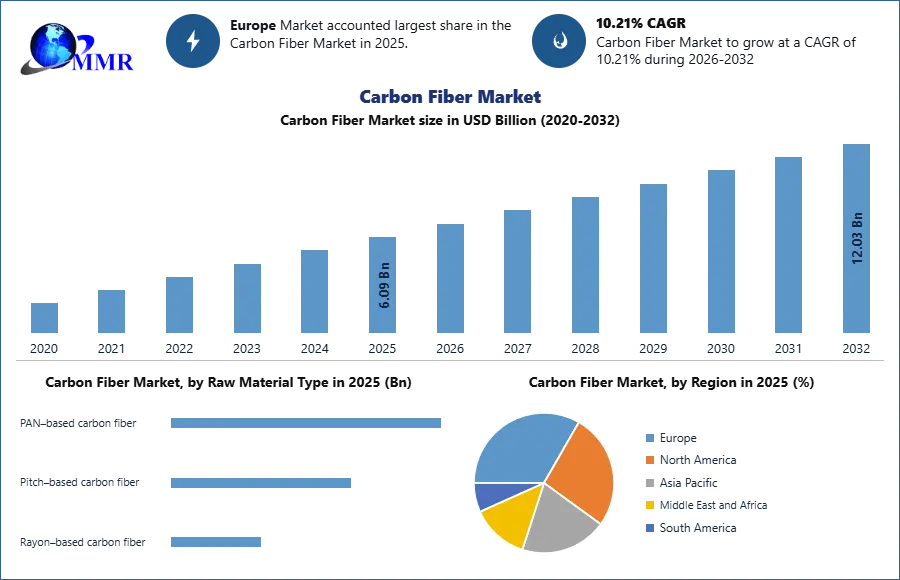
Market Scale Double: The global carbon fiber market is on track to expand from USD 6.09 billion in 2025 to USD 12.03 billion by 2032, maintaining a double-digit 10.21% CAGR.
Volume Metrics Acceleration: Total global volume demand is projected to surge to 160,300 tons in 2026 and hit 225,300 tons by 2032, stressing current precursor conversion capacities.
Precursor Monopolization: Polyacrylonitrile (PAN) remains the core chemical feedstock, with total worldwide PAN demand set to surpass 225 kilotons by 2032 through a 13.1% standalone CAGR.
Downstream Rebalancing: The automotive and high-pressure vessel segments are combining to claim a 20% market share, changing the historic procurement dynamics of carbon composite supply lines.
Why This Matters Now
Industrial supply chains are facing structural shortages as the aerospace rebound and utility-scale wind energy developments compete for limited carbon fiber volumes. For chemical manufacturers, advanced materials investors, and procurement directors, this supply tightness is driving up transaction friction and forcing a re-evaluation of long-term supply contracts. Traditional metallic components no longer satisfy the weight-to-strength ratios mandated by modern regulatory systems and performance specifications.
The primary operational hurdle centers on raw material conversion. Transforming specialized petroleum feedstocks into high-purity polyacrylonitrile (PAN) requires complex chemical control and significant energy inputs, limiting rapid capacity additions. Producers must overcome these scaling constraints or face structural supply deficits as downstream industrial demand moves ahead of global nameplate capacity.
Market Overview
The global carbon fiber Market size industry is transitioning from a high-cost specialty material niche into a high-volume foundational chemistry sector. Valued at USD 6.09 billion in 2025, the market is governed by strict mechanical standards that demand extreme tensile strength, low thermal expansion, and high stiffness under repetitive mechanical strain. These characteristics are critical for structural integrity in flight control systems, deep-sea pressure vessels, and giant utility-scale wind turbines.
The economic justification for replacing steel and aluminum with high-modulus carbon composites relies on lifetime efficiency gains. Lower component weight reduces operational fuel burn in transport networks and increases energy output for power generation equipment. As manufacturing capital flows toward advanced carbon-fiber-reinforced polymers (CFRP), upstream chemical synthesis lines must scale up production to support complex component geometries.
Key Trends Driving Growth
The rapid commercialization of next-generation widebody commercial aircraft and large-scale alternative energy assets is transforming the market structure. Aerospace production lines require immense quantities of high-performance small tow fibers to manufacture large primary structures, including aircraft wings and fuselage sections. At the same time, the wind energy sector requires large-volume commercial tows to manufacture turbine blades that exceed lengths of 100 meters, which require low weight to prevent structural failure at the hub.
Concurrently, natural gas vehicle infrastructure and hydrogen storage technologies are driving consumption through high-pressure containment vessels. These applications require continuous fiber winding to handle extreme internal storage pressures safely. This demand pattern reduces the industry’s historical reliance on commercial aviation cycles and establishes multiple distinct growth tracks across the broader energy and transport sectors.
Segment Insights
Dominant Raw Material (PAN-Based Carbon Fiber): Polyacrylonitrile serves as the dominant chemical pathway, with its downstream market growing at a 13.1% CAGR to surpass 225 kilotons by 2032. Industrial manufacturers prefer PAN over pitch-based feedstocks due to its superior strength-to-weight characteristics and consistent processing behavior.
Dominant Application (Composite Segment): The composite material manufacturing segment holds the highest market share. Downstream polymer compounders combine carbon fibers with thermoset and thermoplastic matrices to create structural components for complex, high-stress operating environments.
Emerging Sectors (Automotive & Pressure Vessels): These combined applications are projected to capture 20% of total market demand, accelerating as automotive lightweighting mandates intensify.
Regional Growth Story
While North America continues to lead in the production of finished carbon fiber-based components, global consumption and capacity shares are rebalancing toward Europe and the Asia-Pacific region. Strategic shifts indicate that by 2032, Asia and Europe will each command a 33% to 34% share of total worldwide demand, slightly ahead of North America’s 32% market share. Europe’s strong position is supported by its major share of worldwide wind energy carbon fiber demand, alongside Airbus’s large-scale aerospace composite procurement operations.
Production capacity is shifting rapidly toward Asian chemical manufacturing centers. Asia is projected to control 52% of the global small tow carbon fiber production capacity by 2032, which is estimated to reach a total of 113,500 tonnes. This concentration of raw synthesis assets positions regional manufacturers in mainland China, Japan, and South Korea as major suppliers for global advanced materials supply chains.
Competitive Landscape
The global carbon fiber landscape is consolidating around primary chemical producers that control integrated precursor manufacturing assets. Maintaining proprietary control over the PAN polymer chain allows top-tier manufacturers to protect their operating margins from volatile acrylonitrile monomer prices and safeguard production quality. These market leaders are focusing capital expenditure on scaling up small tow capacities in Asia to secure long-term market share in the high-margin aerospace and defense sectors.
Concurrently, European and North American suppliers are building closer ties with regional aerospace clusters and wind turbine manufacturers to insulate their businesses from maritime logistics risks. By setting up specialized technical service facilities next to major manufacturing hubs, these suppliers can provide custom fiber sizing formulations, maximizing capacity utilization and defending premium pricing structures against non-integrated competitors.
Recent Developments
Wind Energy Supply Expansion: European wind blade manufacturers have accelerated their consumption of large tow fibers, raising regional demand from approximately 8,000 tonnes per year to 30,000 tonnes per year.
Small Tow Capacity Realignment: Global producers have expanded asset deployments in Asia, bringing the region’s projected share of the 113,500-tonne worldwide small tow capacity to 52% by 2032.
Aerospace Consortium Alignment: European manufacturing sites have consolidated approximately 50% of global aerospace carbon fiber demand, driven by large-scale commercial jet build rates, while North American facilities retain a 40% share.
Strategic Implications
The shifting balance between North American component production and European and Asian fiber supply requires industrial buyers to adjust their sourcing strategies. Procurement teams can no longer rely on spot-market purchases of advanced composites, as long-term aerospace programs and expanding wind energy initiatives pull predictable volumes from major production lines. Securing access to carbon fiber require buyers to form joint ventures or sign long-term take-or-pay agreements with integrated PAN converters.
Furthermore, chemical companies without integrated precursor plants face escalating raw material risks. As global PAN requirements climb past 225 kilotons, non-integrated compounders will likely face tighter margins during periods of high acrylonitrile monomer pricing. To defend their market position, independent material processors must optimize their fiber-matrix sizing chemistry to deliver specialized performance that standard commodity alternatives cannot replicate.
Future Outlook
The global carbon fiber market will likely favor fully integrated chemical groups that can scale up precursor conversion lines while simultaneously reducing the high cost of thermal oxidation and carbonization. As international transport networks and clean energy platforms mature, the gap between low-tier industrial fiber suppliers and high-modulus aerospace component producers will grow wider. The long-term winners will be those who control localized small tow capacities and can deliver consistent volumes directly into the expanding industrial manufacturing hubs of Europe and Asia.
Analyst Perspective
“The carbon fiber market is moving through an intense volume re-engineering process as aerospace manufacturing lines and utility-scale wind projects scale up simultaneously. This dual demand surge is pushing the limits of current polyacrylonitrile conversion capacity, making feedstock integration a primary competitive advantage. Upstream chemical producers must invest heavily in scaling small tow capacity to manage structural supply pressures and secure high-margin supply positions across global transport and energy infrastructure.”— Yash Ghosalkar
About Maximize Market Research
Maximize Market Research Pvt. Ltd. (MMR) is a global market research and consulting company that provides reliable, data-focused, and practical business insights. The firm serves a wide range of industries, including healthcare, pharmaceuticals, technology, automotive, electronics, chemicals, personal care, and consumer goods. Through market forecasts, competitive analysis, strategic consulting, and industry impact assessments, MMR helps organizations understand changing market conditions, identify growth opportunities, and make informed business decisions for long-term success.
2nd Floor, Navale IT Park Phase 3
Pune Banglore Highway, Narhe
Pune, Maharashtra 411041, India
+91 9607365656
sales@maximizemarketresearch.com
