Key Highlights
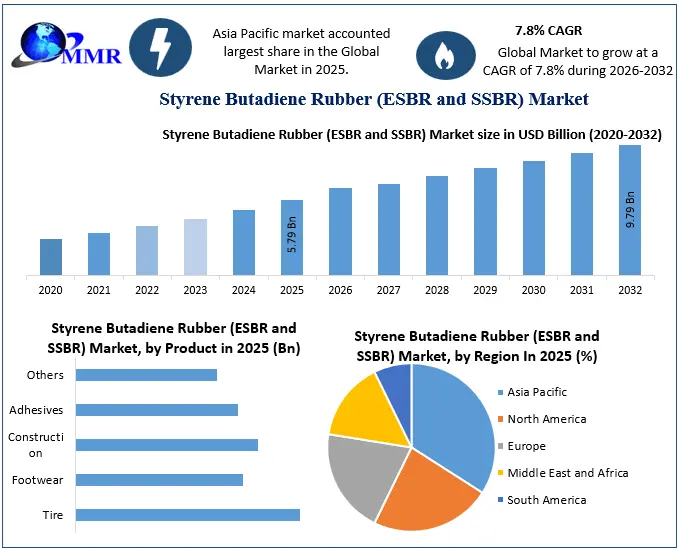
Systemic Market Growth: The global styrene butadiene rubber (ESBR and SSBR) market is sustaining a 7.8% CAGR, supported by long-term volume demand in industrial rubber compounding.
The SSBR Turn: Solution Styrene Butadiene Rubber (SSBR) serves as the primary technical growth track, owing to its superior silica-coupling capacity and mechanical properties.
Tread Engineering Upgrades: Next-generation vehicle platforms are shifting polymer consumption patterns by demanding high-tensile elastomers that offer low rolling resistance and high wet grip.
Supply Chain Integration: Leading synthetic rubber operations are forming integrated supply lines with local butadiene and styrene monomer facilities to mitigate volatile feedstock markets.
Why This Matters Now
Global polymer procurement leaders and tire manufacturers are operating within a constrained synthetic rubber market where older production assets cannot meet high-performance tire requirements. Traditional Emulsion SBR (ESBR) formulations are hitting clear physical limits when subjected to modern low-rolling-resistance and fuel-efficiency standards. For chemical corporate boards, rubber compounders, and strategic sourcing directors, ignoring this material shift introduces significant downside risk as automotive manufacturers phase out low-tier commodity treads.
The central barrier to a rapid market shift lies in production asset flexibility. Converting standard cold emulsion polymer lines into advanced solution polymerization facilities requires heavy capital investments and precise microstructural engineering control. Producers must rapidly address these engineering challenges or risk building excess capacity in low-margin commodity lines while competitors capture high-premium volume contracts.
Market Overview
The global styrene butadiene rubber market Size is evolving from a mature, volume-driven commodity landscape into a specialized materials sector. Expanding at a steady 7.8% CAGR, this industry is guided by strict physical performance requirements from the automotive tire and industrial rubber goods sectors. Modern synthetic elastomers must provide high abrasion resistance, strong cyclic fatigue life, and stable performance across wide temperature ranges to remain commercially viable.
This technical necessity allows industrial designers to substitute high-dispersion synthetic rubber blends for standard natural rubber compounds in demanding applications. As downstream capital investments focus on long-lasting industrial belts, high-pressure hoses, and fuel-efficient tires, elastomer production must match these technical shifts, placing SBR as a key segment within the global synthetic rubber and polymer compounding industries.
Key Trends Driving Growth
The widespread enforcement of tire-labeling laws across major industrial economies has changed how compounders approach polymer design. Modern tire patterns require a careful balance of three competing performance metrics: low rolling resistance, high wet grip, and long wear life. Achieving these targets simultaneously requires precise control over the polymer chain structure, a requirement that traditional cold emulsion polymerization cannot easily fulfill.
Concurrently, growing consumer interest in bio-based and circular chemical processes is pushing manufacturers to modify their monomer supply streams. Driven by long-term carbon reduction targets and volatile crude oil pricing, major chemical operations are beginning to introduce sustainably sourced butadiene and bio-styrene into their production chains. These material adjustments allow industrial buyers to meet strict corporate environmental goals while maintaining the tensile strength and tearing resistance of the final vulcanized compound.
Segment Insights
Dominant Synthesis Segment (Emulsion Styrene Butadiene Rubber – ESBR): This category continues to hold the largest absolute volume share in the global market. Its primary advantage remains its low manufacturing cost and consistent processing behavior, making it the preferred choice for passenger car tires, conveyor belts, shoe soles, and heavy-duty industrial hoses where basic mechanical durability takes precedence over specialty rolling resistance.
Fastest-Growing Synthesis Segment (Solution Styrene Butadiene Rubber – SSBR): This segment is expanding at the fastest pace within the 7.8% compound growth track. SSBR allows precise adjustments to its molecular weight distribution and vinyl content, which helps tire compounders achieve optimal silica dispersion and maximize vehicle fuel economy.
Downstream Applications: The market remains highly focused on automotive tire manufacturing, followed by shoe soles, mechanical rubber goods, and polymer modification.
Regional Growth Story
The Asia-Pacific region functions as the primary driver of both new manufacturing capacity additions and downstream consumption, supported by extensive industrial production across China, India, and Japan. Massive vehicle production lines and expanding industrial manufacturing centers in these hubs generate constant demand for bulk and high-performance synthetic rubber shipments. Local tire manufacturers are aggressively expanding production lines to satisfy domestic automotive requirements and serve high-volume export accounts.
This regional momentum matches wider developments across established chemical processing centers in the United States, Germany, and South Korea. In these advanced manufacturing hubs, domestic producers are optimizing their facilities to produce high-margin, functionalized SSBR grades, helping them avoid low-cost commodity competition and supply highly automated regional tire assembly complexes.
Competitive Landscape
The global styrene butadiene rubber landscape is shaped by consolidation, as long-standing petrochemical firms adapt to more demanding downstream requirements. Top-tier elastomer producers are channeling capital away from legacy emulsion assets to build out advanced solution polymerization lines. This strategic shift allows market leaders to protect their pricing power by offering specialized, functionalized polymer grades that match with highly dispersed silica compounding systems.
To insulate their businesses from feedstock disruptions, integrated chemical players are establishing production centers close to major butadiene extraction operations and aromatic supply complexes. This geographic arrangement secures a steady supply of essential monomers during market imbalances, ensuring high asset utilization and protecting corporate margins from volatile international shipping markets.
Recent Developments
Emulsion Line Optimization: Major synthetic rubber producers are updating existing cold emulsion polymer reactors with advanced modifier feeds to improve the processing consistency of large-volume ESBR grades.
Silica-Coupling Technology Integration: Advanced material labs are introducing new functionalized SSBR polymer grades that feature specialized end-groups designed to bond tightly with reinforcing silica fillers.
Sustainable Monomer Trials: Top chemical groups have completed initial manufacturing runs utilizing bio-attributed butadiene, providing downstream tire networks with a viable path toward low-carbon product lines.
Strategic Implications
The continuous shift from standard ESBR to specialized SSBR grades creates significant challenges for global rubber procurement departments and industrial buyers. Because next-generation vehicle platforms require low-rolling-resistance tires to meet strict regulatory emissions targets, tire manufacturers are modifying their procurement volumes to favor high-end solution-polymerized suppliers. This market shift requires procurement managers to closely monitor regional monomer capacities and build long-term supply relationships with integrated chemical compounders.
Furthermore, non-integrated elastomer producers face increasing operational risks as performance requirements tighten. As the technical gap between high-volume commodity grades and specialized functionalized polymers grows wider, standard ESBR lines face risk of margin compression during periods of high feedstock costs. To defend their market share, independent processors must focus on developing advanced polymer modifications that deliver specific mechanical benefits that low-cost alternatives cannot match.
Future Outlook
The styrene butadiene rubber market will likely reward chemical producers that successfully transition their product portfolios toward functionalized solution-polymerized materials while securing long-term access to critical monomer inputs. As international automotive and industrial supply chains mature, the separation between low-cost commodity ESBR operations and specialized SSBR compounders will widen significantly. The long-term winners will be those who establish localized, highly integrated supply systems capable of delivering high-performance elastomeric compounds directly into expanding industrial production hubs.
Analyst Perspective
“The styrene butadiene rubber industry is undergoing a clear structural shift as modern vehicle designs and tire-labeling mandates pull volumes away from older emulsion processes toward advanced solution-polymerized networks. This change is altering historic feedstock configurations, making integration with local monomer lines essential for long-term supply security. Chemical producers must commit capital to upgrading their polymerization technologies to protect their margins and anchor their positions within high-performance automotive supply chains.”— Yash Ghosalkar
About Maximize Market Research
Maximize Market Research Pvt. Ltd. (MMR) is a global market research and consulting company that provides reliable, data-focused, and practical business insights. The firm serves a wide range of industries, including healthcare, pharmaceuticals, technology, automotive, electronics, chemicals, personal care, and consumer goods. Through market forecasts, competitive analysis, strategic consulting, and industry impact assessments, MMR helps organizations understand changing market conditions, identify growth opportunities, and make informed business decisions for long-term success.
2nd Floor, Navale IT Park Phase 3
Pune Banglore Highway, Narhe
Pune, Maharashtra 411041, India
+91 9607365656
sales@maximizemarketresearch.com
