Key Highlights
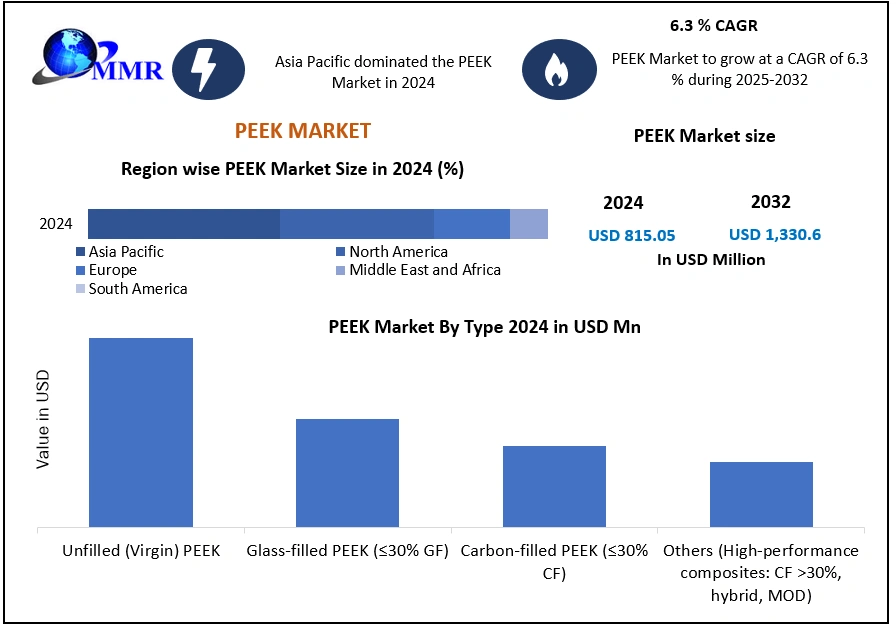
The global PEEK market achieved a valuation of USD 815.05 million in 2024 and is forecast to attain USD 1330.6 million by 2032.
Structural compounding demand across the aerospace and electrical industries yields a calculated CAGR of 6.3% between 2025 and 2032.
Unfilled (Virgin) PEEK represents the primary volume standard, capturing a commanding market share due to its exceptional baseline chemical purity.
Asia-Pacific maintains the leading regional market position, accelerated by rapid electronic manufacturing clusters in China and South Korea.
Major market operators are shifting toward integrated specialty compounding lines to bypass volatile monomer supply chains and optimize localized margins.
Why This Matters Now
Procurement operations face structural supply disruptions as aerospace and electronics industries accelerate the substitution of traditional metals with advanced engineering plastics. Industrial manufacturers relying on standard steel and aluminum components are experiencing escalating weight-related inefficiencies and corrosion expenses. The financial incentive to adopt high-temperature alternatives is forcing a rapid reallocation of raw material assets toward premium polyetheretherketone lines.
With the market expanding at a 6.3% CAGR toward a USD 1330.6 million valuation, early procurement planning is essential to secure continuous factory operations. Delaying long-term supply arrangements risks exposing capital projects to severe structural allocation shortfalls. Industrial buyers who fail to align with primary chemical synthesizers face reduced bargaining leverage as global manufacturing centers consolidate engineering polymer capacities.
Market Overview
The global PEEK Market is transitioning from an expensive, niche specialty compound into a standardized high-volume engineering material across multi-tier supply networks. This linear aromatic polymer delivers a unique combination of mechanical strength, high chemical resistance, and structural stability at elevated temperatures. These physical properties allow the material to replace traditional steel, aluminum, and wood in demanding industrial environments.
Industrial operators use the material to build bearings, piston components, high-performance pumps, HPLC columns, compressor plate valves, and advanced cable insulation. It remains one of the few engineering plastics capable of maintaining long-term physical integrity within ultra-high vacuum systems. As high-value downstream sectors mandate stricter tolerances and extended component lifespans, polymer synthesizers are scaling up production facilities to ensure consistent batch-to-batch chemical uniformity.
Key Trends Driving Growth
Aerospace structural lightweighting and next-generation electronic component scaling are the primary drivers of global volume demand. Modern aerospace engineering relies heavily on improving the structural strength-to-weight ratio of airframe components to minimize fuel burn and lower operating emissions. PEEK polymers match the structural rigidity of lightweight alloys while removing the long-term risk of galvanic corrosion.
In the electrical and electronics sector, the push for smaller components requires insulation materials that can withstand high thermal stress during automated soldering procedures. Additionally, the material’s low outgassing properties under extreme thermal conditions make it the baseline standard for semiconductor wafer handling infrastructure. The expanding oil and gas extraction sector further drives demand, utilizing these advanced polymers in deep-sea downhole tools that operate under high pressure and temperature conditions.
Segment Insights
Dominant Segment: Unfilled (Virgin) PEEK. This primary material class is projected to secure the highest global market share by 2032. Growth is fueled by its unmatched chemical purity, high biocompatibility, and stable mechanical performance at extreme temperatures. These properties make it critical for medical implants, aerospace systems, and semiconductor processing equipment where regulatory oversight prevents the use of reinforcing additives.
Fastest-Growing Segment: Glass-Filled PEEK (≤30% GF). This compound type is expanding rapidly due to its increased structural load capacity and enhanced dimensional stability. Incorporating glass fibers significantly reduces the material’s thermal expansion rate while raising its flexural modulus, making it a preferred choice for automotive engine components and industrial structural valves.
Regional Growth Story
The Asia-Pacific region dominates the global PEEK market and held the highest total market share in 2024. This regional leadership is supported by large consumer electronics and semiconductor manufacturing ecosystems located in China, South Korea, and Japan. Rising urbanization, population growth, and direct state investments in heavy industrial manufacturing further accelerate regional material consumption.
Simultaneously, the United States and Germany are driving specialized demand via their established aerospace and advanced medical device sectors. North American medical technology firms are increasingly selecting high-purity virgin polymers for long-term orthopedic implants, replacing traditional titanium structures. In Europe, strict industrial emissions regulations push automotive manufacturers to deploy carbon-filled composite grades to reduce vehicle weight. Meanwhile, developing chemical clusters in India are rapidly building out processing capacity to serve expanding domestic power distribution networks and nuclear energy stations.
Competitive Landscape
The global competitive structure is defined by consolidated production ownership among a small group of highly capitalized chemical conglomerates. Market leaders like Victrex PLC, Solvay S.A., Evonik Industries AG, and Saudi Basic Industries Corporation (SABIC) control the primary monomer synthesis networks, giving them substantial pricing power over non-integrated compounders. Smaller suppliers, such as Panjin Zhongrun High Performance Polymers Co. Ltd., Celanese Corporation, Zyex Ltd., and Quadrant Epp Surlon India Ltd., focus on high-margin, customized variations to serve local manufacturing industries.
To preserve operational margins against rising feedstock prices, primary polymer producers are forming joint ventures with downstream component molders. This integration strategy allows major suppliers to deliver fully machined components directly to aerospace and automotive assembly plants, effectively bypassing third-party distributors. Furthermore, these consolidated market leaders are investing in proprietary recycling systems to reclaim high-value industrial scrap, building defensible circular economies around their core product lines.
Recent Developments
Advanced monomer processing upgrades have been completed across major production facilities in Europe to stabilize raw material supply lines against shipping bottlenecks.
Strategic compounding alliances have been formed between global automotive tier-one suppliers and polymer synthesizers to develop specialized carbon-fiber-reinforced blends for electric vehicle drivetrains.
Regional production expansions have been executed throughout the Asia-Pacific region to meet the growing volume demands of the local semiconductor manufacturing equipment sector.
Medical-grade polymer lines have received updated regulatory clearances for use in complex structural implants, accelerating the substitution of medical titanium in dental applications.
Strategic Implications
The evolution of the engineering plastics sector requires a fundamental shift in corporate material sourcing strategies. Relying on short-term spot purchases for high-temperature thermoplastics introduces significant operational risk as aerospace and electronic demand approaches maximum output thresholds. Procurement executives must transition toward integrated supply partnerships that guarantee long-term volume allocations and protect against raw material price volatility.
For chemical manufacturers, transitioning from commodity polymer lines to high-value, customized composite formulations is critical to maintaining profitability. Investing in specialized compounding assets allows producers to defend their market share against low-cost, unreinforced polymer imports. Furthermore, establishing certified recycling streams for industrial scrap helps manufacturers satisfy strict corporate sustainability mandates while lowering their reliance on volatile petrochemical feedstocks.
Future Outlook
The global market is positioned for steady expansion as industries integrate advanced polymer substitution strategies across automated manufacturing lines. Market success will belong to chemical producers that integrate their monomer supply chains while scaling up custom-formulated glass and carbon-filled portfolios. Conversely, non-integrated compounding facilities that fail to secure long-term feedstock contracts face narrowing margins and reduced competitiveness as global production consolidates.
Analyst Perspective
“The accelerating shift away from conventional metals toward lightweight, high-temperature thermoplastics is completely transforming downstream procurement priorities,” states Ankita Kagwade, Lead Analyst at Maximize Market Research. “To remain competitive, chemical producers must secure their upstream monomer supply chains and focus on developing highly specialized, application-specific formulations that meet the strict regulatory and purity standards of the aerospace and electronics industries.”
About Maximize Market Research
Maximize Market Research Pvt. Ltd. (MMR) is a global market research and consulting company that provides reliable, data-focused, and practical business insights. The firm serves a wide range of industries, including healthcare, pharmaceuticals, technology, automotive, electronics, chemicals, personal care, and consumer goods. Through market forecasts, competitive analysis, strategic consulting, and industry impact assessments, MMR helps organizations understand changing market conditions, identify growth opportunities, and make informed business decisions for long-term success.
2nd Floor, Navale IT Park Phase 3
Pune Banglore Highway, Narhe
Pune, Maharashtra 411041, India
+91 9607365656
sales@maximizemarketresearch.com
