Key Highlights
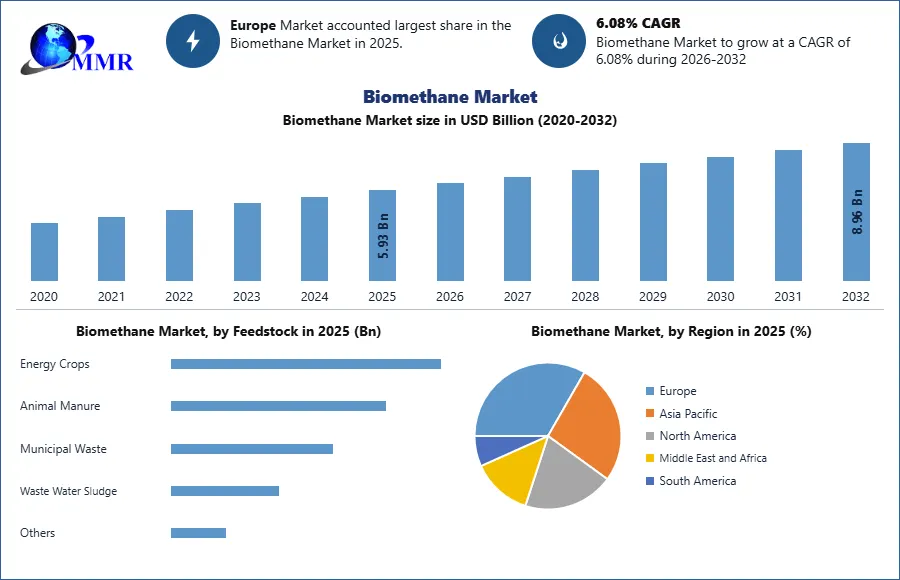
The global biomethane market is projected to grow from USD 5.93 Billion in 2025 to USD 8.96 Billion by 2032, maintaining a 6.08 percent CAGR.
Anaerobic Digestion stands as the dominant production method due to its proven operational scalability and efficient processing of wet organic feedstock.
Municipal waste represents the dominant raw material source, followed closely by animal manure, converting local liabilities into critical chemical inputs.
High initial capital requirements for upgrading infrastructure and specialized distribution pipelines present major barriers to broader market penetration.
Europe controls the leading regional position, supported by legislative mandates aimed at full decarbonization by 2050.
Why This Matters Now
Volatile natural gas pricing and strict greenhouse gas accounting regulations have compromised standard commodity chemical supply chains. Industrial buyers can no longer rely on unmitigated fossil gas without facing higher carbon taxes or losing access to sustainability-minded consumer brands. Biomethane provides a direct drop-in replacement that utilizes existing downstream gas networks while instantly cutting product carbon footprints.
The primary business challenge centers on raw material availability and infrastructure investment. Companies that integrate decentralized biomethane assets into their procurement operations protect themselves from geopolitical supply shocks and create isolated regional circular supply lines. Delaying this transition risks exposing manufacturers to sudden regulatory adjustments and localized feedstock shortages as competing industries claim available regional volumes.
Market Overview
Biomethane Market size serves as a purified, high-value alternative to standard natural gas, generated by refining raw biogas extracted from organic matter including agricultural byproducts, sewage, and municipal refuse. Global industrial demand is climbing because the gas offers a direct path to decarbonizing thermal energy, chemical syntheses, and commercial transport networks without requiring new pipeline construction.
The underlying market dynamics are defined by a shift toward localized, decentralized production networks. This decentralized approach builds supply resilience and eliminates long-distance transmission losses, but requires significant capital for processing plants and grid injection equipment. Industrial scaling requires balancing high upfront capital expenditure with long-term carbon tax savings and fuel price predictability.
Key Trends Driving Growth
Decentralized production is the major operational trend altering the structure of the industrial gas market. Traditional energy networks rely on large, concentrated production facilities, but biomethane production utilizes smaller, distributed installations placed near agricultural or municipal waste sources. This geographic distribution creates regional circular economies, where local organic byproducts are processed directly into industrial fuel, shielding buyers from macro-level logistics breakdowns.
Technological refinements in gas upgrading systems have also improved the economic viability of biomethane. Advancements in pressure swing adsorption, water scrubbing, and membrane separation technologies have lowered processing costs and expanded operational margins. These developments allow smaller facilities to consistently generate pipeline-grade biomethane, making clean energy projects attractive to private infrastructure funds and chemical conglomerates.
Segment Insights
Dominant Production Method: Anaerobic Digestion
Anaerobic digestion represents the dominant production method across the global industry. This operational dominance stems from its verified capability to process highly diverse, wet organic streams such as municipal refuse, food waste, and animal manure through oxygen-free microbial breakdown. The technology has achieved deep commercial maturity, offering predictable conversion yields and seamless integration into existing public and agricultural waste infrastructure.
Fastest-Growing Production Method: Gasification
Gasification is emerging as the fastest-growing technology segment, targeted primarily at dry organic feedstocks including energy crops and woody agricultural residues. This process applies intense thermal energy under restricted oxygen conditions to transform dry biomass into intermediate syngas, which is subsequently converted into biomethane.
Regional Growth Story
Europe maintains the leading position in the global biomethane landscape, driven by statutory frameworks linked to its target of absolute net-zero emissions by 2050. European market rules combine clear green gas mandates with structural subsidies, prompting heavy infrastructure spending across Germany and neighboring manufacturing hubs. This policy structure has accelerated grid injection compliance and built highly integrated trade corridors for renewable gas certificates.
Concurrently, major industrial zones across the United States, China, India, and Japan are building out domestic biomethane infrastructure to bolster supply chain resilience. In these nations, development is driven by a mix of corporate carbon reduction goals and regional waste management mandates. As agricultural and manufacturing hubs in India and China face tighter local pollution limits, waste-to-energy projects are scaling up, positioning these economies as key production centers.
Competitive Landscape
The global biomethane sector is transitioning from a fragmented collection of local biogas projects into an integrated, corporate-driven infrastructure market. Large oil, gas, and chemical corporations are actively acquiring local developers and building out joint ventures to secure direct control over limited organic feedstock streams. This consolidation trend points to a future where large energy players control market pricing and capacity distribution.
Firms that establish early ownership of local agricultural and municipal waste concessions build durable competitive advantages. Because raw organic materials cannot be shipped long distances efficiently, securing localized feedstock rights creates geographic monopolies that insulate developers from outside competition. This regional control gives leading operators substantial pricing power over industrial buyers competing for limited green gas allocations.
Recent Developments
Energy companies are expanding capital allocations for specialized upgrading machinery to convert standard agricultural biogas plants into pipeline-grade biomethane facilities.
Industrial chemical conglomerates are signing long-term biomethane off-take agreements to safeguard their supply of green chemical feedstocks against shifting fossil fuel prices.
Logistics providers are increasing investments in dedicated virtual pipelines and specialized compression trailers to deliver biomethane to industrial facilities disconnected from standard gas grids.
Strategic Implications
For corporate procurement teams, shifting to biomethane is no longer just a compliance exercise; it is an active hedge against changing carbon border adjustments and volatile fossil fuel markets. Relying solely on conventional natural gas exposes chemical manufacturers to margin compression as emission penalties rise. Transitioning to contracted biomethane runs protects upstream manufacturing operations from sudden regulatory interventions.
Furthermore, integrating biomethane into production processes allows specialty chemical companies to capture premium margins on certified sustainable end-products. Consumer brands are willing to pay higher prices for materials with verified low embodied carbon, allowing early adopters of green gas to secure long-term contracts. The corporate winners will be those that integrate decentralized biomethane assets directly into their raw material portfolios.
Future Outlook
The global biomethane industry is on a path toward deeper structural integration with the broader chemical and heavy industrial manufacturing sectors. As infrastructure gaps close and membrane technologies mature, localized production will offer a consistent alternative to volatile global fossil fuel markets. Winners will be determined by their ability to secure long-term regional feedstock agreements and manage high upfront capital demands before regulatory penalties diminish the returns of conventional gas sourcing.
Analyst Perspective
“Biomethane is evolving from an isolated compliance tool into a foundational raw material for the modern chemical and industrial sectors,” stated Yash Ghosalkar, Analyst at Maximize Market Research. “
About Maximize Market Research
Maximize Market Research Pvt. Ltd. (MMR) is a global market research and consulting company that provides reliable, data-focused, and practical business insights. The firm serves a wide range of industries, including healthcare, pharmaceuticals, technology, automotive, electronics, chemicals, personal care, and consumer goods. Through market forecasts, competitive analysis, strategic consulting, and industry impact assessments, MMR helps organizations understand changing market conditions, identify growth opportunities, and make informed business decisions for long-term success.
2nd Floor, Navale IT Park Phase 3
Pune Banglore Highway, Narhe
Pune, Maharashtra 411041, India
+91 9607365656
sales@maximizemarketresearch.com
