Key Highlights
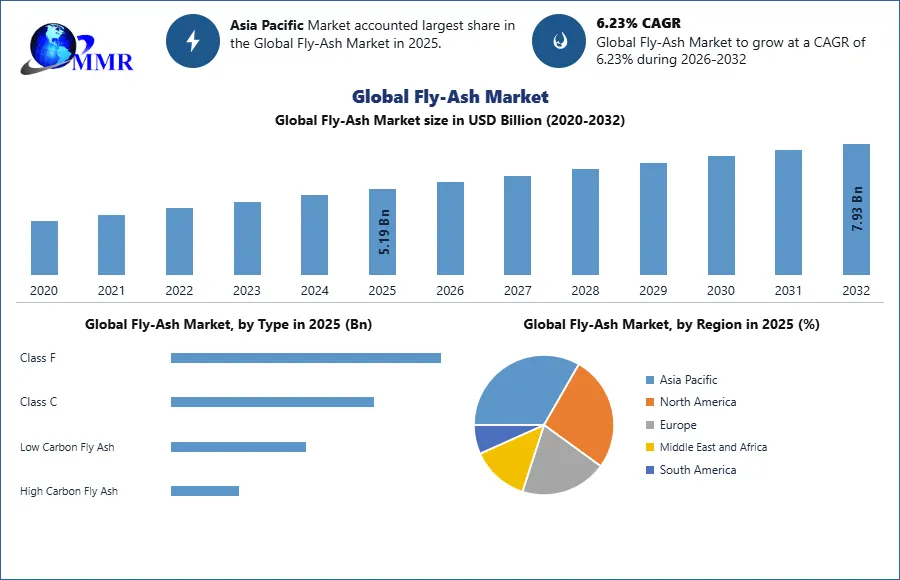
The global fly ash market size is projected to expand from USD 5.19 Billion in 2025 to USD 7.94 Billion by 2032, advancing at a 6.23% CAGR.
Class F fly ash remains the dominant type due to high-strength concrete demand across major infrastructure networks in the United States, China, and India.
The dry process method controls the highest manufacturing share, maximizing processing efficiency directly from thermal plant electrostatic precipitators.
Declining thermal power generation in Europe and North America restricts raw feedstock availability, causing structural regional supply deficits and pricing volatility.
Advanced processing technologies, ash lagoon recovery, and geopolymer synthesis are opening new commercial streams for industrial waste recycling.
Why This Matters Now
Industrial buyers, cement producers, and concrete procurement executives are navigating a high-stakes supply paradox. Decarbonization mandates are accelerating the shutdown of coal-fired utilities in North America and Europe, stripping secondary material markets of high-quality raw flue ash. Conversely, infrastructure pipelines in emerging economies are swelling, forcing the global building materials sector to compete fiercely for supplementary cementitious materials.
This tension alters traditional sourcing economics. Chemical and materials manufacturers cannot treat fly ash as a cheap utility byproduct anymore; it is now a critical, margin-defining asset. Companies that fail to secure long-term offtake agreements or invest in recovery technologies face structural supply shortfalls and volatile input pricing that could derail large-scale infrastructure delivery.
Market Overview
The global fly ash market Size reached a valuation of USD 5.19 Billion in 2025 and is on track to achieve USD 7.94 Billion by 2032. This trajectory represents a steady compound annual growth rate (CAGR) of 6.23% over the forecast period. Fly ash, consisting of the fine particulates captured from the flue gases of coal-fired boilers by electrostatic precipitators, serves as an essential mineral additive. Composed primarily of silicon dioxide, aluminum oxide, and calcium oxide, its chemical structure imparts pozzolanic properties that enhance the long-term durability and structural integrity of concrete.
The commercial momentum of this market stems from a global focus on industrial waste utilization and circular economy mandates. Reclaiming this combustion byproduct keeps millions of tons of material out of landfills while lowering the environmental footprint of downstream concrete production. By displacing energy-intensive clinker in cement formulations, fly ash directly mitigates carbon emissions. This factor aligns it with modern green building certifications and strict public-sector procurement standards worldwide.
Key Trends Driving Growth
The structural shift toward sustainable construction is the primary driver of market volume. Incorporating fly ash into concrete blends optimizes particle packing, minimizes thermal cracking in massive structural pours, and maximizes resistance to chemical and sulfate breakdown. Consequently, public agencies managing large civil works projects increasingly mandate its use to extend the operational life of public infrastructure.
Simultaneously, the industrial push for resource circularity has transformed environmental liabilities into commercial assets. Regulatory pressures and landfill taxes are prompting thermal power operators to partner with materials processors to monetize their ash streams. This dynamic accelerates research into advanced processing methods, such as mechanical activation and fine-particle classification, allowing suppliers to upgrade marginal or variable-quality ash into premium, high-performance binders.
Segment Insights
Class F Fly Ash (Dominant Segment): Sourced from anthracite and bituminous coal combustion, Class F ash leads the global market. Its low calcium chemistry delivers superior sulfate resistance and long-term compressive strength, making it the industry standard for bridges, dams, highways, and marine structures.
Class C Fly Ash: Common in North American markets, this sub-type features higher calcium levels, providing self-cementing properties that accelerate initial setting times in structural concrete applications.
Dry Process (Dominant Segment): Collecting dry particulate matter directly from electrostatic precipitators represents the most cost-efficient processing method. It preserves fine particle structures, eliminates costly dewatering phases, and minimizes outbound logistics costs for ready-mix operations.
Wet Process & Mechanical Activation (Fastest-Growing Segment): Driven by raw feedstock scarcity, systems that extract and mechanically activate ash from legacy disposal ponds and lagoons are growing rapidly, unlocking previously unusable material reserves.
Cement (Dominant Segment): Blended cement production commands the largest consumption share, driven by ready-mix concrete installations, industrial flooring, and large-scale public infrastructure foundations.
Regional Growth Story
The Asia Pacific region maintains a commanding position in the global landscape, fueled by massive industrialization and infrastructure development. China stands as both the largest producer and consumer, utilizing vast networks of coal-fired utilities to supply its massive domestic civil engineering sector. India is experiencing matching demand, with national infrastructure initiatives, industrial corridors, and affordable housing programs driving high consumption of blended cement. The region benefits from a massive, continuous supply of raw ash and supportive regulatory policies that encourage industrial byproduct reuse in commercial construction.
Conversely, North America and Europe present a highly constrained supply landscape. In these mature economies, strict climate regulations and a rapid transition to renewable power options are forcing the closure of legacy thermal plants. This structural decline shrinks local feedstock supplies, driving up transportation costs as concrete producers source ash from longer distances. To counter this regional deficit, North American and European operators are investing heavily in advanced beneficiation and ash pond recovery to reclaim stored materials.
Competitive Landscape
The competitive environment is shifting from basic logistics and transport management toward advanced materials processing and technology ownership. Industrial industrial-byproduct processors and cement conglomerates are actively acquiring local distribution networks and building specialized processing facilities next to active power stations. This integration helps lock in raw material access and control quality right at the source.
Furthermore, market leaders are focusing heavily on technical differentiation. As the structural features of available coal ash shift due to changing power plant operations, the ability to consistently classify, dry, and mechanically treat variable raw material is a major competitive advantage. Companies are setting up sophisticated classification networks to separate high-carbon particles from premium pozzolanic fractions, expanding their margin potential in high-performance concrete markets.
Recent Developments
Processing companies are deploying advanced electrostatic and pneumatic separation systems to extract unburned carbon from high-loss-on-ignition (LOI) ash, turning low-grade waste into compliant concrete additives.
Building materials manufacturers are increasing capital investments in mechanical milling and particle-size optimization assets to maximize the pozzolanic reactivity of Class F ash types.
Commercial partnerships between utility operators and ready-mix concrete providers are scaling up pond-reclamation projects to secure decades of alternative material reserves.
Chemical additives companies are introducing specialized chemical activators designed to maximize the performance of low-carbon and geopolymer concrete formulas.
Strategic Implications
The changing availability of fly ash requires a total overhaul of traditional procurement strategies. Procurement leaders can no longer rely on spot-market purchases from local coal utilities. As thermal plants shut down, buyers must establish long-term, multi-regional sourcing agreements or pivot toward processing partnerships that utilize pond-reclamation networks to ensure supply security.
For chemical and materials developers, this supply squeeze offers an excellent opening for product differentiation. Investing in advanced beneficiation technologies allows processors to transform low-grade, high-carbon ash into consistent, high-value inputs for specialty applications like geopolymers and lightweight aggregates. This shift from commodity trading to specialized processing helps protect margins from regional supply shocks and pricing volatility.
Future Outlook
The long-term trajectory of the global fly ash market will be defined by the industry’s ability to balance shrinking primary production with advanced recycling technologies. While emerging infrastructure markets will sustain high demand for traditional cement blending, mature markets will increasingly rely on beneficiated ash pond reserves and high-efficiency classification systems. Companies that secure ownership of legacy ash deposits and deploy advanced processing technologies will lead the market, while those dependent on unsecured, active thermal plant outputs face intensifying supply constraints.
Analyst Perspective
“The global fly ash market is moving away from its origins as a basic utility byproduct and becoming a highly managed, strategic material asset. As thermal power infrastructure declines in Western economies, the industry’s focus must pivot entirely toward advanced beneficiation and ash pond harvesting. The real winners in this space will be the companies that build resilient, technology-driven supply chains capable of transforming variable, non-compliant waste streams into highly consistent, low-carbon industrial materials.” — Yash Ghosalkar
About Maximize Market Research
Maximize Market Research Pvt. Ltd. (MMR) is a global market research and consulting company that provides reliable, data-focused, and practical business insights. The firm serves a wide range of industries, including healthcare, pharmaceuticals, technology, automotive, electronics, chemicals, personal care, and consumer goods. Through market forecasts, competitive analysis, strategic consulting, and industry impact assessments, MMR helps organizations understand changing market conditions, identify growth opportunities, and make informed business decisions for long-term success.
2nd Floor, Navale IT Park Phase 3
Pune Banglore Highway, Narhe
Pune, Maharashtra 411041, India
+91 9607365656
sales@maximizemarketresearch.com
