Key Highlights
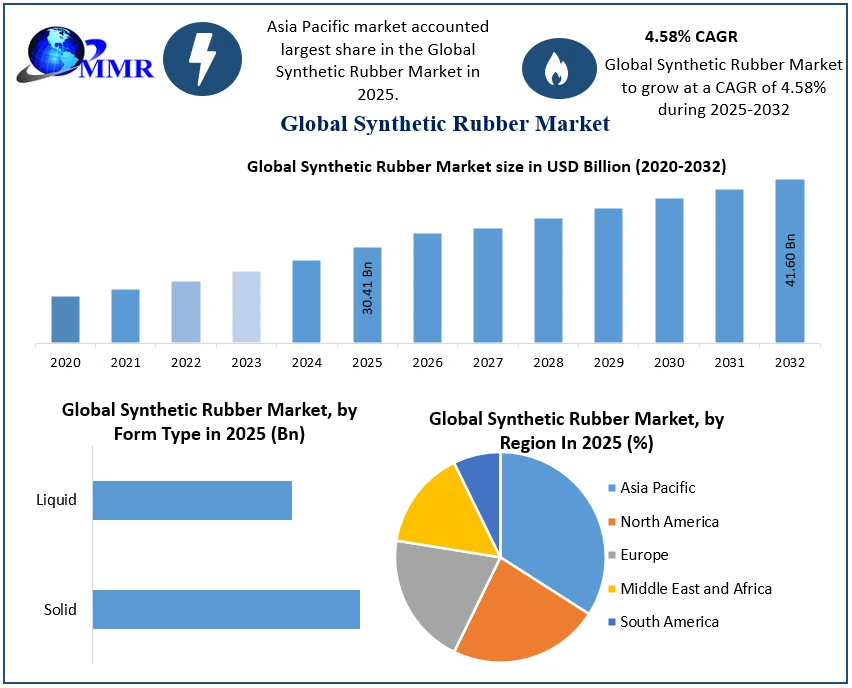
The global synthetic rubber market size is projected to expand from USD 30.41 Billion in 2025 to USD 41.60 Billion by 2032, advancing at a 4.58% CAGR.
Styrene-Butadiene Rubber (SBR) remains the dominant material type, representing 50% to 60% of total synthetic rubber consumption in automotive applications.
Global automotive tire manufacturing dominates the application landscape, fueled by rising vehicle replacement rates and expanding electric vehicle fleets.
Volatile crude oil derivatives, particularly a 30% surge in butadiene prices caused by European refinery shutdowns, are squeezing producer profit margins.
Sustainable bio-based elastomers and recycled rubber solutions are emerging as the fastest-growing technology opportunities due to strict carbon reduction mandates.
Why This Matters Now
Chemical manufacturers and industrial procurement executives face immediate structural disruption as the automotive supply chain transitions to electric mobility. Electric vehicles require specialized low-rolling-resistance tires to preserve battery efficiency, which demands advanced, highly engineered synthetic rubber formulations. This technical shift completely alters the commodity elastomer landscape, transforming synthetic rubber from a standard volume procurement item into a high-performance specialty material.
Compounding this product transition is a highly volatile raw material market. Severe feedstock constraints and tightening global environmental frameworks are forcing rubber processors to overhaul their manufacturing assets. Procurement leaders can no longer rely on stable, low-cost petrochemical baselines; securing resilient, long-term supply agreements for next-generation polymers is now a critical prerequisite for operational continuity.
Market Overview
The global synthetic rubber market Size reached a valuation of USD 30.41 Billion in 2025 and is on track to hit USD 41.60 Billion by 2032. This trajectory represents a steady compound annual growth rate (CAGR) of 4.58% over the forecast period. Synthetic rubber consists of artificial elastomers synthesized from petroleum byproducts, providing tailored physical properties such as exceptional abrasion resistance, heat stability, and chemical durability. These premium characteristics make synthetic rubber an irreplaceable material across the automotive, construction, industrial goods, footwear, and healthcare manufacturing sectors.
Commercial momentum is heavily tied to global automotive tire production, which consumes the largest share of global elastomer output. As vehicle manufacturing expands, industrial demand for high-strength polymers like Styrene-Butadiene Rubber (SBR) and Polybutadiene Rubber (BR) scales proportionally. This industrial consumption is further accelerated by a broader corporate push toward resource circularity, prompting massive R&D investments in bio-based feedstocks and recycled rubber compounding to reduce the carbon footprint of downstream manufacturing.
Key Trends Driving Growth
The rapid expansion of the global electric vehicle sector is the primary driver of specialized elastomer volume. Electric vehicles are significantly heavier than conventional internal combustion engine vehicles due to large battery packs, and they deliver instant torque to the wheels. These operating conditions cause accelerated tire wear, forcing tire manufacturers to utilize advanced synthetic rubber blends that offer superior tensile strength, minimal rolling resistance, and enhanced durability.
Simultaneously, the global transition toward a circular economy is forcing a complete re-engineering of traditional rubber chemistries. Tightening regulatory frameworks regarding industrial emissions and microplastic tire wear particles are driving tire producers to alter their core formulations. This shift creates a massive commercial pull for bio-based synthetic rubber, sustainable elastomers made from plant-derived feedstocks, and advanced recycling technologies that process vulcanized scrap into reusable industrial compounds.
Segment Insights
Styrene-Butadiene Rubber (SBR) (Dominant Segment): SBR commands the largest share of the global market, accounting for 50% to 60% of total synthetic rubber consumption in automotive applications. Its exceptional abrasion resistance, thermal stability, and cost-effectiveness make it the primary polymer choice for passenger and commercial vehicle tire treads.
Polybutadiene Rubber (BR): Utilized extensively alongside SBR in tire manufacturing, BR provides superior crack resistance and low heat buildup, making it critical for heavy-duty commercial truck tires.
Ethylene-Propylene-Diene Rubber (EPDM): This segment targets non-tire automotive components and green construction materials, valued for its resistance to ozone, weathering, and extreme operational temperatures.
Acrylonitrile-Butadiene Rubber (NBR): Valued for its excellent oil and chemical resistance, NBR dominates industrial hoses, gaskets, seals, and medical elastomer applications.
Tire Manufacturing (Dominant Application Segment): The tire sector remains the largest consumer of synthetic rubber, driven by high global vehicle production and a massive international replacement tire market.
Bio-Based & Sustainable Rubber (Fastest-Growing Segment): Driven by zero-carbon targets, elastomers formulated with renewable inputs like soybean oil and bio-butadiene represent the fastest-growing technology segment.
Regional Growth Story
The Asia Pacific region dominated the global synthetic rubber landscape in 2025, supported by a massive manufacturing infrastructure and high concentrations of automotive assembly plants. China remains the largest individual consumer and producer, with domestic consumption exceeding 6 million tons of synthetic rubber to supply its massive tire export and domestic mobility markets. India is experiencing rapid consumption growth, supported by national infrastructure development and the government’s Production-Linked Incentive (PLI) program for automotive components. Japan and South Korea remain critical hubs for high-value specialty elastomers, focusing heavily on R&D for advanced EPDM and eco-friendly EV tire compounds.
In contrast, North American and European markets operate under intense supply chain and regulatory constraints. European manufacturers are navigating high energy costs and severe feedstock availability issues following regional refinery shutdowns. Furthermore, strict environmental frameworks, such as the European Union’s Green Deal and updated industrial emission standards, require heavy capital investments to modernize aging chemical production assets. To maintain market share, North American and European producers are shifting away from standard commodity rubbers to focus on high-margin, sustainable elastomers.
Competitive Landscape
The competitive landscape is transforming as integrated petrochemical corporations and specialty chemical manufacturers race to commercialize sustainable polymer portfolios. Market structure is dictated by raw material access, where companies with backward integration into steam crackers maintain superior pricing power and capacity utilization. To protect margins against volatile oil prices, major producers are actively forming joint ventures and technical partnerships with downstream tire manufacturers to secure dedicated offtake volumes.
Technical differentiation is the primary battleground for global market share. As Tier-1 tire companies commit to aggressive sustainability goals, synthetic rubber suppliers are forced to validate the environmental profile of their product lines. Consequently, competitive position is no longer determined solely by production volume; it is increasingly defined by a supplier’s proprietary catalyst technology and their capability to consistently deliver bio-based or recycled polymer grades that match the performance of legacy petroleum-derived rubbers.
Recent Developments
Petrochemical producers are expanding specialized manufacturing assets to produce bio-butadiene from plant-based feedstocks, reducing dependence on traditional crude oil refining.
Major tire manufacturers have commercialized passenger tires utilizing up to 70% sustainable materials, including specialized soybean oil-based rubber compounds.
Industrial rubber processors are scaling up chemical recycling facilities to break down post-consumer tire scrap into high-purity recycled elastomers.
Major chemical companies in Japan and Europe received over USD 150 million in combined government funding to accelerate industrial synthetic rubber decarbonization programs.
Strategic Implications
The combination of volatile feedstock costs and changing product requirements necessitates an immediate overhaul of industrial purchasing frameworks. Procurement leaders can no longer treat synthetic rubber as a simple commodity bought on the spot market. Because butadiene prices surged by over 30% due to unexpected supply disruptions, buyers must establish diversified, multi-regional sourcing networks and utilize long-term, index-based pricing formulas to insulate corporate margins from sudden petrochemical shocks.
For chemical producers, this market environment requires a clear strategic choice between high-volume commodity production and specialty chemical innovation. Investing in advanced polymer modification and bio-synthetic manufacturing assets allows processors to capture premium margins in the fast-growing EV and sustainable tire sectors. Companies that fail to transition their production lines toward eco-friendly elastomers risk losing access to major automotive supply chains.
Future Outlook
The future structure of the global synthetic rubber market will be defined by the speed at which producers can scale sustainable manufacturing technologies to meet mandatory corporate and regulatory carbon targets. While traditional petroleum-based polymers will continue to support industrial manufacturing volumes in developing economies, mature regional markets will increasingly favor advanced, low-rolling-resistance bio-elastomers and chemically recycled rubber compounds. Chemical companies that successfully secure renewable feedstock supplies and commercialize scalable bio-SBR alternatives will capture dominant market share, while manufacturers tied exclusively to volatile, legacy fossil-fuel inputs will face eroding profitability and shrinking customer bases.
Analyst Perspective
“The synthetic rubber industry is navigating a profound structural transformation where traditional volume-driven metrics are being replaced by strict performance and sustainability credentials. The rapid adoption of electric mobility has permanently altered downstream elastomer requirements, turning what was once a standard commodity into a highly engineered component. The chemical companies that survive this transition are those aggressively investing in bio-based feedstocks and advanced catalyst technologies to insulate themselves from crude oil volatility while meeting the zero-carbon mandates of global tire brands.” — Yash Ghosalkar.
About Maximize Market Research
Maximize Market Research Pvt. Ltd. (MMR) is a global market research and consulting company that provides reliable, data-focused, and practical business insights. The firm serves a wide range of industries, including healthcare, pharmaceuticals, technology, automotive, electronics, chemicals, personal care, and consumer goods. Through market forecasts, competitive analysis, strategic consulting, and industry impact assessments, MMR helps organizations understand changing market conditions, identify growth opportunities, and make informed business decisions for long-term success.
2nd Floor, Navale IT Park Phase 3
Pune Banglore Highway, Narhe
Pune, Maharashtra 411041, India
+91 9607365656
sales@maximizemarketresearch.com
