Key Highlights
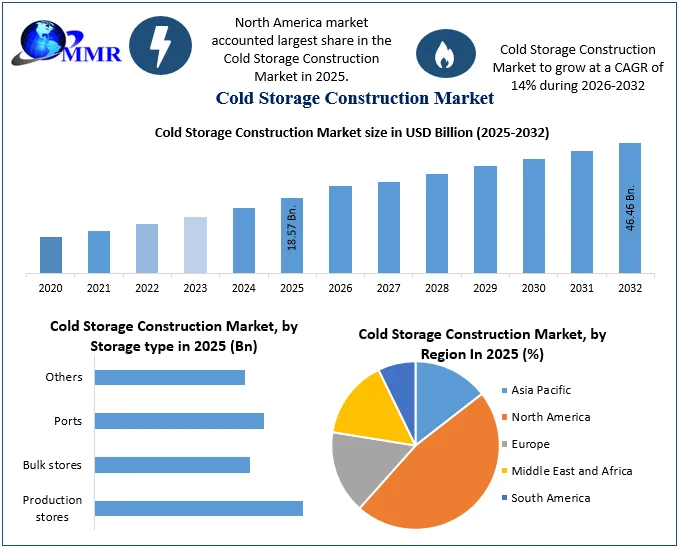
- Market valued at USD 18.57 billion in 2025.
- Forecast to reach USD 46.46 billion by 2032.
- Expected CAGR of 14% during 2026–2032.
- North America accounts for more than 45% of global market revenue.
- Production stores remain the dominant storage segment.
- Perishable food applications generate the largest demand.
- Warehouse automation is transforming facility design.
- Government investments continue expanding cold chain infrastructure globally.
Why This Matters Now
Food security, pharmaceutical distribution, and global trade increasingly depend on reliable temperature-controlled infrastructure. Expanding cold chain capacity reduces food waste, improves healthcare logistics, and strengthens supply chain resilience. Governments and private investors are accelerating capital spending on automated, energy-efficient cold storage facilities to support growing consumption of frozen foods, biologics, and temperature-sensitive products.
Market Overview
Cold storage construction Market involves the design and development of specialized facilities capable of maintaining controlled temperatures for food, pharmaceuticals, chemicals, and other temperature-sensitive products. These facilities combine insulated structures, refrigeration technologies, automated storage systems, and energy management solutions to preserve product quality throughout the supply chain.
Demand is rising as international trade in perishable goods expands and consumers increasingly purchase frozen, processed, and fresh food products through organized retail and e-commerce channels.
Supply growth is supported by investments from logistics providers, food processors, retailers, pharmaceutical companies, and governments seeking to strengthen domestic cold chain infrastructure.
Macroeconomic factors including urbanization, changing dietary habits, healthcare expansion, globalization of food trade, and stricter food safety regulations continue driving long-term infrastructure investment.
Key Trends Driving Growth
Warehouse Automation Reshapes Facility Construction
Automation technologies including robotic storage systems, conveyor networks, automated truck loading, cloud-based warehouse management, and energy optimization are improving operational efficiency while reducing labor costs.
Business impact: Automated warehouses increase storage capacity, reduce operating expenses, and improve inventory accuracy, making large-scale facilities more economically attractive.
Cold Chain Expansion Supports Food Security
Growing international trade in fresh produce, seafood, meat, dairy, and frozen foods requires larger and more sophisticated temperature-controlled logistics networks.
Business impact: Logistics companies and infrastructure developers benefit from rising demand for strategically located cold storage hubs.
Government Infrastructure Programs Accelerate Investment
Governments are increasing financial support for cold chain modernization to reduce post-harvest losses, improve food distribution, and strengthen pharmaceutical supply chains.
Business impact: Public funding lowers investment barriers while creating long-term opportunities for construction firms and cold chain operators.
Energy-Efficient Construction Gains Importance
Operators increasingly adopt advanced insulation materials, environmentally friendly refrigeration systems, and intelligent energy management technologies to reduce operating costs and meet environmental regulations.
Organized Retail Drives New Capacity
The continued expansion of supermarkets, hypermarkets, convenience stores, and e-commerce grocery platforms is increasing demand for regional refrigerated distribution centers capable of handling high inventory volumes.
Explore detailed analysis, insights, and growth opportunities
Segment Insights
Dominant Segment: Production Stores
Production stores represent the leading storage type because manufacturers require temperature-controlled facilities to preserve raw materials, semi-finished goods, and finished products throughout production cycles.
Food processors and pharmaceutical manufacturers increasingly invest in integrated production storage to improve inventory management and minimize product losses.
Business impact: Production storage strengthens manufacturing efficiency while reducing spoilage, supporting higher product quality and improved supply chain reliability.
Fastest-Growing Segment: Perishable Food Applications
Perishable food remains the fastest-growing application due to rising consumption of fresh fruits, vegetables, meat, seafood, dairy products, and frozen foods across developing economies.
Increasing disposable income and expanding retail distribution networks continue driving demand for larger refrigerated storage facilities.
Business impact: Cold storage developers benefit from sustained investment by food manufacturers, retailers, wholesalers, and logistics providers expanding temperature-controlled distribution capacity.
Additional Key Sub-Segments
Refrigerated Containers
Refrigerated containers continue gaining market share because they offer flexible, cost-effective storage and transportation for temperature-sensitive goods across domestic and international supply chains.
Ports Storage
Cold storage facilities located near ports are expanding rapidly as international trade in refrigerated products increases.
Improved import-export infrastructure reduces transit times while strengthening global food distribution networks.
Pharmaceutical Cold Storage
Healthcare expansion and increasing biologics production continue creating demand for specialized pharmaceutical warehouses with highly controlled storage environments and regulatory compliance.
Regional Growth Story
North America
North America remains the largest regional market, accounting for more than 45% of global revenue. Mature logistics infrastructure, high consumption of frozen foods, extensive warehouse networks, and strong private investment continue supporting market leadership.
Mexico is emerging as a major growth center due to logistics expansion, customs modernization, and increasing cross-border trade.
Asia Pacific
Asia Pacific is recording strong growth driven by urbanization, rising disposable income, expanding organized retail, and increasing demand for processed and frozen foods. China and India continue investing heavily in cold chain infrastructure to reduce food losses and strengthen agricultural supply chains.
Europe
Europe benefits from stringent food safety standards, pharmaceutical manufacturing, and sustainability-focused warehouse modernization. Energy-efficient refrigeration technologies continue driving infrastructure upgrades across the region.
Middle East, Africa and South America
Emerging markets are expanding refrigerated logistics infrastructure to improve agricultural exports, strengthen domestic food security, and support pharmaceutical distribution. Government-backed cold chain projects continue attracting infrastructure investment.
Competitive Landscape
The market remains highly fragmented, combining logistics providers, warehouse operators, construction specialists, and integrated cold chain developers.
AmeriCold Logistics LLC and Lineage Logistics continue leading through extensive refrigerated warehouse networks and ongoing infrastructure expansion. Their scale enables efficient nationwide distribution while supporting growing food and pharmaceutical demand.
Construction specialists including Primus Builders, The Stellar Group, Clarion Construction, and Tippmann Group focus on designing advanced temperature-controlled facilities that integrate automation, energy management, and sustainable building technologies.
International logistics providers such as CEVA Logistics, Kerry Logistics, VersaCold Logistics Services, NewCold Coöperatief U.A., Snowman Logistics, and Frialsa Frigorificos are expanding regional cold storage capacity to strengthen end-to-end cold chain capabilities.
Competition increasingly centers on automation, sustainability, facility scalability, and geographic expansion rather than warehouse capacity alone.
Recent Developments
- July 2025: Ti Cold and Karis Cold began construction of a USD 60 million convertible cold storage facility for PermaCold Logistics in Georgia, adding more than 30,000 pallet positions with environmentally friendly refrigeration technology.
- July 2025: The Government of India approved an additional ₹1,920 crore to expand and modernize mega cold storage infrastructure projects.
- January 2026: New CDSCO Schedule M compliance requirements and revised BEE star-rating standards came into force, accelerating adoption of energy-efficient cooling systems and automated monitoring.
- February 2026: Ghana’s Ministry of Food and Agriculture commissioned an expanded cold storage complex and processing facility at Kpone using advanced European technology.
- March 2026: Industry analysis highlighted increasing adoption of modular warehouse retrofits and green warehouse standards, supporting long-term cold storage construction demand.
Future Outlook
Companies that combine automated warehouse technologies with energy-efficient cold chain infrastructure will capture the greatest share of global investment as food security, pharmaceutical logistics, and sustainable supply chains become strategic national priorities.
Analyst Perspective – Ankita Kagawade
“The Cold Storage Construction Market is evolving from conventional refrigerated infrastructure into an intelligent, technology-driven logistics ecosystem. Rising global trade in perishable foods, pharmaceuticals, and biologics is accelerating investment in automated, energy-efficient cold storage facilities that improve supply chain resilience while reducing product losses.
About Maximize Market Research
Maximize Market Research Pvt. Ltd. (MMR) is a global market research and consulting company that provides reliable, data-focused, and practical business insights. The firm serves a wide range of industries, including healthcare, pharmaceuticals, technology, automotive, electronics, chemicals, personal care, and consumer goods. Through market forecasts, competitive analysis, strategic consulting, and industry impact assessments, MMR helps organizations understand changing market conditions, identify growth opportunities, and make informed business decisions for long-term success.
Contact Us :
2nd Floor, Navale IT Park Phase 3
Pune Banglore Highway, Narhe
Pune, Maharashtra 411041, India
+91 9607365656
sales@maximizemarketresearch.com
