Key Highlights
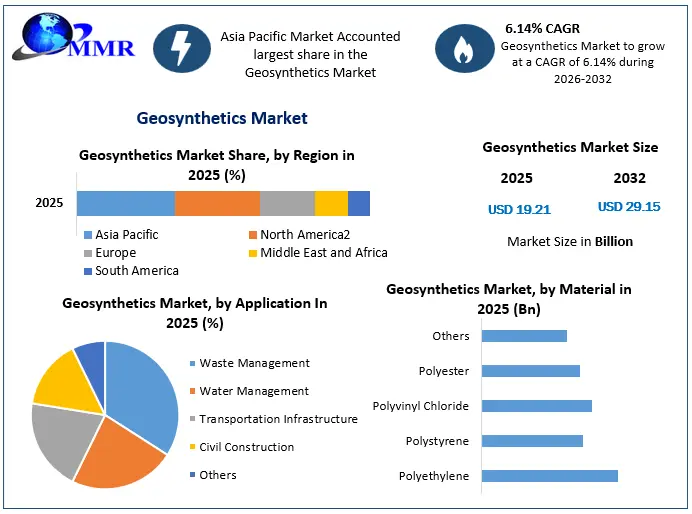
The global geosynthetics market achieved a valuation of USD 19.21 billion in 2025 and is projected to reach USD 29.15 billion by 2032.
Increasing civil infrastructure demands yield a calculated market CAGR of 6.14% over the 2026 to 2032 forecast period.
Permeable geotextiles maintain the dominant market position, serving as the technical standard for global filtration and drainage applications.
Geomembranes operate as highly critical waterproofing layers, driven by stringent national landfill and reservoir containment mandates.
Lack of intensive research and development funding represents a significant restraint that slows down advanced product creation.
Why This Matters Now
Civil engineering procurement teams and polymer manufacturing executives face immediate supply chain adjustments as international infrastructure projects accelerate the deployment of high-performance synthetic layers. Modern roadway systems and environmental containment installations are experiencing higher mechanical stress loads, requiring immediate integration of specialized polymer sheets to prevent structural shifting. Engineering teams that continue to depend on traditional gravel filtration methods face rising maintenance costs and immediate regulatory scrutiny.
With the market expanding at a 6.14% CAGR toward a USD 29.15 billion valuation, securing multi-year polymer supply agreements with primary extruders is a strategic priority. Waiting exposes downstream municipal and transport networks to sudden regional material deficits and high polymer resin price volatility. Procurement managers who fail to lock in long-term manufacturing capacity risk losing critical contract margins as massive national rail and roadway programs consume existing factory outputs.
Market Overview
The global Geosynthetics Market is transitioning from standard civil engineering inputs into highly regulated structural performance standards across the construction sector. These synthetic polymer sheets feature strong tensile strength and chemical resistance, making them invaluable for reinforcing soil slopes, separating soil layers, and stabilizing heavy transportation embankments. The engineered composition of these materials prevents internal soil erosion while allowing water to pass through safely without disrupting adjacent structural foundations.
Contractors deploy these materials across massive transportation corridors, waste management sites, commercial mining pools, hydraulic dams, and coastal protection barriers. The specific polymer base—such as polypropylene, polyester, or high-density polyethylene—directly dictates the final sheet’s hydrostatic resistance and long-term durability. As municipal regulators enforce longer lifespans for public works, specialized manufacturers are upgrading their extrusion lines to supply higher-density configurations that resist underground chemical breakdown.
Key Trends Driving Growth
The rapid modernization of transport networks in developing economies and the expansion of heavy industrial mining assets are the primary drivers of global volume demand. Public infrastructure authorities are directing significant funding toward long-distance highway networks, which increases the consumption of high-strength reinforcement meshes. This civil expansion is supported by growing urban demand for effective green infrastructure, including geocomposite systems designed for rooftop gardens and vertical urban greenery.
In the environmental management sector, regulatory bodies are mandating highly efficient waterproofing barriers to eliminate groundwater contamination around heavy industrial sites. Mining operators are consuming large volumes of high-performance liners to seal tailings ponds and secure mineral processing zones against accidental toxic runoff. Furthermore, advanced construction firms are combining synthetic polymer grids with real-time electronic sensors to monitor internal infrastructure health and identify localized structural weaknesses before failures occur.
Segment Insights
Dominant Segment: Geotextiles. This material classification holds the largest share of the geosynthetics market due to its widespread use as a permeable filtration layer in global civil engineering. Transport authorities utilize these synthetic fiber sheets to separate different soil weights, preventing sub-base shifting while ensuring proper water drainage across high-load railway lines.
Critical Barrier Segment: Geomembranes. This segment commands high market relevance due to its vital role as an impermeable fluid barrier in critical environmental containment networks. Industrial operators install these thick polymer sheets inside modern municipal landfills, water reservoirs, and industrial waste ponds to ensure total isolation from surrounding eco-environments.
Regional Growth Story
The Asia-Pacific region is experiencing rapid market volume expansion, driven by extensive infrastructure development programs across fast-growing municipal centers. Government initiatives focused on expanding local transport networks and securing reliable water containment systems are driving high demand for durable synthetic polymers. This regional development prompts top-tier manufacturers to position fabrication facilities close to active major infrastructure hubs to minimize transit times and secure stable corporate supply agreements.
Simultaneously, North America and Europe maintain large revenue shares, supported by strict environmental protection laws and aging highway remediation projects. North American engineering groups are focusing on integrating geosynthetics to protect fragile shorelines from severe coastal erosion, utilizing heavy geotextile tubes and mats. Meanwhile, European manufacturing facilities are updating their chemical blending processes to integrate non-biodegradable waste materials, aligning their operations with tightening circular economy regulations.
Competitive Landscape
The global competitive ecosystem is characterized by structural fragmentation, featuring numerous small and medium-sized regional extruders alongside large chemical conglomerates. This structural layout creates intense price competition on basic commodity sheets, forcing major suppliers to focus on highly specialized, branded technical variations. Dominant market participants utilize established raw material networks to secure stable polymer feeds, protecting their production lines from volatile petrochemical market swings.
To overcome the slow industry adoption of new construction methodologies, leading geosynthetic producers are investing in technical training partnerships with major engineering associations. This educational strategy helps manufacturers demonstrate the long-term cost benefits of synthetic stabilization over traditional gravel packing, locking in recurring volume commitments from public agencies. Additionally, top-tier operators are expanding their local distribution networks to offer complete geotextile and geomembrane systems directly to site contractors.
Recent Developments
Manufacturing facilities expanded their extrusion lines to scale up the volume availability of composite drainage mats featuring embedded monitoring capabilities.
Strategic technical partnerships were finalized between engineering groups and material producers to standardize green roof geocomposite installations in expanding urban areas.
International logistics networks updated their handling systems to protect high-purity polymer liners from physical puncture during multi-modal freight transport.
Development programs succeeded in blending high-strength recycled plastic components into standard geogrid production lines to decrease reliance on virgin polymer resins.
Strategic Implications
The expanding deployment of performance polymers in public works requires an immediate shift in corporate material sourcing strategies. Relying on transactional, spot-market procurement introduces severe risk as massive municipal transport projects quickly lock up available regional extrusion capacity. Material procurement managers must shift toward integrated supply frameworks that guarantee scheduled volume deliveries and maintain strict batch durability certification.
For chemical and materials manufacturers, moving away from low-margin commodity sheets toward high-performance, sensor-integrated geosynthetics is vital to preserving long-term profitability. Producers must actively counter low industry funding for advanced research by establishing direct development programs with geotechnical engineering universities. Successfully proving that synthetic polymer layers reduce project installation time and lower long-term maintenance costs allows manufacturers to protect their pricing structures from local price wars.
Future Outlook
The global market is on track for steady volume scaling as international engineering networks deploy synthetic polymer sheets to secure infrastructure against extreme weather and soil instability. Future market dominance will belong to integrated polymer extruders that can deliver certified high-tensile materials while complying with tightening environmental recycling mandates. Conversely, unintegrated regional suppliers that fail to invest in advanced product testing face shrinking market access as public infrastructure contracts mandate long-term material performance verification.
Analyst Perspective
“The accelerating scale of international transport and waste management infrastructure is shifting construction models away from high-volume stone aggregate layers toward high-performance polymer sheets,” states Ankita Kagwade, Lead Analyst at Maximize Market Research. “With geotextiles maintaining the dominant position in the global geosynthetics market, manufacturers must focus on improving tensile performance and integrating sustainable materials to capture high-value public infrastructure and industrial containment contracts.”
About Maximize Market Research
Maximize Market Research Pvt. Ltd. (MMR) is a global market research and consulting company that provides reliable, data-focused, and practical business insights. The firm serves a wide range of industries, including healthcare, pharmaceuticals, technology, automotive, electronics, chemicals, personal care, and consumer goods. Through market forecasts, competitive analysis, strategic consulting, and industry impact assessments, MMR helps organizations understand changing market conditions, identify growth opportunities, and make informed business decisions for long-term success.
2nd Floor, Navale IT Park Phase 3
Pune Banglore Highway, Narhe
Pune, Maharashtra 411041, India
+91 9607365656
sales@maximizemarketresearch.com
