Key Highlights
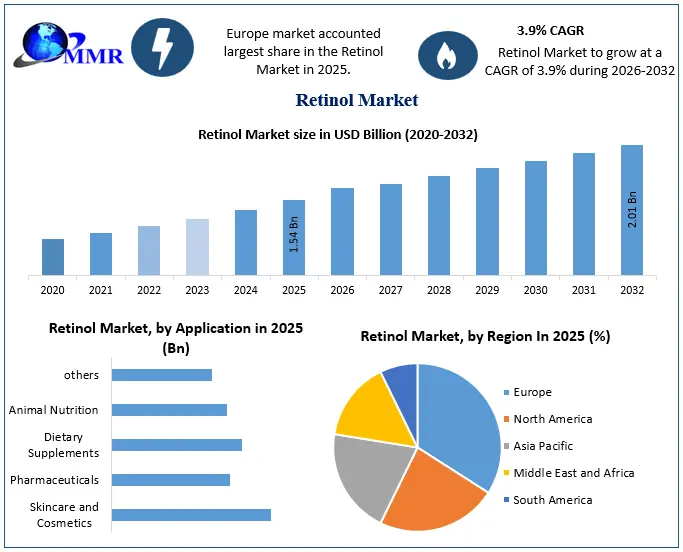
The global retinol market size reached USD 1.54 Billion in 2025 and is projected to scale to USD 2.01 Billion by 2032.
Total marketplace revenue is expanding at a steady compound annual growth rate of 3.9% over the 2026 to 2032 timeline.
Skincare brands are increasingly demanding scientifically backed, stable formulations to guarantee accurate active concentration levels.
Technical collaborations between mass-market formulators and professional dermatologists are acting as the primary volume driver.
Major multi-national suppliers, including BASF SE and DSM, are leveraging advanced synthesis portfolios to protect corporate market share.
Why This Matters Now
Chemical manufacturers, specialty ingredient distributors, and cosmetic procurement directors are operating under immediate operational stress as the global beauty sector transitions toward clinical efficacy. Consumers are abandoning basic marketing claims in favor of verified biochemical performance, positioning high-purity vitamin A derivatives as indispensable inputs. This behavioral change means that skincare brand owners who cannot guarantee precise active ingredient concentration and chemical longevity on retail shelves face immediate displacement by scientifically validated competitors.
This functional requirement elevates raw material stabilization from a standard manufacturing preference into a critical parameter of product lifecycle economics. Retinol molecules are highly sensitive to environmental factors, breaking down rapidly when exposed to air, light, and ambient moisture during transport or storage. Chemical formulation teams must deploy advanced stabilization chemistry right now to eliminate premature product degradation and maintain competitive margins across international retail channels.
Market Overview
The global retinol market Size achieved a baseline valuation of USD 1.54 Billion in 2025 and is verified to reach USD 2.01 Billion by 2032. This value progression represents a consistent 3.9% CAGR, driven by the systematic integration of bioactive molecules into mass-market cosmetic portfolios. Retinol functions as an essential cell-communicating ingredient that stimulates cellular turnover and collagen synthesis, delivering visible reductions in fine lines while enhancing overall skin health.
The commercial footprint of this chemical market is expanding because active skincare is no longer confined to luxury or niche medical channels. Major consumer goods corporations are re-engineering their core product lines to incorporate premium functional ingredients across entire demographic portfolios. This democratization of clinical cosmetics provides chemical synthesis operations with a highly resilient, volume-driven consumer base that offsets seasonal economic contractions.
Key Trends Driving Growth
The most significant operational trend reshaping the chemical ingredient sector is the direct collaboration between cosmetic brand formulators and practicing dermatologists. Skincare companies are actively partnering with medical experts to develop and launch specialized, science-backed product lines that build strong consumer trust. These collaborative frameworks mandate that raw material chemical suppliers provide meticulous documentation regarding molecular purity, precise active concentration levels, and long-term bio-compatibility.
Concurrently, technological breakthroughs in active ingredient protection are altering traditional blending methods. Because uninsulated retinol degrades quickly, ingredient producers are prioritizing advanced micro-encapsulation and time-release polymer matrices. These technical innovations isolate the active vitamin A molecules within a protective chemical shell, ensuring the compound remains completely stable inside the packaging and only activates upon direct contact with the skin surface.
Segment Insights
Skincare Applications (Dominant Segment): Anti-aging creams, corrective serums, and daily dermatological lotions consume the largest baseline volumes of retinol ingredients globally due to deep consumer focus on active skin health.
Stabilized Vitamin A Derivatives (Fastest-Growing Product Segment): Formulations engineered with advanced encapsulation polymers are expanding rapidly, selected by corporate buyers to prevent immediate oxidization losses.
Premium Serums: High-concentration liquid formulations represent a high-margin value stream for chemical producers, requiring specialized solvents to maintain clear molecular suspension.
Mass-Market Cosmetics: Large-scale commercial beauty products are integrating low-dosage active ingredients to capture rising middle-class consumer volumes in developing urban centers.
Regional Growth Story
The North American and European regions maintain a dominant position in the global retinol market, supported by high consumer purchasing power and an established network of clinical skincare brands. Regulatory bodies in the United States and Germany enforce rigorous labeling compliance guidelines, forcing chemical suppliers to verify the stability and safety profiles of their active ingredients. This institutional oversight drives immediate demand for premium-grade, encapsulated synthetic compounds that can withstand extended supply chain journeys without losing chemical potency.
Simultaneously, the Asia-Pacific region is expanding its local production and consumption footprint, led by large-scale cosmetic manufacturing hubs in China, South Korea, and Japan. The rapid development of sophisticated regional beauty ecosystems has triggered massive volume requirements for high-purity chemical ingredients. Local suppliers, including Guangzhou ZIO Chemical Co., Ltd., are scaling up synthesis capacities to service domestic cosmetics companies that require immediate access to technical-grade raw materials to feed high-velocity product launch cycles.
Competitive Landscape
The global retinol competitive field is highly consolidated, with primary chemical groups utilizing advanced synthesis portfolios to protect their corporate pricing power. Top international entities, including BASF SE, DSM, Divi’s Laboratories Limited, and Biotics Research Corporation, control significant market share by operating highly integrated vitamin synthesis networks. These market leaders are continuously investing in advanced chemical processing assets to deliver optimized active structures that resist fast environmental degradation.
To isolate their corporate margins from low-cost commodity chemical competition, these primary suppliers are embedding themselves directly into the product development cycles of global consumer brands like Drunk Elephant. By providing exclusive stability data, customized delivery systems, and tailor-made molecular concentrations, dominant chemical players establish high capital barriers to entry. This deep technical integration ensures that new, uncertified ingredient suppliers face extreme difficulties when attempting to enter premium commercial supply chains.
Recent Developments
Primary chemical manufacturers are scaling up manufacturing investments in specialized multi-component encapsulation technologies to supply highly stable, oxidation-resistant vitamin A derivatives to global brands.
Global skincare corporations are expanding their clinical research budgets to co-develop target-specific retinol delivery systems alongside independent dermatological testing laboratories.
Specialty ingredient suppliers are launching highly concentrated, liquid-stable raw materials designed to streamline the cold-blending manufacturing processes utilized by cosmetic contract packers.
Regional ingredient distribution networks are optimizing their temperature-controlled logistics frameworks to eliminate active raw material degradation during trans-oceanic transit.
Strategic Implications
For cosmetic procurement organizations and sourcing directors, the clinical transformation of the beauty industry requires a transition away from transactional ingredient purchasing. Procurement teams can no longer view retinol as a simple bulk chemical bought based solely on upfront spot prices. Because raw material oxidation directly triggers consumer complaints and compromises brand equity, purchasing leaders must implement rigid multi-layered quality control contracts with tier-one chemical manufacturers who can verify molecular longevity.
For chemical producers, this market environment highlights the importance of scaling up advanced material science capabilities. Continuing to produce basic, unshielded vitamin A liquids represents a long-term commercial risk as brands pivot toward encapsulated technologies. Strategic corporate success requires deploying capital directly into specialized polymer synthesis and clean-room encapsulation lines to secure high-margin supply placement inside next-generation clinical skincare portfolios.
Future Outlook
The long-term commercial balance of the global retinol market will be determined by how effectively chemical manufacturers can optimize molecular stability while handling stricter global cosmetic safety assessments. While basic anti-aging lotions will maintain a steady baseline volume share across mass retail markets, the primary engine for margin expansion will belong exclusively to highly stable, encapsulated vitamin A systems certified by independent dermatological networks. Chemical organizations that master advanced time-release encapsulation and secure verified purity credentials will cement dominant multi-year supply positions, while legacy producers tied to unshielded chemical variants face structural margin erosion.
Analyst Perspective
“The global retinol market is experiencing a profound technical realignment as cosmetic brands abandon superficial marketing in favor of hard, clinical validation. With skin health consumers demanding immediate, visible product efficacy, advanced chemical stabilization has become the ultimate differentiator in the raw ingredient supply chain. The chemical manufacturers currently allocating capital into sophisticated micro-encapsulation and co-developing formulations with dermatological networks are securing long-term pricing power, while basic commodity suppliers are facing rapid obsolescence.” — Yash Ghosalkar, Chemical and Materials Analyst, Maximize Market Research
About Maximize Market Research
Maximize Market Research Pvt. Ltd. (MMR) is a global market research and consulting company that provides reliable, data-focused, and practical business insights. The firm serves a wide range of industries, including healthcare, pharmaceuticals, technology, automotive, electronics, chemicals, personal care, and consumer goods. Through market forecasts, competitive analysis, strategic consulting, and industry impact assessments, MMR helps organizations understand changing market conditions, identify growth opportunities, and make informed business decisions for long-term success.
2nd Floor, Navale IT Park Phase 3
Pune Banglore Highway, Narhe
Pune, Maharashtra 411041, India
+91 9607365656
sales@maximizemarketresearch.com
