Key Highlights
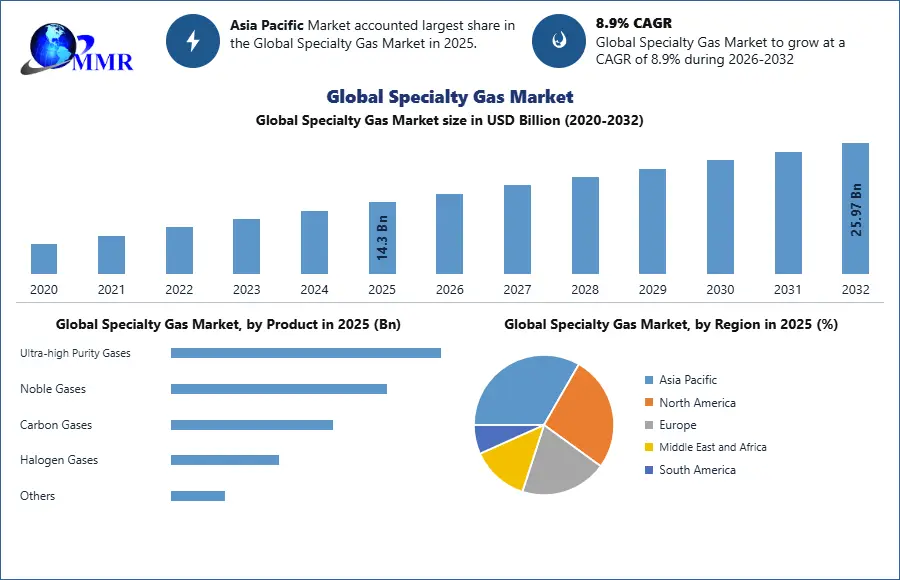
The global specialty gas market achieved an established valuation of USD 14.3 billion in 2025 and is projected to reach USD 25.97 billion by 2032.
Expanding high-precision manufacturing requirements yield a calculated market CAGR of 8.9% over the 2026 to 2032 forecast period.
Ultra-high purity (UHP) gas formulations maintain the dominant market position, driven by rigorous purity mandates exceeding 99.999% across manufacturing networks.
The electronics sector operates as the leading application segment, consuming large gas volumes for critical etching, deposition, and wafer cleaning cycles.
High production costs, intensive purification processing, and specialized transport logistics operate as the primary operational restraints facing market expansion.
Why This Matters Now
Industrial electronics procurement directors and chemical manufacturing executives face immediate supply chain constraints as international semiconductor fabrication plants accelerate their multi-billion-dollar capacity expansions. Modern electronic component foundries and advanced medical testing laboratories are encountering narrower manufacturing tolerance thresholds, requiring immediate integration of ultra-high purity gas infrastructure to prevent catastrophic substrate contamination. Silicon wafer processing operations that continue to rely on baseline industrial-grade chemical feeds face rising scrap rates and immediate rejection by international quality auditors.
With the global specialty gas market scaling at an 8.9% CAGR toward a USD 25.97 billion valuation, securing long-term volume allocations with certified purification plants is a primary corporate survival requirement. Waiting exposes downstream electronic component networks and clinical healthcare systems to severe regional material deficits and high gas distribution price volatility. Procurement managers who fail to lock in multi-year feedstock contracts risk losing essential manufacturing continuity as massive national semiconductor fabrication initiatives absorb existing factory outputs.
Market Overview
The global Specialty Gas Market is transitioning from basic commodity chemical supply models into a highly engineered technical performance standard across advanced industrial sectors. These refined chemical fluids feature extreme structural uniformity, making them essential for executing complex chemical reactions, verifying laboratory calibrations, and protecting sensitive processing equipment from oxidation. The precise chemical composition of these gases prevents fine processing errors while enabling specialized manufacturing networks to achieve stable yield metrics across prolonged processing campaigns.
Downstream operators deploy these materials across multi-tier electronic fabrication networks, healthcare institutions, pharmaceutical synthesis labs, and heavy chemical manufacturing infrastructure. The specific purity classification of the material—extending across ultra-high purity gases, noble gases, carbon gases, and halogen gases—directly dictates its technical reactivity and suitability for advanced industrial deployments. As international regulatory bodies mandate tighter tracking metrics for process contaminants, major gas synthesizers are upgrading their cryogenic separation assets to guarantee consistent particle counts.
Key Trends Driving Growth
The rapid scale-up of advanced silicon foundries and the expansion of high-speed telecommunications infrastructure are the primary drivers of global volume demand. Public and private technology consortiums are directing substantial capital toward building advanced fabrication facilities, which increases the direct consumption of high-purity etching and deposition agents. This industrial expansion is supported by growing consumer and corporate integration of artificial intelligence processing units, fifth-generation communication equipment, and automotive electrification components.
In the global healthcare sector, modern medical institutions are requiring larger volumes of specialized therapeutic and diagnostic gases to support expanding patient networks. Clinical care facilities consume large quantities of medical-grade carbon dioxide, nitrous oxide, and high-purity oxygen blends to sustain precise anesthesia deployment and automated respiratory therapies. Concurrently, environmental monitoring operations are consuming verified gas mixtures to calibrate diagnostic sensors, helping heavy processing plants monitor their ongoing emissions footprint.
Segment Insights
Dominant Product Segment: Ultra-high Purity (UHP) Gases. This product classification commands the leading position in the specialty gas market due to its vital integration within high-precision fabrication environments. Manufacturing operators specify these gases because their purity levels exceed 99.999%, which eliminates the risk of trace particulate defects during delicate wafer layer manufacturing.
Dominant Application Segment: Electronics Sector. This application domain accounts for the largest share of global market consumption, driven by continuous expansion across semiconductor lines and photovoltaic cell assembly networks. Production facilities deploy these specialized chemical agents as essential processing inputs during highly technical etching, surface cleaning, and thin-film chemical vapor deposition cycles.
Regional Growth Story
The Asia-Pacific region maintains its dominant position in the global specialty gas market, projected to retain the largest total market volume share through 2032. This regional leadership is driven by the rapid construction of massive semiconductor fabrication hubs and extensive electronics manufacturing complexes in China, Japan, South Korea, and India. Local manufacturing groups are investing heavily to localize their industrial gas production capabilities, helping domestic electronics clusters insulate their assembly lines from unexpected international trade disruptions.
Concurrently, North America and Europe retain substantial revenue shares, supported by rising healthcare investments and advanced environmental monitoring requirements. North American healthcare networks are driving up the consumption of laboratory-grade calibration mixtures to support complex biomedical diagnostics and pharmaceutical research programs. Meanwhile, European chemical manufacturing centers are advancing automated gas delivery systems to optimize purity control, ensuring strict compliance with regional hazardous material handling regulations.
Competitive Landscape
The global competitive ecosystem is characterized by high centralization, featuring a specialized group of integrated chemical and industrial gas corporations. Market operators including Linde plc, Air Liquide, Air Products and Chemicals Inc., Messer SE & Co. KGaA, Nippon Sanso Holdings Corporation, Taiyo Nippon Sanso Corporation, Airgas Inc., and Matheson Tri-Gas Inc. maintain significant market influence. These dominant suppliers utilize extensive distribution infrastructure, including custom cylinder fleets and specialized on-site gas generation plants, to secure long-term commercial supply contracts.
To protect corporate profit margins against volatile energy inputs and rising purification equipment costs, top-tier producers are shifting away from basic industrial gases toward custom-blended specialty formulations. These market leaders are locating their new separation and purification facilities directly adjacent to major semiconductor clusters, locking in recurring high-volume demand. Additionally, specialized regional operators such as SK Materials Co. Ltd., Yingde Gases Group, and Mitsui Chemicals Inc. are expanding their local filling stations to compete effectively on distribution timelines.
Recent Developments
Primary industrial gas producers completed major purification plant upgrades to scale up the volume availability of ultra-high purity electronic etching components.
Engineering groups optimized specialized cylinder treatment processes to reduce trace contamination risks during the long-term storage of corrosive halogen gas mixtures.
Agrochemical and industrial chemical providers expanded local distribution networks to secure stable feedstock channels for regional environmental monitoring laboratories.
Advanced manufacturing facilities integrated real-time analytical gas chromatography systems to automate purity verification directly at the point of consumption.
Strategic Implications
The expanding dependence on ultra-high purity inputs across electronic and healthcare lines requires an immediate update to corporate material procurement frameworks. Relying on transactional, spot-market purchasing introduces severe financial risks as specialized purification capacities approach maximum regional allocations. Material procurement executives must establish integrated, long-term supply frameworks that guarantee scheduled volume deliveries and feature clear clauses covering maximum allowable trace moisture counts.
For specialty chemical manufacturers, transitioning production assets away from low-margin commodity industrial gases toward high-value specialty formulations is vital to preserving long-term profitability. Producers must proactively manage high production and handling costs by investing in automated purification systems and corrosion-resistant distribution equipment. Effectively demonstrating that high-purity batches reduce manufacturing defects allows chemical producers to protect their pricing structures from generic market competition.
Future Outlook
The global market is positioned for sustained volume scaling as international technology networks deploy advanced semiconductor components to handle complex artificial intelligence processing tasks. Long-term market dominance will belong to integrated industrial gas corporations that can deliver certified ultra-high purity materials while managing high purification logistics and strict contamination control frameworks. Conversely, non-integrated regional gas suppliers that fail to invest in advanced cryogenic separation technologies face shrinking market access as high-tech production contracts mandate stricter purity verification metrics.
Analyst Perspective
“The continuous scale-up of advanced electronics manufacturing and high-precision semiconductor foundries is shifting chemical input specifications toward rigid contamination boundaries,” states Ankita Kagawade, Lead Analyst at Maximize Market Research. “With the ultra-high purity gases segment establishing dominant market value, chemical producers must focus on expanding advanced purification infrastructure and securing localized delivery pathways to protect high-volume contracts with global technology and healthcare networks.”
About Maximize Market Research
Maximize Market Research Pvt. Ltd. (MMR) is a global market research and consulting company that provides reliable, data-focused, and practical business insights. The firm serves a wide range of industries, including healthcare, pharmaceuticals, technology, automotive, electronics, chemicals, personal care, and consumer goods. Through market forecasts, competitive analysis, strategic consulting, and industry impact assessments, MMR helps organizations understand changing market conditions, identify growth opportunities, and make informed business decisions for long-term success.
2nd Floor, Navale IT Park Phase 3
Pune Banglore Highway, Narhe
Pune, Maharashtra 411041, India
+91 9607365656
sales@maximizemarketresearch.com
