Key Highlights
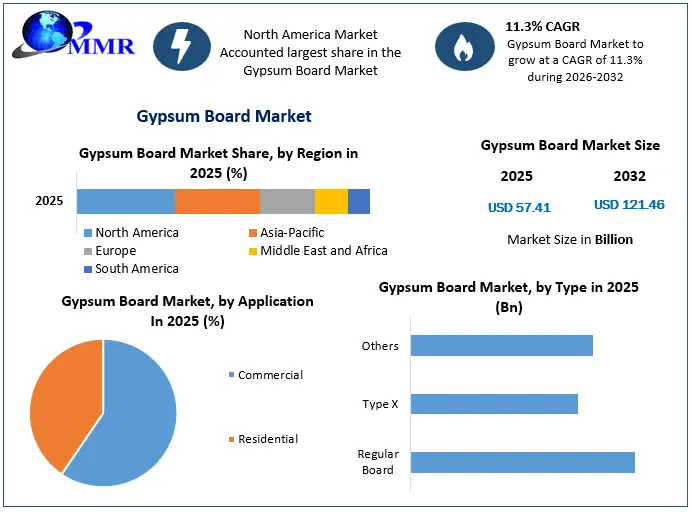
The global gypsum board market achieved an established valuation of USD 57.41 billion in 2025 and is projected to reach USD 121.46 billion by 2032.
Rising adoption of lightweight modular components yields a calculated market CAGR of 11.3% over the 2026 to 2032 forecast period.
The wallboards product segment maintains a dominant market presence, commanding an established revenue share of approximately 47% in 2025.
Residential construction operates as the leading application segment, holding a dominant revenue share of more than 45% in 2025.
North America emerged as the largest geographical territory for gypsum boards, accounting for around 41% of total revenue in 2025.
Why This Matters Now Corporate procurement directors and commercial real estate investors face immediate logistical pressure as international construction schedules accelerate the shift toward rapid drywall assembly. Modern housing developments and high-density commercial complexes encounter shorter project delivery timelines, requiring immediate integration of pre-fabricated panels to eliminate long curing times associated with traditional wet plastering. Construction firms that continue to depend on legacy plaster and lath techniques face rising labor overhead, extended project backlogs, and direct margin erosion.
With the global gypsum board market expanding at an 11.3% CAGR toward a USD 121.46 billion valuation, securing long-term volume allocations with primary manufacturers is an immediate operational priority. Waiting exposes downstream contractors to localized material shortages and intense distribution price swings as major regional real estate programs lock up existing factory lines. Supply chain managers who fail to establish structural volume contracts risk losing essential execution timelines as massive residential programs consume local material capacities.
Market Overview The global Gypsum Board Market is transitioning from simple structural lining supplies into highly engineered performance systems across the international construction sector. These multi-layered sheets feature an inner core of gypsum plaster encased in durable paper or fiberglass faces, making them highly efficient for constructing interior walls and ceilings. This specific material architecture speeds up room partition installation while allowing modern structures to achieve uniform surface areas ready for immediate decorative treatment.
Downstream builders deploy these advanced panels across extensive residential complexes, commercial office structures, corporate healthcare facilities, and retail developments. The specific product classification—extending across wallboards, ceiling boards, and pre-decorated boards—directly determines its technical suitability for specific interior decorative applications and structural requirements. As international building codes mandate more reliable thermal and acoustic barrier parameters, primary manufacturers are upgrading their core formulation processes to guarantee consistent panel density.
Key Trends Driving Growth The rapid scale-up of modern residential housing developments and expanding consumer investments in high-quality interior modifications are the primary drivers of global volume demand. Large-scale real estate developers are directing substantial capital toward automated building technologies, which increases the direct consumption of lightweight drywall sheets. This structural expansion is supported by growing consumer preferences for premium interior decorative applications that offer superior aesthetic finishes and quick installation pathways.
In the global building sector, corporate developers are using specialized gypsum boards to substitute old plaster and lath methods completely to optimize onsite workforce utilization. This operational shift allows construction teams to finish room divisions rapidly, reducing the physical labor hours required per square meter of wall space. Concurrently, manufacturing networks are allocating significant research and development funding to engineer specialized boards tailored for specific fire-resistant and moisture-controlled environments.
Segment Insights
Dominant Product Segment: Wallboard. This product classification holds the largest share of the gypsum board market, accounting for around 47% of total revenue in 2025. Industrial builders select these panels as a complete replacement for plaster and lath systems because they simplify structural installation and provide reliable performance across large interior surfaces.
Dominant Application Segment: Residential Sector. This application domain commands the leading position in market revenue, holding a share of more than 45% in 2025. Real estate networks drive this volume demand by integrating automated drywall panels across major housing initiatives to meet accelerating consumer requirements for advanced construction materials.
Regional Growth Story North America maintains its dominant position in the global gypsum board market, accounting for around 41% of total revenue in 2025. This leading market position is supported by well-developed construction industries, rapid acceptance of advanced manufacturing technologies, and an established pool of skilled drywall installers. Local distribution networks are optimizing their regional supply pathways to ensure consistent material delivery to major suburban housing projects, protecting builders from international freight delays.
Concurrently, the Asia-Pacific region is emerging as a critical growth engine, driven by massive public and private construction projects across expanding urban zones in India and China. Local authorities are backing extensive urban renewal programs, which increases regional demand for sustainable, high-efficiency interior panels to support high-density residential high-rises. Meanwhile, established manufacturing hubs in Germany and Japan are advancing automated material extrusion systems to supply premium pre-decorated boards for international export markets.
Competitive Landscape The global competitive ecosystem is characterized by strategic integration, featuring a specialized group of multinational material conglomerates and focused building product manufacturers. Key industry participants, including YOSHINO GYPSUM CO., LTD., AYHACO Gypsum Products Manufacturing, LafargeHolcim, Saint-Gobain, Etex, Beijing New Building Material (Group) Co., Ltd., NATIONAL GYPSUM PROPERTIES LLC, Global Mining Company, USG Corporation, and Knauf Group, maintain significant market influence. These dominant operators use massive rock processing assets and localized board extrusion plants to secure strong regional pricing power.
To maintain maximum capacity utilization across their capital-intensive factories, top-tier producers are prioritizing strategic acquisitions and targeted structural expansions. These market leaders position their automated panel fabrication lines close to high-demand metropolitan corridors to minimize transit costs and offer rapid delivery to large-scale contractors. Furthermore, independent regional suppliers face intensive competition because leading conglomerates leverage multi-tier distribution channels to capture high-volume commercial supply agreements.
Recent Developments
May 14, 2026: USG Corporation expanded its technical manufacturing infrastructure to increase the baseline volume availability of specialized wallboard products for high-density commercial developments.
April 28, 2026: Orange City Council advanced localized urban construction guidelines, encouraging the deployment of efficient drywall configurations across regional building initiatives to reduce installation times.
March 15, 2026: ChemAnalyst updated its material tracking indexes, confirming steady volume accumulation across primary gypsum processing networks to satisfy expanding global application parameters.
January 29, 2025: Knauf Group implemented manufacturing efficiency upgrades through its USG subsidiary, optimizing automated board extrusion to ensure stable panel supply to North American construction clusters.
Strategic Implications The growing dependence on rapid drywall systems across major real estate lines requires an immediate modernization of corporate material sourcing models. Relying on unstable spot-market purchasing introduces severe execution risks as high-volume residential projects approach peak seasonal activity and exhaust local warehouse stocks. Procurement executives must transition toward integrated, long-term supply frameworks that lock in scheduled factory capacity and guarantee strict compliance with physical panel dimensions.
For materials manufacturers, shifting production resources toward high-value pre-decorated and specialized interior decorative applications is essential to preserving corporate profit margins. Producers must actively counter raw material shipping challenges by securing direct links to reliable mineral deposits and optimizing synthetic gypsum recycling streams. Successfully proving that advanced wallboards reduce onsite labor dependencies allows chemical and material companies to defend their pricing structures against low-tier commodity suppliers.
Future Outlook The global market is positioned for sustained volume scaling as international construction corporations deploy modular drywall systems to satisfy strict execution timelines across urban commercial and residential landscapes. Long-term market dominance will belong to integrated material producers that can deliver certified high-density wallboards while maintaining reliable regional distribution networks and strong factory capacity utilization metrics. Conversely, unintegrated panel suppliers that fail to invest in advanced product varieties face narrowing market access as international construction specifications require certified fire and acoustic performance parameters.
Analyst Perspective “The continuous scale-up of corporate housing initiatives and modern commercial real estate is shifting construction practices away from slow wet plastering toward rapid drywall installations,” states Ankita Kagawade, Lead Analyst at Maximize Market Research. “With the wallboards segment commanding an established 47% market share, primary material producers must focus on expanding automated extrusion lines and securing long-term volume agreements with large-scale developers to capture the accelerating global demand for sustainable construction materials.”
About Maximize Market Research
Maximize Market Research Pvt. Ltd. (MMR) is a global market research and consulting company that provides reliable, data-focused, and practical business insights. The firm serves a wide range of industries, including healthcare, pharmaceuticals, technology, automotive, electronics, chemicals, personal care, and consumer goods. Through market forecasts, competitive analysis, strategic consulting, and industry impact assessments, MMR helps organizations understand changing market conditions, identify growth opportunities, and make informed business decisions for long-term success.
2nd Floor, Navale IT Park Phase 3
Pune Banglore Highway, Narhe
Pune, Maharashtra 411041, India
+91 9607365656
sales@maximizemarketresearch.com
