Global Aeroponics Market Soars as Sustainable Farming and Vertical Agriculture Revolutionize Food Production
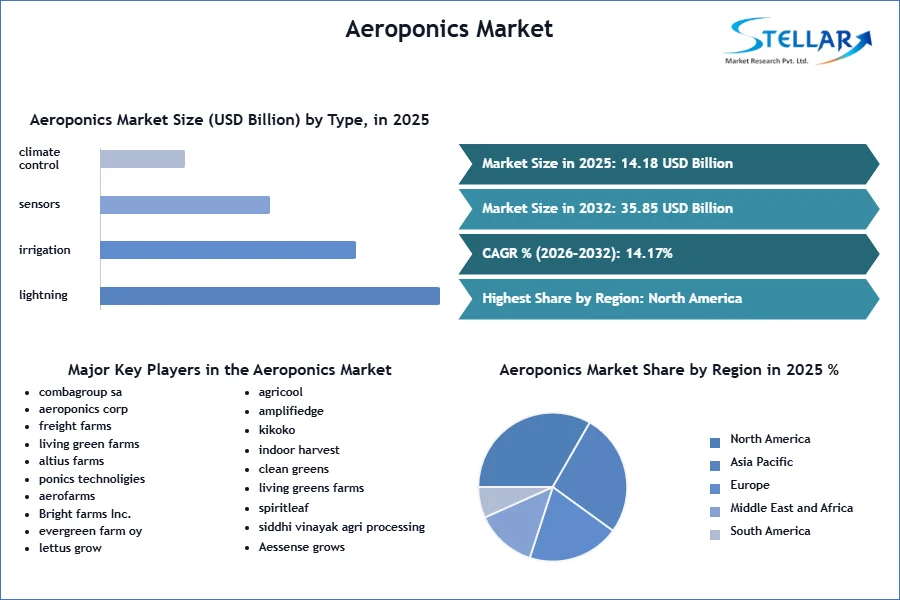
The global Aeroponics Market is witnessing remarkable growth as the agriculture sector embraces innovative, soil-free cultivation techniques to improve food production while conserving natural resources. Rising concerns over food security, water scarcity, and limited arable land are accelerating the adoption of aeroponic farming systems worldwide. According to Stellar Market Research, the global Aeroponics Market was valued at USD 14.18 billion in 2025 and is projected to reach USD 35.85 billion by 2032, expanding at a CAGR of 14.17% during the forecast period.
Sustainable Agriculture Drives Market Growth
Aeroponics is an advanced farming method in which plant roots are suspended in air and supplied with a nutrient-rich mist, eliminating the need for soil while significantly reducing water consumption. This technology enables faster plant growth, higher crop yields, and efficient resource utilization, making it an attractive solution for modern agriculture.
Key market growth drivers include:
- Rising global population and food demand
- Increasing water scarcity
- Growing adoption of vertical farming
- Rising demand for pesticide-free produce
- Expansion of urban agriculture
- Government support for sustainable farming initiatives
As climate change and shrinking agricultural land continue to challenge conventional farming, aeroponics is emerging as an effective solution for year-round food production.
𝐃𝐨𝐰𝐧𝐥𝐨𝐚𝐝 𝐅𝐫𝐞𝐞 𝐏𝐃𝐅 𝐁𝐫𝐨𝐜𝐡𝐮𝐫𝐞: https://www.stellarmr.com/report/req_sample/Global-Aeroponics-Market/1399
Indoor Farming Leads Market Adoption
Indoor farming remains the largest application segment due to its ability to provide controlled growing environments that maximize crop quality and productivity.
Aeroponic indoor farms offer several advantages, including:
- Faster plant growth
- Higher crop yields
- Reduced water usage
- Minimal pesticide requirements
- Efficient land utilization
- Year-round cultivation
These benefits are encouraging commercial growers, research institutions, and urban farming companies to invest in aeroponic systems.
Water Conservation and Resource Efficiency Fuel Adoption
One of the greatest advantages of aeroponics is its exceptional resource efficiency. Compared to traditional farming methods, aeroponic systems use dramatically less water while delivering nutrients directly to plant roots.
Major sustainability benefits include:
- Up to 95–98% lower water consumption
- No soil degradation
- Reduced fertilizer waste
- Lower risk of plant diseases
- Faster harvesting cycles
- Higher nutritional quality of crops
These advantages make aeroponics particularly attractive for regions facing water shortages and increasing pressure on agricultural resources.
Technology Innovation Accelerates Market Development
Advancements in agricultural technology are making aeroponic systems more efficient and commercially viable. Modern systems integrate automation and precision monitoring to optimize growing conditions.
Key innovations include:
- LED grow lighting
- IoT-enabled environmental monitoring
- Automated nutrient delivery systems
- Climate control technologies
- Smart irrigation management
- AI-powered crop monitoring
These technologies improve operational efficiency while reducing labor requirements and production costs.
Vegetables and Herbs Dominate Crop Production
Aeroponic systems are widely used for cultivating high-value crops that benefit from controlled growing environments.
Common crops include:
- Leafy vegetables
- Tomatoes
- Strawberries
- Herbs
- Microgreens
- Medicinal plants
Demand for fresh, chemical-free produce is encouraging supermarkets, restaurants, and consumers to increasingly source crops grown using aeroponic methods.
𝐃𝐨𝐰𝐧𝐥𝐨𝐚𝐝 𝐅𝐫𝐞𝐞 𝐏𝐃𝐅 𝐁𝐫𝐨𝐜𝐡𝐮𝐫𝐞: https://www.stellarmr.com/report/req_sample/Global-Aeroponics-Market/1399
North America Leads the Global Market
North America holds the largest share of the global Aeroponics Market, supported by advanced agricultural technologies, strong investments in controlled-environment agriculture, and growing demand for locally produced food.
Meanwhile, the Asia-Pacific region is expected to witness rapid growth due to:
- Increasing urbanization
- Rising food security concerns
- Expanding vertical farming projects
- Government support for smart agriculture
- Growing investment in sustainable farming technologies
Countries such as United States, Canada, China, India, Japan, and Singapore are increasingly adopting aeroponic farming systems to improve agricultural productivity and reduce environmental impact.
Competitive Landscape
Leading companies are investing in automation, smart farming technologies, and commercial-scale aeroponic systems to strengthen their market position.
Key players in the global Aeroponics Market include:
- AeroFarms
- LettUs Grow
- Freight Farms
- BrightFarms Inc.
- Altius Farms
- Ponics Technologies
- Living Greens Farm
- AEssenseGrows
- Agricool
- CombaGroup SA
These companies are focusing on technological innovation, sustainable food production, and expanding commercial farming operations to meet rising global demand.
Future Outlook
The future of the Global Aeroponics Market appears highly promising as governments, agribusinesses, and investors increasingly prioritize sustainable agriculture and resource-efficient food production. Continued advancements in automation, artificial intelligence, IoT-enabled farming systems, and controlled-environment agriculture are expected to further improve productivity and scalability.
As the demand for fresh, pesticide-free, and locally grown produce continues to rise, aeroponics is set to play a vital role in the future of global agriculture, supporting resilient food systems and sustainable farming practices through 2032.
