Key Highlights
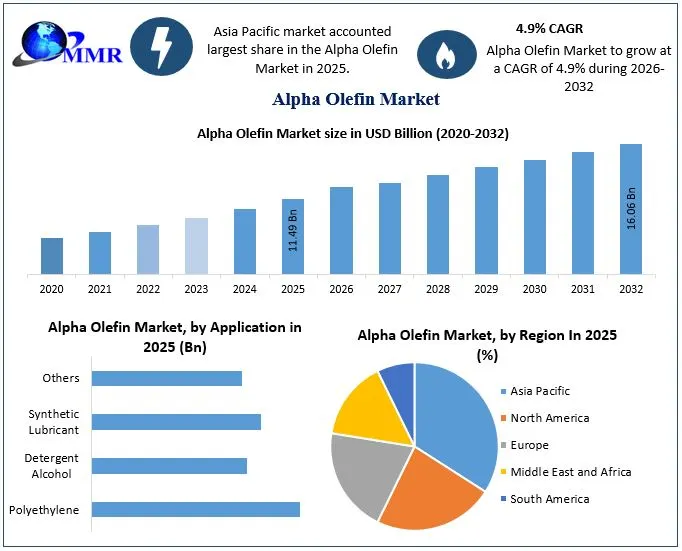
Market valuation expands from US$ 11.49 billion in 2025 to an estimated US$ 16.06 billion by 2032, registering a stable compound annual growth rate of 4.9%.
The 1-Hexene product segment holds the largest portion of market share, supported by continuous consumption as a co-monomer in polyethylene production.
The 1-Dodecene product segment is established as the fastest-growing market component due to escalating volume requirements for synthetic lubricants and household cleaners.
Asia-Pacific dominates global alpha olefin procurement, despite severe structural changes in the Chinese pulp and paper sector limiting local auxiliary chemical demand.
Price corrections and strict inventory allocations by major producers highlight rising input pressures linked directly to sudden ethylene cost spikes.
Why This Matters Now Volatile chemical conversion economics are tightening the margins of downstream polymer and lubricant manufacturers globally. A sudden escalation in ethylene feedstock values has forced market leaders to transition from volume-driven production to aggressive spot-market regulation. Procurement leaders can no longer rely on stable historical baselines; navigating this landscape requires real-time insight into upstream cracker margins and regional inventory drawdowns. At the same time, regional single-use plastic bans are altering long-term linear low-density polyethylene asset viability, forcing structural shifts across the entire supply chain.
Market Overview the global Alpha Olefin Market was valued at US$ 11.49 billion in 2025. Operating at a compound annual growth rate (CAGR) of 4.9% during the forecast period from 2026 to 2032, total industry revenue is projected to hit US$ 16.06 billion by the end of 2032. Structurally, alpha-olefins represent a distinct family of organic alkene compounds identified by a reactive double bond at the primary or alpha position. This chemical positioning allows for the synthesis of critical industrial intermediates, including synthetic lubricants, oxo alcohols, alkylated aromatics, alpha olefin sulfonates, and epoxides. The macro health of this market depends heavily on the consumption patterns of core end-use sectors like packaging, automotive, oil and gas, personal care, and electronics.
Key Trends Driving Growth Industrial adoption of paper packaging alternatives is accelerating the demand for custom chemical sizing agents. Alkenyl succinic anhydride (ASA), synthesized directly from intermediate alpha olefin cuts, is utilized by modern paper mills to enhance material softness and water resistance. Data from the Environmental Paper Network indicates that global paper consumption surpassed 400 million tonnes annually, driven by a worldwide pivot toward sustainable packaging materials. This systemic increase in global paper volumes translates directly into expanded consumption of alpha olefin feedstock within industrial paper processing plants.
Concurrently, international environmental mandates targeting transportation emissions are accelerating the consumption of cleaner-burning fuel alternatives. Branched alpha olefins, specifically isobutylene, are essential precursors for the production of methyl-tert-butyl ether (MTBE) and ethyl-tert-butyl ether (ETBE). These compounds serve as critical high-octane gasoline blending components designed to lower combustion emissions. Data from the United States Energy Information Administration highlights that gasoline consumption accounted for approximately 58% of total energy use within the domestic transportation sector in 2019. This massive baseline fuel demand creates a reliable floor for continuous isobutylene consumption in refining centers.
Segment Insights
1-Hexene (Dominant Segment): This product configuration holds the largest market share and drives baseline volume performance across the industry. The structural dominance of 1-hexene stems from its widespread utilization as a standard co-monomer for manufacturing high-density polyethylene (HDPE) and linear low-density polyethylene (LLDPE). Ongoing polymer plant investments across emerging economies like China, India, and Brazil ensure that 1-hexene remains the primary volume driver for alpha olefin producers.
1-Dodecene (Fastest-Growing Segment): Exhibiting rapid growth during the 2026–2032 forecast window, 1-dodecene is gaining immediate momentum as an essential component in high-tier synthetic lubricant formulations. Additionally, its deployment in the synthesis of detergent alcohols creates strong demand within household, industrial, and personal care cleaning sectors. However, long-term asset planning must account for a projected transition toward bio-based detergent alcohols, which may eventually displace conventional fossil-derived 1-dodecene cuts.
Polyethylene (Dominant Application): Driven primarily by the global construction and packaging sectors, polyethylene production remains the absolute focal point of alpha olefin utilization. Manufacturers prefer low-density polyethylene variants due to low relative production costs, excellent optical clarity, high elongation properties, and reliable heat sealability.
Regional Growth Story The Asia-Pacific region maintains absolute dominance over global alpha olefin consumption, driven by an extensive network of chemical manufacturing hubs stretching across China, Japan, South Korea, and India. The regional market structure is undergoing intense disruption due to major regulatory adjustments in China. The country enacted an absolute ban on all wastepaper imports, leading to the systematic elimination of more than 45 million metric tonnes of inefficient, backward paper production capacity over a seven-year period. Tightened regulatory limits and structural raw material scarcity have effectively halted new domestic investments in the Chinese pulp and paper sector. This localized contraction acts as a significant headwind, reshaping downstream alpha olefin consumption trends across the region.
Competitive Landscape The global alpha olefin competitive architecture is heavily consolidated, with major chemical conglomerates exerting significant pricing power over downstream conversion units. Recent commercial choices reveal a clear focus on margin management and the exploitation of proprietary, high-purity chemical fractions. Instead of competing purely on volume, market leaders are actively matching their output mixes with specific high-tier industrial applications, such as specialized drag-reducing agents and high-performance synthetic lubricants.
This strategic optimization indicates that top-tier producers are shifting away from lower-margin commodity chemical cycles. By concentrating on highly specialized carbon chain purification, these corporations are building insulated market niches that are less vulnerable to cyclical downswings in general polymer demand. The ability to control regional spot availability during feedstock shocks demonstrates a high level of market control, allowing primary producers to protect their margins by transferring energy costs directly to downstream buyers.
Recent Developments
April 2025: HPCL-Mittal Energy Limited surpassed 2 million tonnes in annual polymer sales, supported by major downstream capacity additions. This operational milestone confirms the successful integration of its linear alpha olefin intermediate units with high-performance polymer manufacturing assets.
July 2025: SABIC initiated a targeted price correction for its linear alpha olefin streams at Al Jubail, responding to an oversupply of global volumes and lower ethylene feedstock conversion values. This structural pricing adjustment optimized internal cost metrics while maintaining competitive supply contracts for downstream detergent and oilfield chemical operations.
March 2026: ExxonMobil Product Solutions realigned the commercial distribution of its Elevexx™ Linear Alpha Olefins portfolio, focusing tightly on high carbon number purity. The commercial pivot optimizes fluid processing efficiencies for drag-reducing agents and synthetic lubricant additives used in global pipeline infrastructure.
May 2026: INEOS, working alongside regional supply partners, executed tight restrictions on immediate spot allocations of linear alpha olefins within the Asia-Pacific market following an abrupt surge in ethylene feedstock costs. This tactical inventory control drew down available regional stockpiles, successfully transferring higher manufacturing costs directly to downstream polymer and lubricant markets.
Strategic Implications The operational moves executed by INEOS and SABIC clarify a major structural reality: alpha olefin margins are permanently tied to upstream cracker dynamics. When ethylene feedstock costs spike unexpectedly, primary producers will quickly throttle spot-market availability to force price increases down the supply chain. Procurement teams must diversify their supply networks and integrate flexible contract mechanisms to buffer against these sudden allocation cuts.
Simultaneously, the regulatory pressures facing polyethylene use—such as California’s SB270 plastic bag ban and Tanzania’s complete import and manufacturing prohibitions—signal long-term volume risks for commodity alpha olefin components. Manufacturers failing to transition asset capacities toward specialized applications like synthetic lubricants or high-purity pipeline drag-reducing agents risk holding underutilized, stranded commodity chemical assets.
Future Outlook Market survival over the coming decade will depend on a producer’s ability to swiftly pivot between commodity polymer co-monomer production and specialized chemical synthesis. Regulatory restrictions on standard polyethylene applications will continue to create friction in developed economies, making high-purity segments like 1-dodecene the primary engines of true margin growth. The future belongs exclusively to agile chemical producers who can absorb upstream ethylene pricing shocks through flexible refining operations while simultaneously capturing high-value downstream lubricant and oilfield service contracts.
Analyst Perspective “The global alpha olefin arena is no longer a simple volume-driven game; it has transformed into a complex balancing act between volatile ethylene inputs and tightening regional environmental frameworks,” stated Ankita Kagawade, Lead Analyst at Maximize Market Research. “Producers who fail to rapidly commercialize high-purity specialized streams like the Elevexx portfolio will find themselves caught in a margin squeeze as traditional commodity plastic outlets face increasing regulatory restrictions across major global economies.”
About Maximize Market Research
Maximize Market Research Pvt. Ltd. (MMR) is a global market research and consulting company that provides reliable, data-focused, and practical business insights. The firm serves a wide range of industries, including healthcare, pharmaceuticals, technology, automotive, electronics, chemicals, personal care, and consumer goods. Through market forecasts, competitive analysis, strategic consulting, and industry impact assessments, MMR helps organizations understand changing market conditions, identify growth opportunities, and make informed business decisions for long-term success.
2nd Floor, Navale IT Park Phase 3
Pune Banglore Highway, Narhe
Pune, Maharashtra 411041, India
+91 9607365656
sales@maximizemarketresearch.com
