Key Highlights
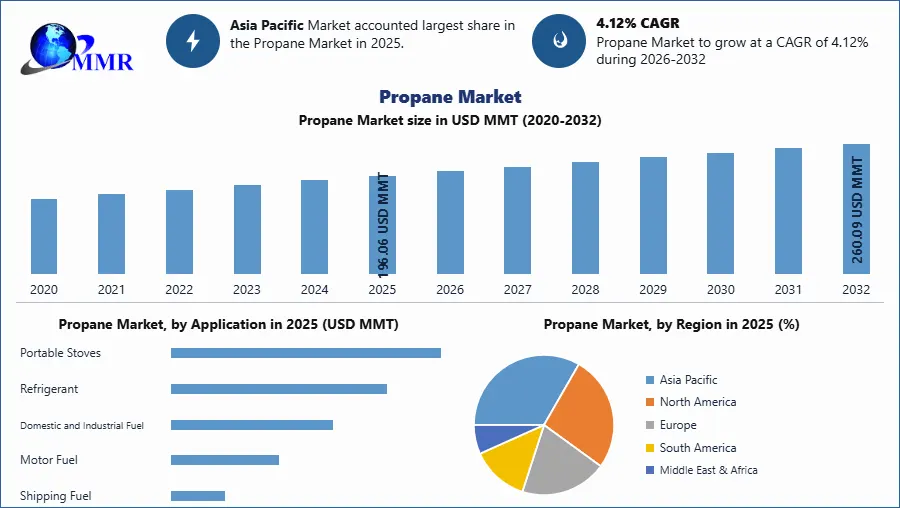
Volume Projections: The global propane market size reached 196.06 million metric tons in 2025 and is modeled to expand to 260.09 million metric tons by 2032.
Expansion Velocity: The market is registering a consistent 4.12% compound annual growth rate (CAGR) across the 2026 to 2032 forecast window.
Dominant Application: Domestic and industrial fuel applications control the largest volume share, serving as the baseline energy source for rural households and off-grid manufacturing assets.
Regional Anchor: Asia-Pacific maintains absolute market dominance, with China operating as the single largest country-level consumer of bulk propane.
Supply Foundations: Natural gas processing remains the primary production source, capturing structural advantages from rising global shale gas extractions.
Why This Matters Now
Volatile structural dynamics across international energy corridors are forcing chemical procurement leaders and industrial buyers to re-evaluate their primary fuel baselines. Relying strictly on pipeline-bound natural gas introduces immediate regional vulnerability during geopolitical or regulatory disruptions. Propane provides an independent, highly transportable alternative that allows energy managers to insulate processing plants from localized utility failures while maintaining a lower carbon footprint than fuel oil or coal.
The business imperative is sharpening as countries step up their domestic clean-cooking mandates to phase out traditional biomass. For global energy suppliers and infrastructure investors, this policy shift represents a direct demand transformation that requires immediate capital commitments. Enterprises failing to secure allocation contracts in high-volume production zones risk getting priced out of the market as emerging consumer networks lock up long-term supply volumes.
Market Overview
The global Propane market is entering a phase of steady, structural accumulation linked to industrialization metrics and regional population dynamics. Valued at 196.06 million metric tons in 2025, the market is expanding at a 4.12% CAGR, positioning total volume to hit 260.09 million metric tons by 2032. This volume advancement represents a steady re-alignment of heavy chemical and localized thermal processing portfolios toward reliable, higher-density alkane feedstocks.
As a three-carbon alkane ($C_3H_8$), propane is captured as a co-product during natural gas processing and crude oil refining operations. This means its availability is tied closely to the broader capital investment patterns of upstream oil and gas extraction companies. Because it is easily liquefied under moderate pressure, it bypasses the structural pipeline dependencies that restrict standard natural gas distribution. This flexibility supports a global export-import market that responds rapidly to seasonal demands and changing price spreads between regions.
Key Trends Driving Growth
The most influential factor shaping international trade volumes is the expansion of state-sponsored household energy transition programs. For example, India’s Pradhan Mantri Ujjwala Yojana successfully deployed tens of millions of liquefied petroleum gas (LPG) connections to low-income families. Because propane is a primary constituent of industrial and residential LPG blends, these multi-million cylinder distribution networks create a structural floor for long-term global consumption.
Concurrently, the agricultural sector is expanding its use of propane for specialized, high-volume thermal processing. Modern farming operations are replacing aging electrical systems with dedicated propane-fired infrastructure for grain drying and cattle shelter heating. Large-scale storage cylinders and automated supply monitoring technologies allow remote agricultural assets to run continuous operations, driving up baseline fuel consumption in major farming regions.
Segment Insights
Domestic and Industrial Fuel (Dominant Segment): This application segment continues to hold the dominant position in the global supply matrix. Its leading market share is maintained by widespread reliance on propane for remote residential space heating, backup electrical generation, and specialized rural industrial boilers.
Natural Gas Processing Source: Operating as the primary production source, natural gas processing accounts for the largest share of global propane supply. This dominance is driven by the continuing exploitation of shale gas fields, which yield higher volumes of natural gas liquids (NGLs) than conventional crude oil refining lines.
Motor Fuel (Autogas) and Shipping: This segment represents a steady, regulatory-backed application area. Transit fleets, including public buses, forklifts, and delivery vehicles, are adopting propane to meet localized urban particulate and nitrogen oxide limits.
Regional Growth Story
Asia-Pacific remains the primary growth driver, leading the global propane market in volume terms. China commands the highest consumption share within the region, utilizing massive volumes of propane as feedstock for its rapidly growing petrochemical complexes and dehydrogenation (PDH) plants. Rapid industrial production scaling and infrastructure investment across India, Japan, and South Korea provide a strong regional foundation, ensuring the area remains the central focus for international supply allocations.
North America continues to hold a significant position in the global market, backed by abundant shale gas resources in the United States and Canada. The region operates as a top-tier global exporter, utilizing its massive natural gas processing infrastructure to supply energy-deficient international markets. Substantial capital investments in localized LPG export docks and coastal storage hubs have strengthened the North American supply chain, allowing regional producers to capture premium pricing during peak demand cycles overseas.
Competitive Landscape
The global competitive environment is characterized by large, integrated energy corporations that exert significant influence over market pricing through their control of upstream extraction assets and export infrastructure. Top-tier operators maintain stable margins by balancing their domestic refining outputs with international trade volumes, shielding their operations from sudden regional price shocks.
To capture higher margins in a commodity-driven market, major energy firms are investing heavily in supply chain technology. Companies are deploying automated refilling networks and smart tank monitoring sensors across commercial and industrial distribution lines. These technical integrations allow suppliers to improve route density, lower distribution costs, and build long-term supply partnerships with high-volume industrial and agricultural buyers.
Recent Developments
Export Dock Expansions: Leading North American midstream operators completed major construction projects on coastal LPG export terminals, increasing daily processing capacities to meet rising demand from Asian petrochemical plants.
Fleet Modernization: Major logistics companies expanded their use of propane-powered forklifts and medium-duty delivery vans across urban fulfillment centers to lower vehicle maintenance costs and comply with local air quality rules.
Distribution System Upgrades: European energy firms deployed IoT-enabled smart meters on commercial storage assets, automating inventory management and optimizing delivery schedules for rural industrial customers.
Strategic Implications
Strategic shifts in corporate positioning indicate that premier energy suppliers are moving away from uncommitted spot-market transactions toward long-term supply agreements tied to specific industrial projects. This trend increases stability across the international marketplace, giving producers the financial visibility needed to fund multi-billion-dollar extraction and fractionation assets. This development leaves unhedged procurement managers exposed to supply availability risks during peak winter heating seasons.
Additionally, capital expenditure patterns demonstrate a clear focus on improving transport efficiency through large-capacity gas carrier vessels. By optimizing maritime logistics and expanding deep-water port access, global trading firms can rapidly shift volume flows between Europe and Asia based on changing regional price spreads. For industrial buyers, this fluid trade network underscores the importance of maintaining flexible, multi-source procurement strategies to adapt to shifting international supply dynamics.
Future Outlook
The future direction of the market will be determined by how effectively supply infrastructure expands to match the growing consumption requirements of developing economies. As countries continue to build out their domestic distribution pipelines and container storage hubs, propane will expand its role as a versatile, low-emission transition fuel for both residential energy and heavy chemical processing. Energy enterprises that secure long-term production contracts and invest in advanced distribution logistics will capture sustainable value as global industrial supply lines adjust to a lower-emissions baseline.
Analyst Perspective
“Propane has transitioned from a simple refinery byproduct into a strategic asset for global industrial energy security and petrochemical manufacturing. As nations accelerate the phase-out of high-emission solid fuels, propane’s transportability makes it the practical choice for off-grid power, agricultural heating, and clean cooking initiatives. Organizations that build resilient procurement strategies around large-scale distribution assets will secure a distinct operational advantage over the next decade.”
— Ankita Kagawade, Principal Analyst, Chemicals & Materials
About Maximize Market Research
Maximize Market Research Pvt. Ltd. (MMR) is a global market research and consulting company that provides reliable, data-focused, and practical business insights. The firm serves a wide range of industries, including healthcare, pharmaceuticals, technology, automotive, electronics, chemicals, personal care, and consumer goods. Through market forecasts, competitive analysis, strategic consulting, and industry impact assessments, MMR helps organizations understand changing market conditions, identify growth opportunities, and make informed business decisions for long-term success.
2nd Floor, Navale IT Park Phase 3
Pune Banglore Highway, Narhe
Pune, Maharashtra 411041, India
+91 9607365656
sales@maximizemarketresearch.com
