Key Highlights
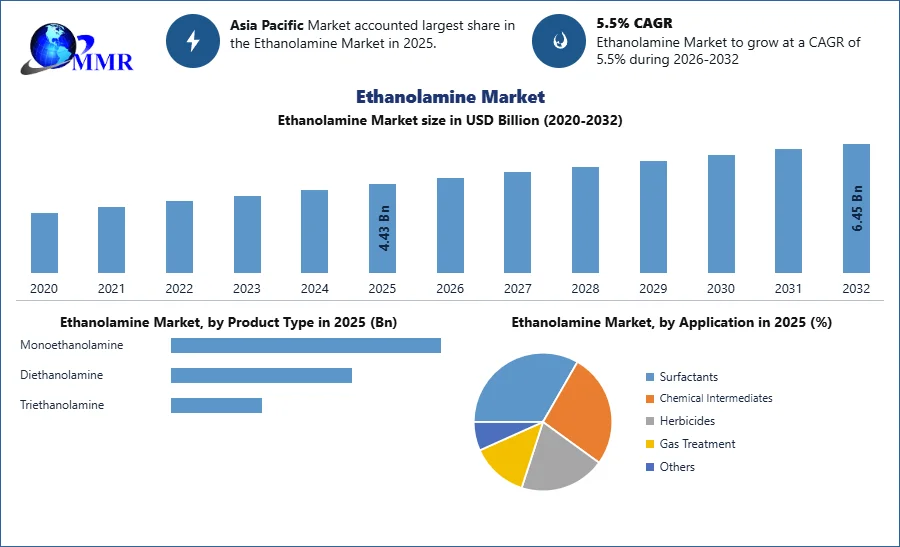
Market Growth Profile: The global ethanolamines market registered a baseline valuation of USD 4.22 billion in 2024, on track to reach USD 6.74 billion by 2032.
Expansion Trajectory: Volume and revenue distribution are advancing at a steady 6.9% compound annual growth rate (CAGR) from 2025 through 2032.
Dominant Product Classification: Monoethanolamine (MEA) remains the dominant segment, supported by continuous consumption in gas sweetening and wood preservation.
Primary Application Driver: Surfactant manufacturing leads the application breakdown, driven by the expanding global demand for biodegradable detergents and personal care products.
Geographic Concentration: The Asia-Pacific region commands a dominant 42.88% market share, backed by extensive chemical processing investments in China and India.
Why This Matters Now
Volatile feedstock prices and strict chemical safety rules are changing the production economics of the global intermediate chemicals sector. Procurement leaders and chemical manufacturers face sudden margin pressure as standard processing lines cope with shifting regulations on toxicity and emissions. The ethanolamines sector sits at the center of this change, requiring industrial buyers to quickly redesign their supply chains to secure less hazardous, highly stable intermediate inputs.
This transformation is gaining speed due to rising demand for sustainable agrochemicals and personal care formulations. Traditional, high-emission synthesis processes face increasing penalties under modern environmental frameworks, making clean chemical intermediate sourcing essential. Organizations that do not upgrade their supply networks to include high-purity monoethanolamine and triethanolamine alternatives risk losing access to key consumer markets as global sustainability standards tighten.
Market Overview
The global Ethanolamines Market is entering a period of steady structural growth linked closely to manufacturing activity and agricultural demand. Valued at USD 4.22 billion in 2024, the market is expanding at a 6.9% CAGR, positioning total sector revenue to reach USD 6.74 billion by 2032. This value advancement represents a broad realigned focus by chemical producers toward functional amino alcohols that provide dual amine and hydroxyl characteristics.
The production of ethanolamines relies on the exothermic reaction of ethylene oxide with ammonia. This dependency ties product availability and pricing directly to upstream petrochemical cracker operations and ethylene supply chains. Because the reaction produces a mix of monoethanolamine (MEA), diethanolamine (DEA), and triethanolamine (TEA), manufacturers use precise distillation tuning to adjust their output ratios based on changing market demands. This flexibility allows producers to manage shifting requirements across the agrochemical, textile, and gas processing sectors.
Key Trends Driving Growth
The most important factor driving volume expansion is the large-scale integration of ethanolamines into modern gas sweetening systems. Industrial gas treatment plants utilize monoethanolamine and diethanolamine to scrub carbon dioxide and hydrogen sulfide from natural gas and refinery streams. This processing step protects pipeline infrastructure from acid-gas corrosion and helps energy companies meet tight clean-burning fuel mandates.
At the same time, the global agrochemical industry is expanding its consumption of ethanolamines for specialized herbicide manufacturing. These compounds serve as critical chemical intermediates in the synthesis of high-volume weed control products. The continuous push to maximize crop yields across developing farming regions keeps demand high, ensuring a reliable volume floor for basic amine producers worldwide.
Segment Insights
Monoethanolamine (Dominant Segment): This product segment holds the dominant position in the global supply matrix. Its leading market share is maintained by widespread reliance on MEA for gas scrubbing, detergent manufacturing, and as a feedstock for ethyleneamines production.
Surfactants (Dominant Application Segment): Surfactant production leads the application categories. This dominance is driven by the emulsifying, pH-adjusting, and biodegradable properties that ethanolamines bring to household laundry detergents and industrial cleaners.
Triethanolamine (TEA): This segment represents a fast-growing product area, experiencing high demand from the personal care and cosmetics industries for its function as a non-irritating neutralizer in skin creams and shampoos.
Regional Growth Story
The Asia-Pacific region remains the primary growth driver, leading the global ethanolamines market with a 42.88% share of total revenue. China serves as the central hub within the region, utilizing its large-scale chemical manufacturing capacity to supply domestic and international markets. Rapid industrialization and expanding textile processing networks in India provide a strong regional foundation, ensuring the area remains a focus for international supply allocations.
Europe continues to hold a significant position in the global market, led by major chemical clusters in Germany. The regional market focuses on environmental compliance and product safety, driving research into bio-friendly amine alternatives. Meanwhile, North American market development is supported by robust demand for gas treatment chemicals, with United States shale gas extraction operations consuming substantial volumes of amine-based scrubbing solutions.
Competitive Landscape
The competitive environment is characterized by large, integrated chemical corporations that maintain market position through control of upstream ethylene oxide feedstocks and global distribution networks. These major operators protect their margins by balancing domestic production with international trade, shielding their businesses from sudden regional supply disruptions.
To capture higher margins in a competitive marketplace, leading chemical firms are investing heavily in logistics and specialized product development. Companies like Dow Inc. and BASF SE are expanding their product portfolios, entering new downstream application areas, and optimizing their international distribution chains. These strategic investments help manufacturers improve delivery speeds, lower freight costs, and secure long-term supply partnerships with global surfactant and agrochemical producers.
Recent Developments
Logistics Network Upgrades: Global chemical producers expanded their specialized bulk liquid distribution fleets, improving delivery safety and supply security for hazardous intermediate amines across transatlantic trade lanes.
Process Efficiency Investments: Major Asian chemical manufacturers upgraded their ethylene oxide reaction lines, allowing operators to adjust production ratios between MEA, DEA, and TEA more efficiently to match shifting market demands.
Agrochemical Supply Pacts: International herbicide formulators secured multi-year supply contracts with regional ethanolamine providers, stabilizing input costs against volatility in raw material markets.
Strategic Implications
Strategic alignments across the global market demonstrate that premier chemical suppliers are moving away from uncommitted spot-market sales toward dedicated long-term supply agreements. This trend increases stability across the marketplace, providing producers with the financial clarity needed to fund future capacity additions and technology upgrades. This development leaves unhedged procurement managers exposed to supply availability risks during periods of high seasonal demand.
Additionally, capital allocation patterns highlight a focus on improving supply chain resilience through localized manufacturing investments. By placing production facilities closer to major downstream consumer networks, global chemical firms reduce transport times and insulate their operations from maritime shipping disruptions. For industrial buyers, this regional manufacturing presence underscores the value of sourcing materials from suppliers with diversified, local production assets.
Future Outlook
The long-term development of the market will depend on how effectively producers manage regulatory limits on chemical emissions while meeting the volume requirements of expanding industrial economies. As nations continue to tighten environmental standards and demand biodegradable personal care products, ethanolamines will maintain their important role as versatile chemical intermediates and functional processing inputs. Chemical enterprises that secure reliable ethylene oxide feedstocks and invest in clean manufacturing technologies will capture sustainable value as global supply chains shift to a lower-emissions baseline.
Analyst Perspective
“Ethanolamines have transitioned from simple intermediate blocks into essential components for modern industrial gas processing and biodegradable surfactant formulation. As chemical safety rules tighten globally, the ability to supply high-purity, structurally predictable amino alcohols is a clear market advantage. Organizations that build resilient procurement strategies around integrated, feedstock-secure producers will protect their operating margins from future supply and price volatility.”Ankita Kagawade, Reserach Analyst, Chemicals & Materials
About Maximize Market Research
Maximize Market Research Pvt. Ltd. (MMR) is a global market research and consulting company that provides reliable, data-focused, and practical business insights. The firm serves a wide range of industries, including healthcare, pharmaceuticals, technology, automotive, electronics, chemicals, personal care, and consumer goods. Through market forecasts, competitive analysis, strategic consulting, and industry impact assessments, MMR helps organizations understand changing market conditions, identify growth opportunities, and make informed business decisions for long-term success.
2nd Floor, Navale IT Park Phase 3
Pune Banglore Highway, Narhe
Pune, Maharashtra 411041, India
+91 9607365656
sales@maximizemarketresearch.com
