Key Highlights
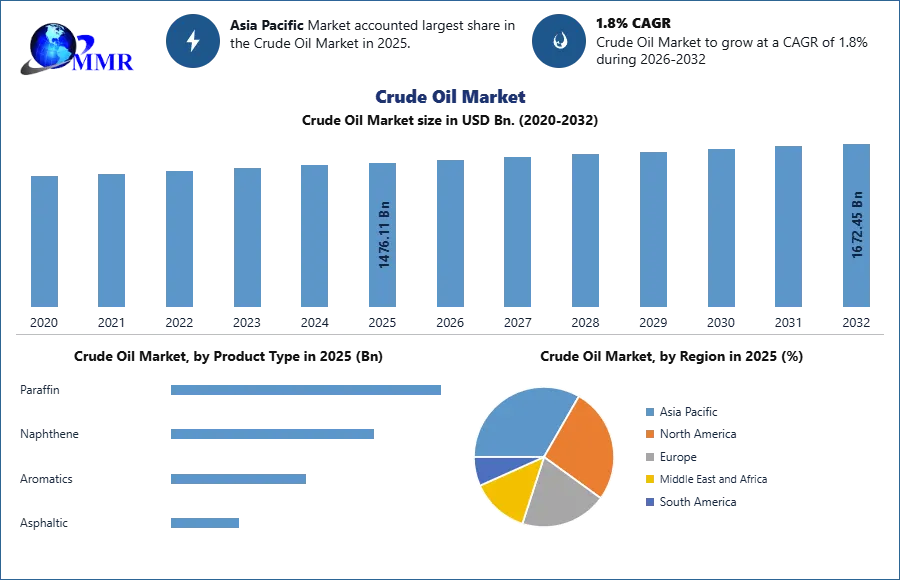
Global crude oil market valuation reached USD 1476.11 billion in 2025 and is forecasted to reach USD 1672.45 billion by 2032, maintaining a 1.8% compound annual growth rate.
The 2026 Middle East crisis triggered the most significant supply disruption in history, closing the Strait of Hormuz and cutting global oil flows by 8 to 10 million barrels per day.
Geopolitical risk drove Brent futures to a peak of $118 per barrel, widening the Brent-WTI spread to an extreme $25 per barrel.
International Energy Agency members authorized a massive 400-million-barrel emergency reserve release to counter supply imbalances and stabilize volatile pricing.
Digital oilfield investments and AI-driven predictive maintenance models are lowering upstream operating expenses by $2 per barrel.
The Asia Pacific region dominates global consumption and holdings, commanding 48% of the world’s known and identified oil reserves.
Why This Matters Now The de facto closure of the Strait of Hormuz in early 2026 has severed critical energy arteries, removing 8 to 10 million barrels per day from international trade flows. This unprecedented shock decoupled global crude pricing from soft underlying supply-demand fundamentals, forcing procurement leaders and industrial buyers to rewrite their risk playbooks. Chemical manufacturers face an immediate squeeze as Brent crude futures peaked at $118 per barrel, inflating raw material costs across the downstream value chain. Investors and boardroom executives must immediately adapt to an environment where a $25 per barrel Brent-WTI spread redraws regional competitive advantages overnight. Survival now hinges on structural agility, navigating massive emergency inventory releases, and deploying capital into cost-slashing extraction technologies.
Market Overview Crude Oil Market stands as the world’s first most traded product, representing 5.44% of total international trade in 2025. The global infrastructure reached an estimated valuation of USD 1476.11 billion in 2025, with expectations to grow to USD 1672.45 billion by 2032. This expansion represents a steady 1.8% CAGR over the forecast period, reflecting deep structural dependency across industrial sectors. However, physical constraints continue to define the market balance, as global crude oil supply rests at 0.0927 billion barrels per day, while global demand sits higher at 0.0981 billion barrels per day. This persistent baseline deficit exposes industrial consumers to immediate volatility when geopolitical blockades restrict physical flows. Although OPEC handles approximately 40% of global production and holds 75% of proven reserves, its long-term pricing power faces erosion as non-OPEC basins expand.
Key Trends Driving Growth A booming global transportation sector and rising manufacturing consumption represent the dual engines driving long-term volume growth. Urbanization and population dynamics are accelerating these baseline demands; the world population is projected to expand by 2 billion people, moving from 7.7 billion to 9.7 billion by 2050. For procurement planners, this demographic expansion translates directly into heightened consumption of public transport, private passenger vehicles, and household products. Downstream chemical consumption is surging concurrently, with escalating industrial requirements for agricultural fertilizers, protective pesticides, and consumer detergents. Plastics, synthetic rubber, and synthetic textiles remain completely dependent on stable petrochemical feedstocks, ensuring that rising consumer goods manufacturing directly expands upstream oil drilling. Furthermore, marine transport reliant on heavy bunker fuel and expanding commercial aviation networks demanding jet fuel ensure that crude demand remains resilient despite tightening environmental policies.
Segment Insights
Paraffin (Dominant Segment): Held the largest product market share at 43% in 2025. Extracted crude oils exhibit high wax contents of up to 32.5%, with paraffin wax consisting of 80% to 90% normal paraffin content. This high concentration dictates the melting points, boiling points, and solubility profiles of downstream materials, making it the primary, indispensable chemical block for commercial plastic and industrial lubricant manufacturing.
Transportation (Dominant & Fastest-Growing Segment): Captured a leading 34% application share in 2025. Rapidly expanding logistics networks and rising global vehicle sales are accelerating the consumption of refined products, including gasoline, diesel, kerosene, liquefied petroleum gas, and jet fuels. This segment drives immediate refinery utilization trends, dictating the broader operational economics of the entire oil and gas value chain.
Regional Growth Story The Asia Pacific region commanded the global landscape in 2025, securing 48% of the world’s known and identified oil reserves and leading international consumption. The regional market is projected to expand at a 1.9% CAGR through 2032, driven primarily by extensive subsea oil and gas exploration and aggressive capacity additions. Industrial giants China and India have established themselves as dominant consumption hubs, jointly accounting for nearly 17% of total global crude oil consumption in 2025. This immense consumption concentration leaves Asian manufacturing hubs highly exposed to maritime trade choke points, requiring massive import bills. In 2025, China led the world as the top importer with an outlay of USD 204 billion, followed by India at USD 92.7 billion, South Korea at USD 67.4 billion, and Japan at USD 64 billion.
North America is positioned for significant growth, with a projected CAGR of 1.93% during the forecast period. This growth is anchored by extensive infrastructure investments and the heavy presence of major corporate producers. The United States utilizes nearly 45% of its entire domestic oil requirement exclusively for producing gasoline, tethering its economic stability directly to domestic refining margins. On the export side, the region remains a major global supplier; the United States recorded USD 61.9 billion in crude exports in 2025, while Canada exported USD 67.8 billion, positioning North America as a vital counterweight to Middle Eastern supply disruptions.
Competitive Landscape The global market operates under a highly competitive structure dominated by state-owned corporations and multinational supermajors, including Saudi Aramco, Sinopec, ExxonMobil, Royal Dutch Shell, BP Plc, Rosneft, Kuwait Petroleum Corporation, ConocoPhillips, Hess, and Devon Energy. Operational scale, technological differentiation, and extraction efficiency serve as the primary sources of pricing power. As geopolitics fragment traditional trade routes, these leaders are aggressively shifting capital away from high-risk exploration toward technological extraction and brownfield efficiency. Corporate consolidation and asset reshaping are accelerating, with dominant players utilizing strategic mergers and joint ventures to secure low-cost basins. The widening Brent-WTI spread has granted temporary cost advantages to producers with direct access to inland North American crudes, altering international refining margins and shifting capital toward low-cost extraction fields.
Recent Developments
January 7, 2026 (Kpler Insight): Data confirmed global floating storage reached a three-year high of 123 million barrels due to structural supply imbalances. This substantial waterborne inventory was poised to anchor Brent prices in the low $60s before geopolitical events completely overrode physical indicators.
January 14, 2026 (OPEC+): The alliance formalized a pause in headline production increases through the first quarter of 2026 to counter seasonal oversupply. This coordinated supply constraint successfully stabilized initial inventory drawdowns and protected the delicate sweet-sour price differential.
February 18, 2025 (Reliance Industries Ltd): Initiated a massive USD 25 billion investment phase targeting domestic upstream exploration and production. This major capital commitment focuses on deepwater drilling and AI integration to minimize import dependency in India.
March 1, 2026 (U.S. Energy Information Administration): Released structural data forecasting a domestic production decline to 13.5 million barrels per day for 2026 due to natural depletion in mature basins like the Bakken. The data reflects a firm industry shift toward corporate capital discipline over unbridled volume growth.
March 10, 2026 (Saudi Aramco): Confirmed the full integration of advanced AI-driven reservoir modeling software across its primary production fields. This technological deployment optimizes extraction paths, lowering per-barrel lifting costs by $2 to maintain dominant margins in volatile pricing environments.
Strategic Implications The stark contrast between massive floating storage and sudden geopolitical blockades emphasizes that logistical resilience is now more critical than raw capacity. For chemical procurement officers, the $25 per barrel Brent-WTI spread completely shifts the economics of global sourcing, rendering North American ethane and naphtha options significantly more competitive than European or Asian alternatives. Companies that fail to diversify their feedstock import channels risk localized margin compression or sudden plant shutdowns. Upstream, the shift toward capital discipline noted by the EIA means that supply cushions will remain thin, keeping the market highly sensitive to minor disruptions. Technology has moved from an operational luxury to a core survival mechanism; operators deploying AI-driven reservoir modeling can effectively insulate their cash flows against depressed baseline pricing by reducing lifting costs.
Future Outlook Looking ahead, the global crude oil market will operate under a dual-track reality where long-term demographic demand growth clashes with near-term geopolitical fragmentation. Total market scale will inevitably march toward its USD 1672.45 billion forecast by 2032, but the path will be marked by intense localized pricing distortions. Supply chain regionalization will accelerate as buyers prioritize secure, non-OPEC trade flows to bypass volatile maritime pathways. The ultimate winners will be industrial operators who rapidly hedge their feedstock vulnerabilities through multi-regional sourcing contracts and upstream producers who aggressively implement cost-slashing digital oilfield solutions.
Analyst Perspective “The extreme volatility observed in 2026 proves that geopolitical risk has completely decoupled crude oil pricing from soft underlying supply-demand fundamentals,” states Ankita Kagawade, Lead Analyst at Maximize Market Research. “For chemical manufacturers and industrial buyers, navigating a historic supply disruption alongside a massive 400-million-barrel emergency reserve release requires a total abandonment of traditional procurement models. True competitive advantage now belongs exclusively to organizations that can dynamically recalibrate their supply chains around expanding non-OPEC outputs and leverage digital oilfield efficiencies to mitigate inflated raw material costs.”
About Maximize Market Research
Maximize Market Research Pvt. Ltd. (MMR) is a global market research and consulting company that provides reliable, data-focused, and practical business insights. The firm serves a wide range of industries, including healthcare, pharmaceuticals, technology, automotive, electronics, chemicals, personal care, and consumer goods. Through market forecasts, competitive analysis, strategic consulting, and industry impact assessments, MMR helps organizations understand changing market conditions, identify growth opportunities, and make informed business decisions for long-term success.
2nd Floor, Navale IT Park Phase 3
Pune Banglore Highway, Narhe
Pune, Maharashtra 411041, India
+91 9607365656
sales@maximizemarketresearch.com
