Key Highlights
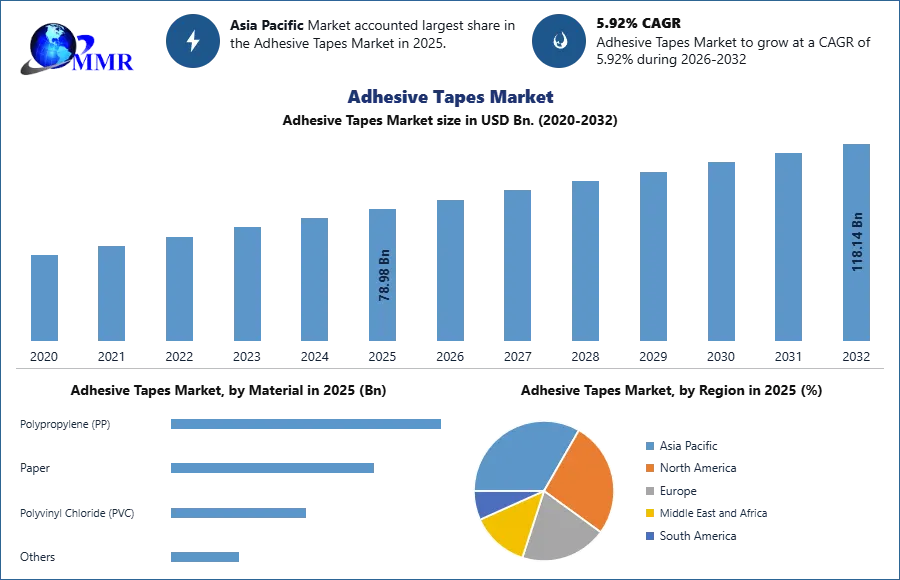
Market Expansion: Global valuation climbs from USD 78.98 Billion in 2025 to a projected USD 118.14 Billion by 2032, expanding at a steady 5.9% CAGR.
Engineering Disruption: Downstream automotive and construction engineers are replacing traditional rivets, screws, and bolts with high-strength structural adhesive tapes.
Feedstock Constraints: Production margins face severe pressure from supply limitations of critical tape raw materials, specifically piperylene and C9 monomers.
Circular Economy Pivot: The commercial launch of 70% post-consumer recycled PET backing tapes combined with waterborne acrylics establishes a new recyclability benchmark.
Regional Hegemony: The Asia Pacific region leads global demand, expanding at a rapid 9.1% CAGR driven by massive localized manufacturing relocations and vehicle assembly.
Why This Matters Now
Petroleum derivative price spikes and tightening regulatory restrictions on legacy chemical formulations are upending long-term margin projections for industrial tape manufacturers. As manufacturing engineers replace mechanical rivets with pressure-sensitive agents to lower vehicle and structural weights, chemical processors face an immediate, double-edged demand shift. The transition from commodity backings to post-consumer recycled substrates is forcing rapid capital reallocation across the sector.
Industrial buyers are migrating away from traditional mechanical fasteners to eliminate rust, reduce noise, and cut assembly time. This downstream engineering shift creates an urgent necessity for chemical producers to stabilize their supply lines amidst severe monomer shortages. Concurrently, strict international environmental frameworks are penalizing non-recyclable multi-material laminate waste. Companies that fail to integrate waterborne acrylics and post-consumer recycled (PCR) substrates risk losing access to high-margin automotive and logistics contracts.
Market Overview
The global Adhesive tapes market Size reached a valuation of USD 78.98 Billion in 2025. Driven by escalating industrial integration, total sector revenue is expected to grow at a CAGR of 5.9% from 2026 to 2032, ultimately reaching nearly USD 118.14 Billion. This capital appreciation is directly tied to expanding production volumes in downstream industrial sectors that require flexible joining materials. Any flexible base material, including textiles, paper, or polymer sheets, can undergo conversion into tape using pressure-sensitive bonding agents designed for rapid or repositionable adhesion.
The industry is navigating an aggressive input-cost environment driven by volatile crude oil valuations and capacity limitations in core chemical resin supply lines. Shortages in essential C9 monomers and piperylene fractions have restricted raw material availability, driving up production costs for base adhesives. Furthermore, elevated global energy prices have inflated processing overheads. This requires tape manufacturers to optimize their capacity utilization and adjust finished-product pricing to protect operating margins.
Key Trends Driving Growth
The structural replacement of traditional mechanical fasteners represents a major commercial catalyst for the market. Engineers are substituting screws, rivets, nuts, and bolts with high-performance adhesive films to distribute tensile stress evenly across disparate surfaces, preventing material cracking under high pressure. This engineering shift improves product durability, minimizes assembly line cycle times, and lowers overall manufacturing costs.
The rapid adoption of recycled polyethylene terephthalate (PET) packaging solutions is also reshaping production requirements. Industrial buyers are shifting toward recycled PET backing materials that match the tensile strength and performance of traditional polyvinyl chloride (PVC) and biaxially oriented polypropylene (BOPP) alternatives. These sustainable variants utilize waterborne acrylic adhesive technologies that permit complete disposal into standard paper recycling streams along with cardboard containers without disrupting pulp processing.
Segment Insights
Dominant & Fastest-Growing Segment: The automotive industry constitutes the highest-growth vector, projected to expand at a CAGR of 7.8% over the forecast period. Modern vehicles incorporate between 800,000 and 900,000 square meters of adhesive tapes across the global industry to bundle and secure 2 to 5 kilometers of internal wiring per vehicle. A single newly manufactured automobile integrates up to 50 individual adhesive tapes to isolate production gaps, secure interior trim components, hold seating assemblies, and mask body panels during high-temperature paint cycles.
Building & Construction Segment: This segment is projected to grow at a CAGR of 7.1% through 2032. Constructive bonding films have become structural components in modern architectural design, securing elevator panels, window assemblies, glass partitions, solar infrastructure components, and commercial skyscraper facades. These applications require high-durability formulations capable of enduring extreme thermal expansion and mechanical stress while speeding up construction schedules.
Regional Growth Story
The Asia Pacific adhesive tapes market occupies the dominant global position and is projected to deliver the fastest growth at a CAGR of 9.1% through the forecast period. This regional expansion is sustained by heavy industrial capital investments in automotive manufacturing, commercial building construction, and electronics assembly across China, India, and South Korea. Furthermore, a surge in regional manufacturing plant construction is driven by lower localized production costs and proximity to expanding consumer markets. The region is also experiencing elevated consumption of medical-grade adhesive bandages, first-aid items, and traditional wound care dressings as public health awareness improves.
In Western economies, including the United States and Germany, market activity is characterized by strict adherence to changing chemical safety legislations. Small and medium enterprises (SMEs) in these regions are allocating capital to build specialized regulatory compliance teams to manage shifting bans on specific chemical additives, while major chemical conglomerates leverage dedicated divisions to pivot toward bio-based resin alternatives.
Competitive Landscape
The global marketplace is defined by a high concentration of market share among established suppliers operating alongside specialized regional processors. Key industry participants include ABI Tape, Adchem, ADH Tape, and Adhesives Research. The competitive environment is shifting from generic commodity volume production toward proprietary specialty chemical formulations. Top-tier manufacturers are actively investing in waterborne adhesive technologies and specialized cleanroom manufacturing lines to serve the stringent validation needs of the medical device and automotive electronics sectors.
To offset the volatility of petroleum-derived feedstocks, market leaders are utilizing strategic joint ventures and localized supply partnerships to lock in key monomer allocations. Small and medium-scale producers are facing intense margin compression due to their limited bargaining power in raw material procurement, accelerating consolidation trends across the sector.
Recent Developments
Tesa introduced the 60412 recycled PET packaging tape, featuring a backing material composed of 70% post-consumer recycled plastic coupled with a waterborne acrylic adhesive matrix.
Industrial manufacturing transitions have validated the complete pulp-recyclability of modern acrylic-based tapes under the INGEDE certification framework, allowing co-disposal with paper waste.
Chemical supply chain constraints have intensified for C9 monomers and piperylene fractions, prompting producers to redesign formulations around alternative hydrocarbon resins.
Strategic Implications
The chemical industry’s pivot toward circular economy inputs signals a long-term restructuring of base resin purchasing agreements. Producers who rely entirely on legacy solvent-based formulations face imminent compliance pressures as international environmental restrictions tighten around volatile organic compound (VOC) emissions. Investment in waterborne acrylic chemistry and automated hot-melt production lines is no longer optional; it is a baseline requirement for supplier retention in the automotive and electronics verticals.
Procurement organizations must actively diversify their raw material sourcing to mitigate localized supply disruptions of critical monomers. The integration of structural adhesive tapes into downstream automated assembly lines means that any batch-to-batch performance variation can stall high-speed industrial production lines, raising the financial penalties associated with product defects.
Future Outlook
The global adhesive tapes market will increasingly divide along technological capabilities, with commoditized packing films facing intense price competition while high-performance structural bonding layers command premium margins. Success will depend on engineering reliable, bio-derived pressure-sensitive agents that can match petroleum performance metrics under extreme industrial loads.
Manufacturers who invest heavily in backward integration or secure proprietary contracts for post-consumer recycled plastics will effectively insulate themselves from Middle East crude fluctuations, positioning their operations to capture the highest-margin contracts in the automotive and aerospace assembly sectors while non-integrated legacy asset owners face progressive obsolescence.
Analyst Perspective
“The structural substitution of mechanical rivets with pressure-sensitive adhesive tapes in automotive and aerospace design is no longer a niche engineering trend; it is a primary driver of volume growth for advanced resin formulations. However, the true differentiator over the next decade will be supply chain resilience in the face of volatile C9 and piperylene monomer feedstocks. Chemical manufacturers that successfully commercialize drop-in bio-based alternatives or high-tensile PCR backings will capture premium industrial accounts, while non-compliant commodity producers will face severe margin erosion from rising regulatory penalties.”— Yash Ghosalkar, Lead Analyst, Maximize Market Research
About Maximize Market Research
Maximize Market Research Pvt. Ltd. (MMR) is a global market research and consulting company that provides reliable, data-focused, and practical business insights. The firm serves a wide range of industries, including healthcare, pharmaceuticals, technology, automotive, electronics, chemicals, personal care, and consumer goods. Through market forecasts, competitive analysis, strategic consulting, and industry impact assessments, MMR helps organizations understand changing market conditions, identify growth opportunities, and make informed business decisions for long-term success.
2nd Floor, Navale IT Park Phase 3
Pune Banglore Highway, Narhe
Pune, Maharashtra 411041, India
+91 9607365656
sales@maximizemarketresearch.com
