Key Highlights
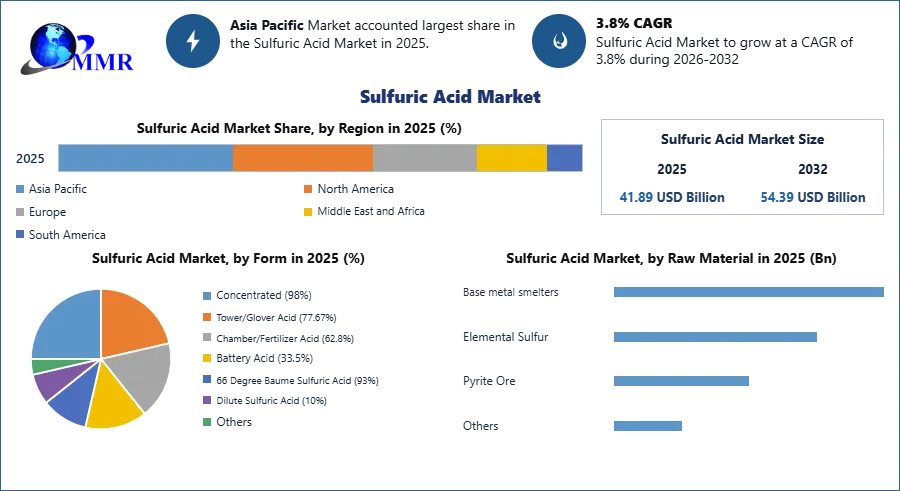
The global sulfuric acid market reached a valuation of USD 41.89 billion in 2025 and is projected to scale to USD 54.39 billion by 2032, exhibiting a stable 3.8% CAGR.
More than 55% of total global sulfuric acid output is consumed directly by the phosphoric acid manufacturing segment to feed downstream phosphate fertilizer production.
Elemental sulfur feedstock prices experienced severe fluctuations of 20% to 30% in 2024–25, pressuring margins for fertilizer producers and chemical manufacturers.
The global regulatory push has triggered a rapid technology migration toward Double Contact Double Absorption units, which deliver a 99.8% conversion efficiency.
Modern DCDA installations reduce sulfur dioxide emissions by more than 85% while generating substantial industrial steam for integrated facility operations.
China and India dominate global volumes, combining to consume more than 65 million tonnes of sulfuric acid annually for agricultural and industrial processing.
Why This Matters Now Volatile pricing and strict environmental mandates are forcing chemical manufacturers, procurement leaders, and industrial buyers to re-engineer their sulfuric acid supply chains. Elemental sulfur feedstocks—dependent on oil refining sectors for 70% of total supply—fluctuated by 20% to 30% in 2024–25, instantly destabilizing contract margins across the globe. Concurrently, environmental regulations are phasing out aging production systems, mandating massive capital allocations toward high-efficiency Double Contact Double Absorption technology. Industrial procurement teams are facing tight regional supply pockets exacerbated by base metal smelter shutdowns across Chile, the United States, and Canada. For boardroom executives and investors, mitigating these upstream shocks requires immediate geographic diversification and rapid technical adaptation to avoid localized feedstock starvation.
Market Overview The global Sulfuric Acid Market represents one of the most volume-intensive sectors within the chemical and material industries, recording a valuation of USD 41.89 billion in 2025. Driven by an intensifying agricultural matrix and expanding metallurgical operations, the market is on track to hit USD 54.39 billion by 2032, growing at a 3.8% CAGR. As an elite industrial chemical, its systemic consumption tracks closely with macroeconomic manufacturing health. At present, the structural stability of the market is tested by a geographical disconnect between primary elemental sulfur producers and high-demand refining centers. While refining industries supply the vast majority of sulfur feedstock through hydrodesulfurization, maintenance cycles and changing oil outputs cause sudden availability drops, reshaping trade flows and pricing trends across international boundaries.
Key Trends Driving Growth The primary growth engine for the market is the unyielding global demand for phosphoric acid, which acts as the base for essential phosphate fertilizers such as DAP, MAP, SSP, and TSP. As the global population trends toward 9.7 billion by 2050, agricultural intensification is expanding fertilizer applications across developing nations. This trend is heavily reinforced by state level interventions, including India’s Nutrient-Based Subsidy policy and China’s strategic mandate for complete domestic fertilizer self-reliance. Beyond agriculture, the rapid expansion of electric vehicle manufacturing is driving consumption of high-purity battery acid electrolytes. Industrial applications across wastewater treatment, crop protection chemicals, pigments, and detergents are expanding simultaneously, cementing sulfuric acid’s role as an indispensable raw material within global chemical supply chains.
Segment Insights
Elemental Sulfur (Dominant Raw Material Segment): Dominated the market landscape in 2025. This raw material benefits from the expanding global refining sector, where sulfur is recovered cleanly via hydrodesulfurization. Converting elemental sulfur provides distinct purity and cost advantages over processing base metal smelter by-products or roasting pyrite ore, allowing operators to run DCDA lines with lower baseline emissions and superior operational control.
Concentrated 98% Acid (Dominant Form Segment): Expected to dominate the sulfuric acid market through 2032. This chemical grade is the indispensable concentration required for mass-scale phosphoric acid production, petroleum refining, chemical synthesis, and mining leach processes. Its high purity profile ensures consistent downstream performance, making it the primary commercial target for major DCDA installations worldwide.
Regional Growth Story The Asia Pacific region dominated the global sulfuric acid market in 2025 and is positioned to maintain its leading stance through the forecast period. The region’s command is anchored by immense agricultural requirements, with China and India utilizing over 55% of regional output exclusively for fertilizer acid manufacturing. China’s domestic chemical infrastructure produces nearly 90 to 95 million tonnes of sulfuric acid annually, while India’s domestic output exceeds 20 million tonnes. This volume is supported by extensive refinery networks and rapid installations of integrated DCDA facilities. The region is further bolstered by accelerating industrial mining and smelter expansions across ASEAN nations, where low-cost feedstock availability and government backstops drive continuous manufacturing investments.
In parallel, major global fertilizer import and export trade structures are reshaping regional demand footprints. Brazil remains the world’s largest individual fertilizer importer due to its vast agricultural acreage, drawing in substantial derivative acid demand, followed closely by India and the United States. On the supply side, Russia continues to dominate international fertilizer exports through large production capacity and aggressive pricing, with China, Canada, Morocco, and Saudi Arabia serving as vital structural suppliers. This global trade web heavily influences where sulfuric acid capacity additions are deployed, with massive production complexes expanding rapidly across Morocco, Saudi Arabia, and Indonesia to locate acid production next to primary phosphate ore mines.
Competitive Landscape The global competitive ecosystem is characterized by a mix of specialized chemical producers, major mining conglomerates, and national agricultural agencies. Key market leaders driving capacity and technological direction include OCP Group, Ma’aden, DuPont Clean Technologies, BASF SE, Chemtrade Logistics, and various local state enterprises. Pricing power in this commodity market is tightly bound to feedstock integration and energy recovery efficiency. Top-tier operators are actively investing in large-scale, automated contact facilities to capture co-generated industrial steam, which is then re-routed to power adjacent manufacturing blocks. Strategic focus is shifting rapidly away from standalone chemical processing toward fully integrated agricultural and metallurgical complexes, maximizing margin retention amid volatile elemental sulfur import costs.
Recent Developments
Feedstock Volatility (2024–25): Elemental sulfur prices fluctuated by 20% to 30% globally, driven by oil refinery maintenance turnarounds and altered crude oil production runs, causing immediate margin pressure for non-integrated chemical producers in India and Brazil.
Smelter Supply Tightening (2025): Multiple base metal smelter shutdowns across Chile, the United States, and Canada restricted the availability of by-product sulfuric acid, forcing regional industrial consumers to seek higher-cost elemental sulfur alternatives.
DCDA Technical Migration (2025–26): Global equipment producers reported a rapid, wholesale shift toward double contact double absorption plant architecture to achieve a 99.8% gas conversion efficiency and satisfy tightening regional emissions ceilings.
Morocco and Saudi Arabia Expansions (2025): OCP and Ma’aden initiated major localized infrastructure expansions, building world-scale DCDA units directly at extraction sites to optimize the processing of indigenous phosphate ores.
Technology Integrations (2026): Leading producers integrated advanced gas cleaning systems and waste-heat recovery mechanisms into existing lines, converting environmental compliance expenses into a source of low-cost industrial steam generation.
Strategic Implications For chemical procurement leaders and industrial buyers, the lesson of recent feedstock volatility is clear: security of supply can no longer be assumed. Pure commodity chemical buyers are highly vulnerable to the 20% to 30% price spikes seen in elemental sulfur; they must evaluate shifting toward long-term indexed contracts or sourcing from integrated producers. Furthermore, as copper and base metal smelters close or face operational restrictions in the Americas, regional consumers must brace for structural increases in logistical and freight costs. Embracing a circular approach by recovering spent acid from petroleum refining or battery recycling lines is shifting from a green initiative to an economic necessity. Companies operating older, inefficient contact plants face regulatory obsolescence if they fail to fund upgrades to modern DCDA or hybrid wet-process architectures.
Future Outlook The global sulfuric acid market will increasingly split into two distinct operational classes: high-efficiency integrated complexes and vulnerable standalone processors. Total market size will steadily climb toward the USD 54.39 billion mark by 2032, but localized profitability will depend entirely on how well producers manage their energy balances and sulfur supply chains. The rapid industrialization of developing economies will ensure that the Asia Pacific, Middle East, and North African corridors capture the vast majority of new capacity additions. The ultimate winners in this landscape will be operators who build co-generation DCDA plants next to secure refinery feeds, effectively transforming an environmental compliance reality into an unassailable cost advantage.
Analyst Perspective “We are witnessing a structural decoupling of the sulfuric acid market based on technological sophistication and feedstock access,” says Ankita Kagawade, Lead Analyst at Maximize Market Research. “With elemental sulfur prices fluctuating wildly by up to 30%, non-integrated chemical manufacturers can no longer rely on spot-market procurement. Surviving the next decade requires an immediate pivot toward double contact double absorption technology, which not only satisfies strict regional emission laws but also insulates the plant’s bottom line by generating valuable industrial steam. The future belongs to integrated chemical hubs that view acid production as both an environmental stewardship mandate and an energy-efficiency play.”
About Maximize Market Research
Maximize Market Research Pvt. Ltd. (MMR) is a global market research and consulting company that provides reliable, data-focused, and practical business insights. The firm serves a wide range of industries, including healthcare, pharmaceuticals, technology, automotive, electronics, chemicals, personal care, and consumer goods. Through market forecasts, competitive analysis, strategic consulting, and industry impact assessments, MMR helps organizations understand changing market conditions, identify growth opportunities, and make informed business decisions for long-term success.
2nd Floor, Navale IT Park Phase 3
Pune Banglore Highway, Narhe
Pune, Maharashtra 411041, India
+91 9607365656
sales@maximizemarketresearch.com
