Key Highlights
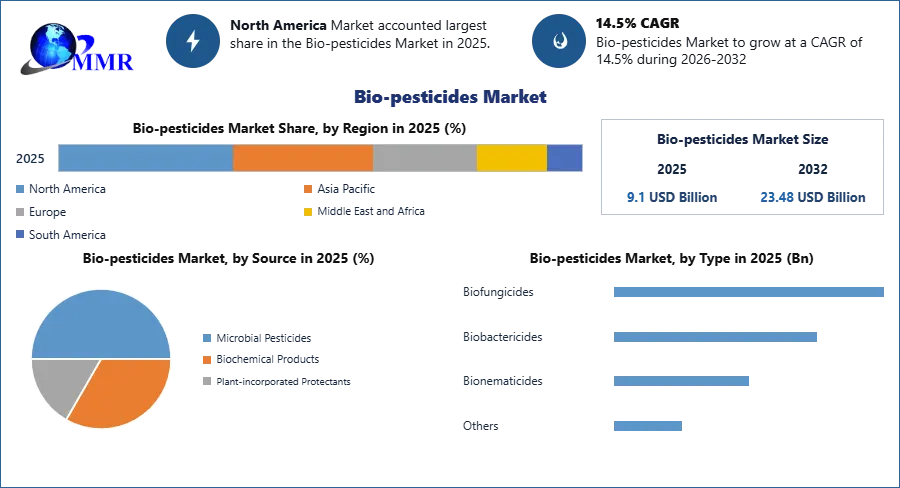
Market valuation expands from USD 9.1 billion in 2025 to nearly USD 23.48 billion by 2032, registering a compound annual growth rate of 14.5 percent.
Microbial pesticides represent the largest technology base, capturing 45.5 percent of global market share due to precise, target-specific organism control.
Liquid formulations dominate structural demand and fuel faster growth because they are highly compatible with commercial mechanized spraying assets.
Regional regulatory prohibitions, notably Europe’s complete ban on neonicotinoid active ingredients, are removing synthetic chemistries from distribution networks.
Elevated asset development costs and long regulatory timelines for new synthetic molecules are driving start-up capital toward biological product research pipelines.
Why This Matters Now Agrochemical manufacturers and agricultural capital allocators face immediate revenue erosion as international environmental agencies aggressively withdraw licenses for foundational chemical active ingredients. The sudden removal of established synthetic chemicals like neonicotinoids across European agricultural supply chains has disrupted corporate chemical portfolios, exposing companies with single-chemistry exposures to significant regulatory risks. Agrochemical procurement teams must re-engineer their inputs immediately to avoid sudden supply gaps as field-level resistance reduces the effectiveness of traditional chemical treatments.
The commercial equation for global crop protection has reached an inflection point. Developing a completely new synthetic molecule now involves high capital costs and multi-year registration delays, which lowers the return on capital for synthetic R&D. Biological crop controls offer cheaper development timelines and faster registration pathways, prompting major chemical groups to reallocate capital into biological infrastructure to secure corporate margins and retain market access.
Market Overview The global Bio-Pesticides Market reached a valuation of USD 9.1 billion in 2025, reflecting a baseline expansion driven by escalating demand for low-residue specialty crop protection. Industry data indicates total market value will reach USD 23.48 billion by 2032, growing at a compound annual growth rate of 14.5 percent over the forecast period. This capital migration represents a profound shift in industrial agriculture as major chemical firms integrate biological fermentation and extraction capabilities directly into their core distribution lines.
This market operates where tightening food chain safety margins and intensive broad-acre crop production intersect. The biological market includes microbial products, biochemical formulations, and plant-incorporated protectants, each engineered to degrade naturally without leaving toxic synthetic residuals in the soil or harvested crops. This fast-changing landscape attracts significant corporate investment from major chemical companies looking to purchase specialized biological patent portfolios and secure access to high-margin global produce trade routes.
Key Trends Driving Growth A major structural force driving market expansion is the rise of biological pest resistance to standard synthetic chemical molecules. Decades of continuous application have triggered widespread field-level mutations, rendering entire classes of commodity chemical pesticides ineffective and forcing growers to seek multi-mechanism biological alternative combinations. Incorporating biological strains provides multi-site modes of action, which directly prevents target pests from developing resistance and extends the commercial life of existing chemical portfolios.
Simultaneously, the commercial sector is responding to strict zero-residue supply chain targets enforced by international fresh produce retailers. Food retailers increasingly reject entire shipments of grains, fruits, and vegetables that show trace amounts of traditional chemical residues, putting the financial risk back onto regional farming groups and distribution handlers. Consequently, agricultural producers are adjusting their late-season application calendars, replacing traditional synthetic inputs with fast-degrading biological formulations to ensure compliance with export markets.
Segment Insights
Microbial Pesticides (Dominant Segment): This technology group captured 45.5 percent of the total market share in 2025, driven by the low production cost and low toxicity profiles of bacterial and fungal strains. These specialized formulations, including both Bacillus thuringiensis (Bt) and non-Bt products, deliver precise, pathogen-specific control that protects non-target beneficial organisms.
Liquid Formulations (Fastest-Growing Segment): Liquid biopesticide delivery mechanisms are expanding rapidly due to their simple handling characteristics, uniform plant canopy coverage, and seamless integration with existing industrial mechanical sprayers. This operational flexibility allows commercial farming outfits to deploy biological treatments without investing in specialized, non-standard application equipment.
Regional Growth Story North America led the global industry in 2025, holding a dominant 45 percent market share due to its massive broad-acre farming regions and large corporate investments in biological input distribution networks. The regional market benefits from automated registration processes for biological entities, which allows ag-tech innovators to commercialize new products faster than in heavily bureaucratic jurisdictions. This established operational base serves as the main testbed for large-scale biological deployment on high-value cash crops.
Conversely, the Asia-Pacific region is projected to expand at the fastest pace through 2032, driven by intensive cultivation of staple grains, cereals, and export-oriented fruits across China and India. The regional expansion is fueled by rising domestic food demand from growing populations, combined with tightening national export rules aimed at lowering synthetic chemical levels in outgoing food shipments. While developing territories in Africa and Southeast Asia offer substantial long-term growth potential, they currently face market uncertainties due to limited rural cold-chain infrastructure and inconsistent local application rates.
Competitive Landscape The competitive structure of the bio-pesticides market is consolidating rapidly as Tier-1 multinational chemical groups systematically acquire independent biological specialists. Industry leaders like BASF SE, Bayer AG, Syngenta Group, and Corteva Agriscience are actively deploying their substantial balance sheets to buy out niche fermentation developers and natural extract innovators. These strategic acquisitions allow global conglomerates to bundle biological products with traditional chemical portfolios, strengthening their pricing power and securing early access to vital raw material supply chains.
To protect chemical margins against cheaper generic imports, major producers are investing heavily in advanced formulation technologies to extend the shelf life of biological strains. Traditional biological formulations often suffer from rapid breakdown when exposed to ambient ultraviolet light or standard warehouse storage temperatures. Leading companies are using advanced micro-encapsulation methods to keep microbial spores dormant until field application, creating a technical barrier that limits competition from underfunded, non-integrated regional manufacturers.
Recent Developments
Global chemical manufacturers are expanding specialized biological research laboratories to accelerate the screening of novel soil microbes and plant-derived compounds.
Leading agrochemical suppliers are partnering with global agricultural drone developers to optimize field delivery, ensuring uniform application of liquid biological formulations over large canopy areas.
Agrochemical distributors are upgrading regional warehouse assets with temperature-controlled infrastructure to handle the distinct logistics requirements of live microbial inputs.
Strategic Implications For corporate chemical directors and ag-tech investment committees, investing in biological production assets provides a vital hedge against changing environmental compliance rules. Organizations that continue to focus exclusively on legacy synthetic chemistries face sudden revenue declines as international regulatory bodies withdraw chemical registrations. Building up biological production capacity ensures corporate supply chains remain operational when local authorities impose immediate bans on traditional chemical options.
Additionally, adopting biological product structures changes how firms manage their downstream customer relationships. By supplying reliable biological alternatives that prevent chemical buildup on premium export crops, chemical companies become essential partners for commercial farming enterprises aiming for high-margin global trade routes. This deeper integration into the food value chain strengthens customer retention and insulates crop protection providers from cyclical commodity chemical price swings.
Future Outlook The ultimate market split between biological and synthetic crop protection will depend on reducing processing costs and optimizing large-scale industrial fermentation infrastructure. As regional regulatory agencies continue to reduce allowable chemical residue limits on imported food commodities, the long-term success of ag-input manufacturers will rely on their ability to supply stable biological formulations that match the field performance of legacy synthetic chemistries. Companies that successfully combine advanced stabilization technology with global distribution logistics will lead the transition as biological inputs catch up with traditional chemical volumes over the next decade.
Analyst Perspective “The transition away from highly restricted synthetic crop protection molecules is reshaping capital allocation across the global agrochemical sector,” stated Ankita Kagawade, Analyst at Maximize Market Research. “Agrochemical firms can no longer view biological formulations as a minor niche addition, but must treat them as a core baseline technology required to maintain market access and ensure long-term corporate viability.”
About Maximize Market Research
Maximize Market Research Pvt. Ltd. (MMR) is a global market research and consulting company that provides reliable, data-focused, and practical business insights. The firm serves a wide range of industries, including healthcare, pharmaceuticals, technology, automotive, electronics, chemicals, personal care, and consumer goods. Through market forecasts, competitive analysis, strategic consulting, and industry impact assessments, MMR helps organizations understand changing market conditions, identify growth opportunities, and make informed business decisions for long-term success.
2nd Floor, Navale IT Park Phase 3
Pune Banglore Highway, Narhe
Pune, Maharashtra 411041, India
+91 9607365656
sales@maximizemarketresearch.com
