Key Highlights
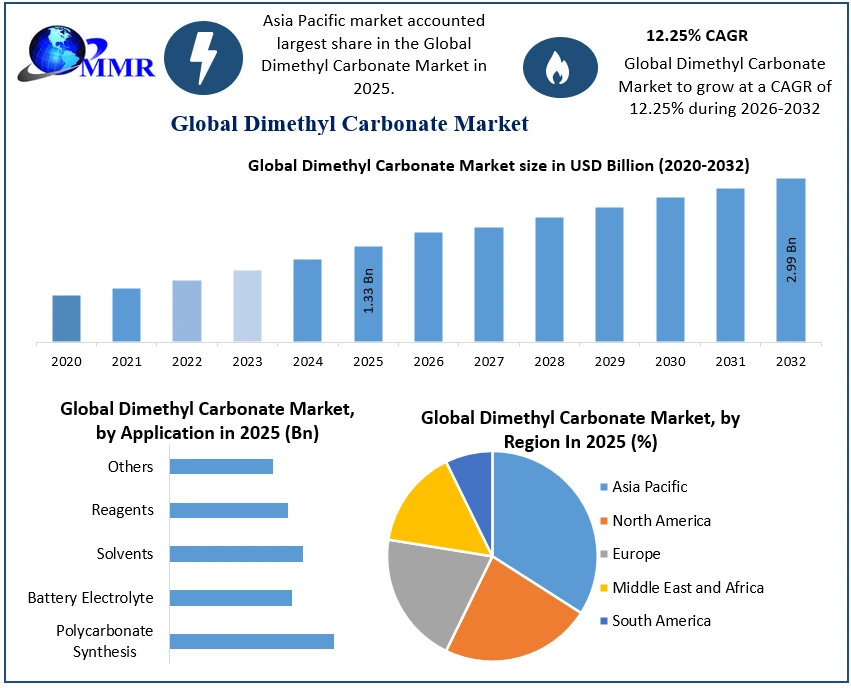
The global dimethyl carbonate market size reached USD 1.33 billion in 2025 and is projected to expand significantly down to the end of the forecast cycle.
Market revenue is growing at a compound annual growth rate of 12.5 percent over the 2026 to 2032 forecast period, reaching nearly USD 2.99 billion by 2032.
The battery grade product segment maintains absolute structural dominance, driven by high-purity requirements exceeding 99.9 percent by weight.
The battery electrolyte sector stands as the dominant application segment, outstripping alternative industrial use cases in 2025.
The Asia-Pacific region commands the global landscape, securing a 57.74 percent market share in 2025 due to dense downstream converting assets.
Why This Matters Now
Industrial battery manufacturing plants and engineering polymer procurement teams face immediate operational shifts as global energy storage specifications mandate ultra-high purity chemical inputs. The historical practice of synthesizing materials using dangerous or highly regulated halogenated substances is facing severe enforcement actions from international labor and environmental bodies, forcing chemical companies to pivot. Chemical manufacturers must transition directly to dimethyl carbonate platforms immediately to guarantee access to high-growth automotive component chains and maintain regulatory compliance in export-oriented markets.
The baseline calculation for global automotive supply risk has fundamentally altered. Chemical procurement leaders can no longer view green carbonate esters as luxury additives or secondary formulation choices. Rising safety mandates for high-capacity energy storage systems, alongside tightening volatile organic compound thresholds across international jurisdictions, demand the immediate integration of dimethyl carbonate into core industrial lines to avoid sudden market exclusion.
Market Overview
The global Dimethyl Carbonate Market reached a valuation of USD 1.33 billion in 2025, demonstrating substantial expansion driven by the widespread utilization of non-toxic chemical intermediates. Official market intelligence indicates that total market revenue is growing at a compound annual growth rate of 12.5 percent from 2026 to 2032, reaching an estimated USD 2.99 billion by 2032. This rapid capital deployment represents a significant reorganization within industrial processing, as major electronics companies and structural polymer groups integrate high-purity carbonate streams directly into their operations.
This organic market operates at the center of the transition toward green chemistry and robust energy storage networks. Dimethyl carbonate, a transparent, colorless, and flammable organic compound grouped as a carbonate ester, functions as an eco-friendly alternative in industrial assembly because its breakdown does not yield hazardous phenols or strong acids. Industrial manufacturing plants deploy this compound as a building block and selective carrier across polycarbonate synthesis, battery electrolytes, solvents, reagents, and oxygenated fuel additives.
Key Trends Driving Growth
A major trend driving the dimethyl carbonate industry is the surging global demand for lithium-ion battery pack configurations within the electric vehicle sector. High-purity battery grade variants are vital for formulating electrolytes that optimize ion transport, ensuring efficient power delivery and superior thermal stability during heavy discharge phases. This requirement is reinforced by the expansion of large-scale renewable energy storage assets, such as wind and solar farms, which require durable battery materials to extend service lifetimes.
Concurrently, the architectural paints and industrial coatings industry is adopting dimethyl carbonate to manufacture low-emissions, water-based organic coatings. Because the compound was exempted from strict volatile organic compound regulations in the United States, manufacturers are using its unique solvent properties to replace traditional ketones and glycol ethers. This formulation adjustment helps corporate users meet regional air quality goals without diminishing coating drying times or reducing adhesion strength on metal substrates.
Segment Insights
Battery Grade (Dominant Grade Segment): This ultra-high purity variant, specified at greater than 99.9 percent by weight, dominated the market in 2025 due to strict electronics and electric vehicle specifications. Operating as a baseline requirement for battery cells, battery-grade material ensures low moisture and minimal metallic contamination, positioning it ahead of commodity industrial grades.
Battery Electrolyte (Dominant Application Segment): This advanced chemical blending segment captured the highest share of market utilization in 2025, driven by the expanding consumer electronics and portable device markets. The widespread use of smartphones, laptops, and tablet computers creates massive, continuous demand for stable electrolyte fluids capable of supporting high energy density and preventing early cell degradation.
Polycarbonate Synthesis (Fastest-Growing Segment): The demand for dimethyl carbonate as a non-phosgene intermediate in polycarbonate plastics production is expanding at a rapid pace due to heavy automotive and construction investments. This rapid adoption is driven by the global demand for impact-resistant, optically clear polymers used extensively in automotive light housings, digital display screens, and architectural glazing.
Regional Growth Story
The Asia-Pacific region dominated the global dimethyl carbonate market in 2025, capturing a commanding 57.74 percent revenue share, supported by dense conversion assets and manufacturing centers. Regional demand is projected to expand at the highest compound annual growth rate of 5.38 percent during the forecast period, driven by large-scale polycarbonate projects in China, Japan, South Korea, Thailand, Taiwan, Singapore, and Malaysia. The dense concentration of major lithium-ion battery gigafactories in the region guarantees a massive, domestic market for high-grade chemical intermediate supplies.
North America held a 19.71 percent share of the global market in 2025 and is projected to expand at a moderate 3.30 percent compound annual growth rate over the forecast horizon. This growth is directly linked to extensive public infrastructure upgrade programs and the revival of regional automotive assembly plants. The United States acts as a primary beneficiary within the North American zone, driven by the massive consumption of high-purity solvents across its pharmaceutical manufacturing networks.
Competitive Landscape
The competitive matrix of the global dimethyl carbonate market features a mix of Tier I international chemical companies and specialized battery material developers. Key market participants include Ube Industries Limited, Merck KGaA, Kowa American Corporation, Kishida Chemical Co. Limited, Shandong Shida Shenghua Chemical Group Co. Limited, Guangzhou Tinci Materials Technology Co. Limited, Shandong Haike Chemical Group, Arrow Chemical Group Corporation, Panax Etec, and Henan GP Chemicals Co. These major Tier I and Tier II vendors leverage integrated production lines to manage fluctuating raw material inputs and maintain consistent output quality.
To safeguard market share, leading suppliers are deploying capital toward high-purity distillation networks to meet the strict quality standards of the battery industry. Companies are forming tight supply agreements with major automotive cell manufacturers, ensuring long-term off-take volumes and insulating operations from spot market price swings. These technical capabilities create high barriers to entry, preventing smaller commodity chemical processors from easily matching the extreme purity levels required for battery electronics.
Recent Developments
Advanced chemical manufacturers are deploying dedicated purification infrastructure to upgrade standard industrial grade assets into premium battery grade lines.
Engineering research groups are evaluating the performance of dimethyl carbonate as an alternate oxygenated fuel additive for diesel and gasoline mixtures. If accepted globally, this application is expected to create lucrative growth opportunities for the dimethyl carbonate market over the forecast period.
International logistics firms are investing in specialized stainless steel transport fleets to preserve the purity of battery grade shipments during long-distance maritime trade flows.
Strategic Implications
For battery procurement directors and chemical operations managers, incorporating high-purity dimethyl carbonate serves as an essential hedge against tightening chemical handling rules. Production facilities that shift away from processes involving hazardous phosgene gas insulate their capital investments from sudden regulatory closures. This proactive transition helps retain access to global supply chains while improving workplace safety metrics.
Additionally, using dimethyl carbonate as an alternative raw material for polymer synthesis opens up secondary commercial options for engineering plastics groups. Companies can market their finished polycarbonates as sustainable materials because the production loop eliminates the formation of hazardous acids and waste phenols. This product differentiation enables manufacturers to command higher margins in competitive consumer electronics and automotive styling segments.
Future Outlook
The future expansion of dimethyl carbonate manufacturing facilities will depend on optimizing advanced transesterification pathways to minimize energy and capital inputs. As global supply chains face scrutiny regarding carbon footprints, the long-term success of market participants will rely on securing reliable access to feedstock molecules like ethylene carbonate or propylene carbonate. Engineering organizations that combine high-efficiency distillation setups with automated quality control systems will establish the benchmark for the next generation of industrial green solvent supply chains.
Analyst Perspective
“The transition toward ultra-high purity chemical components is a structural reality across modern energy storage and advanced material manufacturing,” stated Ankita Kagawade, Analyst at Maximize Market Research. “Industrial producers and chemical distributors must move beyond standard grade blending and invest directly in advanced purification technologies to secure high-value positions in the expanding electric vehicle battery ecosystem.”
About Maximize Market Research
Maximize Market Research Pvt. Ltd. (MMR) is a global market research and consulting company that provides reliable, data-focused, and practical business insights. The firm serves a wide range of industries, including healthcare, pharmaceuticals, technology, automotive, electronics, chemicals, personal care, and consumer goods. Through market forecasts, competitive analysis, strategic consulting, and industry impact assessments, MMR helps organizations understand changing market conditions, identify growth opportunities, and make informed business decisions for long-term success.
2nd Floor, Navale IT Park Phase 3
Pune Banglore Highway, Narhe
Pune, Maharashtra 411041, India
+91 9607365656
sales@maximizemarketresearch.com
