Key Highlights
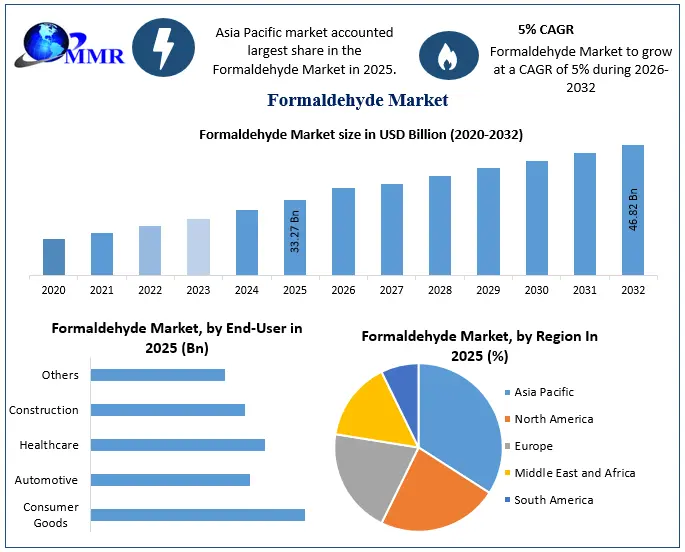
Global Market Valuation: The Global Formaldehyde Market established a baseline valuation of USD 33.27 Billion in 2025.
Growth Projections: Expected to climb steadily to USD 46.82 Billion by 2032, expanding at a 5% CAGR.
Core Industry Anchor: The construction and building materials sector commands the largest share of the market, accounting for over 65% of global formaldehyde consumption.
Raw Material Dynamics: Methanol remains the primary feed material, linking global formaldehyde pricing directly to upstream petrochemical and synthesis gas production loops.
High-Performance Properties: Excellent thermal stability and high chemical resistance drive the steady adoption of formaldehyde derivatives in aerospace and automotive sub-assemblies.
Advanced Sectors Expansion: Rising utilization in pharmaceutical production, including hard-gel capsule shells and anti-infective formulations, introduces high-margin growth avenues.
Why This Matters Now
Industrial chemical processors and commercial manufacturing networks face tight supply-chain balancing acts as global urbanization increases material requirements. For chemicals boards, institutional procurement teams, construction conglomerates, and industrial safety regulators, the formaldehyde landscape has transformed into an optimization race focused on yield efficiency and strict emission tracking. The sector’s transition toward low-fuming wood binders, modified urea-formaldehyde (UF) mixtures, and advanced alternative fuel processing techniques highlights a permanent shift in industrial processing. Manufacturers capable of securing stable methanol feedstock channels while providing certified low-emission resin alternatives are winning exclusive supply contracts with global furniture and automotive Tier-1 brands. Conversely, operators relying on outdated, high-emission formulation processes face diminishing market access and intensifying regulatory hurdles.
Market Overview
The Global Formaldehyde Market is moving rapidly beyond basic commodity chemicals into a highly integrated industrial system supplying essential binders, finishes, and intermediate compounds. Recording a market valuation of USD 33.27 Billion in 2025, the sector’s steady growth to USD 46.82 Billion by 2032 highlights its role as a fundamental building block in modern manufacturing infrastructure. This consistent 5% CAGR reflects non-discretionary industrial demand. Because formaldehyde possesses exceptional cross-linking capabilities, it serves as the foundation for durable chemical adhesives, molding compounds, and specialized performance plastics that cannot easily be replaced at scale by alternative organic compounds.
Process technology advances are modifying the market’s standard processing economics. Lighter, more efficient silver and metal-oxide catalyst configurations maximize product yield while decreasing total manufacturing energy inputs. Advanced gas-phase monitoring applications and modern containment solutions help plants limit workplace exposure, preserving operating margins amidst tightening workplace environmental safety rules. Concurrently, increasing capital flows into multi-country chemical supply agreements and manufacturing partnerships are helping local chemical operations upgrade storage infrastructure, protecting cross-border distribution networks from sudden changes in feedstock supply.
Key Trends Driving Growth
Digital supply chain transformation is becoming an essential asset for primary chemical producers across the globe. Automated raw material tracking portals and direct-to-factory distribution channels optimize shipping schedules while reducing inventory friction at local regional warehouses. These data platforms give manufacturing teams deep visibility into chemical consumption patterns, allowing for precise production adjustments and minimizing storage container holding costs.
Advanced molecular data modeling is also reshaping initial product development and emissions compliance auditing. Laboratory groups apply chemical simulation setups to engineer low-fuming resin formulations, ensuring compliance with strict building product standards. This technical engineering layer allows local development teams to fast-track regional green certifications, facilitating entry into premium architectural markets.
On-demand housing infrastructure and growing commercial remodeling programs are expanding high-performance adhesive consumption across rapidly expanding residential corridors. Modern housing panels and laminates require superior bonding strength and reliable moisture resistance, generating a steady baseline of high-volume orders for advanced industrial resin configurations.
Additionally, international regulatory commissions are introducing specialized emission classes for interior consumer furnishings. Public health agencies look at indoor air quality indicators with intense scrutiny, prompting manufacturers to invest heavily in low-free-formaldehyde processing technologies to protect their market share.
Segment Insights
Dominant Segment: Formaldehyde-Based Resins for Wood and Construction Adhesives. The constant high volume of construction panels, floorboards, and cabinetry manufactured daily puts wood binders at the top of total consumption tables. Specialized wood processing yards and building material companies serve as the core market drivers. For global chemical operators, these bulk contracts act as major revenue generation lines, leveraging extensive shipping networks to maintain bulk supply agreements with top architectural panel factories.
Fastest-Growing Segment: Advanced Automotive Resins and Pharmaceutical Intermediates. High-durability plastic compounds and structural parts are expanding at a rapid pace as vehicle engineers try to reduce overall weight. In parallel, specialized chemical variants used to manufacture high-grade hard capsules and modern medical components are experiencing strong demand, driven by stricter quality validation metrics in healthcare production fields.
Regional Growth Story
Asia-Pacific leads the global market in total volume consumption, driven by extensive construction investments and rapid housing expansion across China and India. Growing residential real estate developments and local furniture production operations make the region a key market for global chemical distributors. Public investments in new manufacturing centers further accelerate localized production plant operations.
North America controls a substantial share of advanced industrial chemical value, backed by active commercial building remodeling and a strong domestic automotive manufacturing foundation. The United States market benefits from stable consumer demand for premium cabinetry and high-performance laminates, supporting continuous consumption of advanced chemical intermediates.
In Europe, industrial hubs like Germany and the United Kingdom lead through strict safety frameworks and proactive emission tracking structures. European architectural supply lines rely on certified low-emission wood binders, keeping regional chemical suppliers focused on high-purity product variants. Meanwhile, expanding chemical manufacturing zones across Central Europe, South America, and the Middle East continue to drive steady growth for specialized chemical derivatives.
Competitive Landscape
The global industry layout is divided between heavy chemical conglomerates and targeted, regional specialty compound blenders. Tier-1 multi-national companies focus heavily on optimizing production capacity and securing basic feedstock pipelines to preserve their cost advantages, using integrated manufacturing sites to produce derivatives at scale.
On the processing side, the market remains highly consolidated around experienced chemical processors. Global players like BASF SE, Johnson Matthey, Hexion, Celanese AG, Momentive Specialty Chemicals, and Georgia-Pacific Chemicals lead through extensive technical expertise. These companies use specialized production licensing and global logistics infrastructure to secure primary positions in major enterprise procurement contracts.
Smaller specialized chemical companies face higher raw material volatility, yet they remain essential suppliers for regional manufacturing nodes. Because transporting concentrated liquid solutions over long distances is costly, regional blenders are increasingly setting up co-located production or toll-manufacturing agreements with larger industrial networks, building an ecosystem centered on localized delivery speed.
Recent Developments
Catalyst Efficiency Upgrades Deployed (2025): Major manufacturers accelerate the deployment of high-selectivity oxide catalysts, boosting chemical conversion performance while minimizing raw material losses during large-scale manufacturing runs.
European Laminates Industry Scales Capacity (Late 2025): Production footprint expansions for engineered panels and high-pressure laminates across Central Europe drive high-volume feedstock commitments for primary organic intermediates.
Low-Emission Resins Secure Broad Approvals (2026): Leading chemical developers launch zero-added-formaldehyde (NAF) and ultra-low emitting (ULEF) adhesive options, satisfying strict regional green building product rules.
Upstream Feedstock Partnerships Formed (2026): Tier-1 chemical networks establish long-term integration agreements with major clean methanol hubs to insulate core operations from shifting hydrocarbon pricing cycles.
Strategic Implications
For bulk shipping providers, specialized containment asset companies, and industrial process automation firms, the changing chemical processing market creates a reliable source of commercial demand. Chemical complexes require automated gas detection devices, corrosion-resistant tanks, and cloud-linked inventory systems to supervise manufacturing safety. Plant technology providers see ongoing contract volume as facilities install upgraded automated systems to minimize operational emissions.
National economic planners must view primary chemical synthesis paths and regional raw material networks as foundational industrial assets. Governments that provide transparent safety frameworks, clear factory zoning rules, and unified transport standards can draw stable manufacturing capital, ensuring core construction material security without requiring emergency public funding during supply blockades.
Future Outlook
The next competitive phase will not be won simply by running high-volume, standard chemical lines, but by establishing the most advanced low-emission derivative plants. Organizations that integrate predictive process safety analytics, optimized catalyst technology, and compliant green resin options will build a clear long-term competitive position. On the other hand, production sites that delay modernizing their catalyst setups run the risk of losing major supply accounts in an increasingly sustainability-focused global supply economy.
Analyst Perspective
“The global formaldehyde market is entering a phase of non-negotiable processing updates,” says Ankita Kagwade, Analyst at Maximize Market Research. “While mass construction components and architectural panel adhesives supply consistent, massive baseline volume, chemical operations must adapt to increasingly rigid global indoor emission and safety boundaries. This shift alters the competitive field, transferring clear commercial advantages to integrated chemical companies and tech-enabled processing operations. Long-term market leadership requires shifting away from high-fume commodity products and directing engineering capital into next-generation, high-purity binders across major regional construction hubs.” – Ankita Kagwade
About Maximize Market Research
Maximize Market Research Pvt. Ltd. (MMR) is a global market research and consulting company that provides reliable, data-focused, and practical business insights. The firm serves a wide range of industries, including healthcare, pharmaceuticals, technology, automotive, electronics, chemicals, personal care, and consumer goods. Through market forecasts, competitive analysis, strategic consulting, and industry impact assessments, MMR helps organizations understand changing market conditions, identify growth opportunities, and make informed business decisions for long-term success.
2nd Floor, Navale IT Park Phase 3
Pune Banglore Highway, Narhe
Pune, Maharashtra 411041, India
+91 9607365656
sales@maximizemarketresearch.com
