Key Highlights
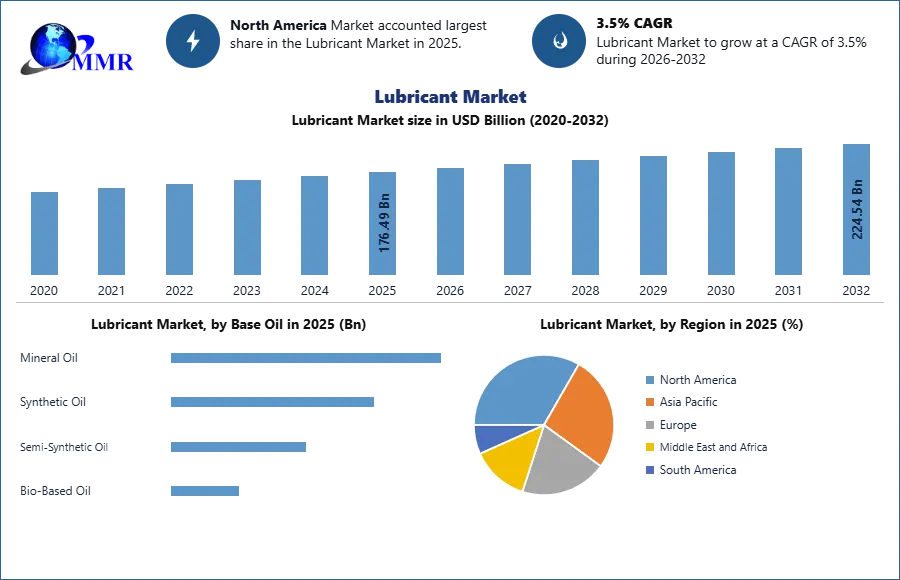
The global lubricant market size reached USD 176.49 billion in 2025 and is projected to expand to USD 224.54 billion by 2032.
Market revenue is progressing at a 3.5% CAGR over the 2026 to 2032 forecast window.
Asia Pacific holds a considerable share of global volume and revenue due to industrial expansions in China and India.
Mineral oil base stocks continue to dominate the market owing to their low cost and widespread availability.
The engine oil segment remains the dominant product type driven by large worldwide vehicle fleets.
The wind energy sector provides emerging growth opportunities through complex turbine oil demands.
Advancements in hybrid vehicles pose volume risks, potentially cutting fluid consumption per vehicle by half.
Why This Matters Now Procurement operations face immediate restructuring as high-performance engine architectures demand advanced chemical tolerances. Industrial buyers must adapt quickly to changing fluid specifications as traditional mineral oils face strict regulatory pressures. What changed is the engineering benchmark, shifting lubricants from basic maintenance commodities into highly technical engine components.
Why now? Rapid development in wind energy systems and high-output hybrid machinery requires specialized synthetic and bio-based alternatives to sustain mechanical efficiency. This change benefits integrated chemical processors capable of blending oxygen-containing esters with upgraded additives. Non-integrated blenders face margin compression if they fail to secure advanced synthetic base stocks amid shifting raw material availability.
Market Overview The global lubricant market achieved an industrial valuation of USD 176.49 billion in 2025. Data published by Maximize Market Research indicates that steady growth will drive total revenue to USD 224.54 billion by 2032. This trajectory represents a compounding annual growth rate of 3.5% across the seven-year forecast period.
Industrial definitions show that a lubricant is a specialized material designed to lower friction between two moving surfaces in contact. This action decreases the absolute heat generated during mechanical operations while transferring forces, removing foreign particles, and providing thermal control. The sector supports complex industrial manufacturing, commercial logistics, and deep-sea shipping operations. Rising global baseline operations necessitate massive chemical volumes to protect high-value capital assets from premature wear and mechanical failure.
Key Trends Driving Growth Accelerating investments in the power generation sector provide significant commercial momentum for the industry. Industrial lubricants, ranging from turbine oil to transformer oil, are consumed extensively to ensure operational uptime in utility infrastructure. The renewable energy segment serves as a primary driver, with expanding wind turbine installations requiring specialized fluids to survive severe environmental stresses. This technical requirement forces chemical manufacturers to invest heavily in advanced synthetic blends designed for high-load gearbox applications.
Concurrently, shifting automotive engine technologies drive the need for highly refined formulations. The market experiences continuous demand spikes for fluids that can support high-performance internal combustion engines under tighter tolerances. Furthermore, rising societal awareness stemming from public health initiatives and specialized medical programs drives a parallel demand vector for specialized personal and medical-grade lubricants. These diverse applications insulate the broader industry from localized industrial manufacturing slowdowns.
Segment Insights
Dominant Base Oil Segment: Mineral oil dominated the market in 2025 and is expected to hold the largest market share during the forecast period. Its low cost, widespread availability, and sufficient performance for standard automotive and industrial applications maintain its leading market position.
Fastest-Growing Base Oil Segment: Bio-based and synthetic oils are experiencing a strong commercial comeback due to tightening environmental regulations and improved blending technologies.
Dominant Product Type Segment: The engine oil segment dominated the market in 2025 because of its critical role in automotive applications. It experiences consistent demand due to the massive global vehicle fleet and frequent oil change intervals across passenger cars and commercial vehicles.
Feedstock Trends: Modern bio-based grease formulations are utilizing new lubricant feedstocks derived from algae or exotic plants containing specialized blends of mineral and plant-based oils.
Regional Growth Story The Asia Pacific region is expected to hold a considerable share of the global lubricant market in terms of both volume and revenue during the forecast period. Rapidly expanding industrial investments and infrastructure advancements across China, India, and Indonesia make the region a primary hub for chemical producers. Growing populations in these developing markets drive high consumer vehicle adoption, ensuring long-term demand for high-volume automotive engine oils.
Furthermore, regional industrial expansion boosts bulk sales of hydraulic and gear oils. China and India are attracting substantial capital for heavy manufacturing and power infrastructure, directly expanding the regional consumption of specialized turbine and compressor oils. This concentrated industrial activity shapes trade flows, making Asia Pacific the primary target for major global lubricant export volumes.
Competitive Landscape The competitive structure of the global lubricant market is shifting from traditional refinery output models to advanced chemical compounding. Major international energy firms and independent chemical manufacturers compete through base oil integration and proprietary additive packages. Companies with direct access to Group II and Group III base oil refining infrastructure hold significant pricing power over non-integrated blenders.
This corporate structure forces independent blenders to focus on niche specialty applications, such as wind turbine oils and bio-based greases, to avoid direct price competition with low-cost mineral oil producers. The ability to supply high-purity synthetic formulations at scale remains the primary differentiating factor among top-tier market participants.
Recent Developments
Upgraded bio-based grease formulations now utilize advanced additive packages specifically engineered to keep pace with volatile oxygen-containing esters.
Global vehicle manufacturers are increasing the production of hybrid platforms, changing long-term automotive fluid requirements.
Industrial power operators are deploying specialized wind turbine lubricants that integrate exotic plant oils and mineral blends to improve thermal stability.
Regulatory frameworks in developed manufacturing hubs are tightening disposal laws, accelerating the commercial shift toward synthetic oil advancements.
Strategic Implications The rapid increase in hybrid vehicle production signals a major adjustment in future automotive volume demand. Industry data reveals that hybrid vehicles can reduce lubricant consumption per vehicle by nearly half. This efficiency improvement, combined with rising battery parity, threatens to lower the overall volume of traditional automotive engine oils. Consequently, major oil blenders must alter their long-term capacity utilization, shifting from high-volume commodity automotive fluids to high-margin industrial formulations.
This shift changes the purpose of manufacturing investments toward synthetic and bio-based processing lines. To remain competitive, chemical companies are modifying their production setups to handle complex ester chemistries and algae-derived feedstocks. This investment strategy helps insulate processors from a shrinking conventional passenger car market while positioning them to capture premium pricing in the expanding renewable energy and industrial power sectors.
       Global Lubricant Market Volumetric Dynamics & Shifts (2025-2032)
       ────────────────────────────────────────────────────────────────
       [Hybrid Vehicle Adoption] ──► Reduces Engine Oil Volume Per Vehicle By ~50%
       [Wind Power Infrastructure] ──► Accelerates Demand For High-Load Synthetic Gear Oils
       [Algae/Exotic Plant Stocks] ──► Emerging Feedstocks Displace Conventional Bases
Future Outlook The global lubricant market will increasingly reward chemical manufacturers that successfully balance traditional low-cost mineral oil production with advanced synthetic formulations. While the massive global vehicle fleet ensures a stable revenue baseline for conventional engine oils, long-term growth depends on high-margin industrial applications. Managing the volume risks from hybrid vehicle adoption while meeting strict environmental standards for bio-based greases will separate leading chemical companies from struggling blenders.
Analyst Perspective “The structural shift toward hybrid vehicle technologies and renewable power infrastructure is forcing a complete re-evaluation of product portfolios within the global lubricant market,” stated Ankita Kagawade, Research Analyst at Maximize Market Research. “While mineral oils maintain a dominant market share due to their low cost base, future market value is moving rapidly toward specialized synthetic and bio-based formulations that can handle extreme mechanical stresses.”
About Maximize Market Research
Maximize Market Research Pvt. Ltd. (MMR) is a global market research and consulting company that provides reliable, data-focused, and practical business insights. The firm serves a wide range of industries, including healthcare, pharmaceuticals, technology, automotive, electronics, chemicals, personal care, and consumer goods. Through market forecasts, competitive analysis, strategic consulting, and industry impact assessments, MMR helps organizations understand changing market conditions, identify growth opportunities, and make informed business decisions for long-term success.
2nd Floor, Navale IT Park Phase 3
Pune Banglore Highway, Narhe
Pune, Maharashtra 411041, India
+91 9607365656
sales@maximizemarketresearch.com
