Key Highlights
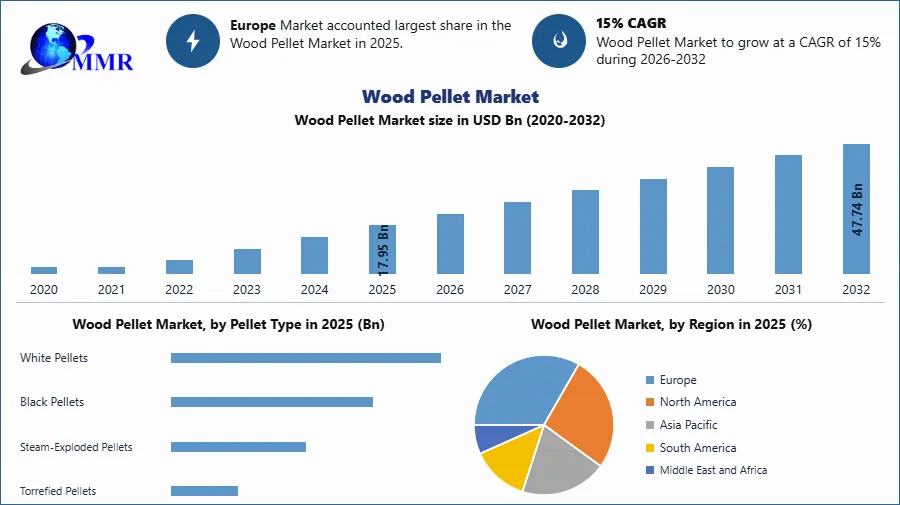
The global wood pellets market size reached USD 17.95 billion in 2025 and is projected to expand to USD 47.74 billion by 2032.
Sector revenue is progressing at an accelerated 15% CAGR over the 2026 to 2032 forecast window.
The industrial application segment commands a dominant position, capturing more than 35% of total market revenue by 2032.
Asia Pacific represents the fastest-growing regional market, exhibiting a leading CAGR of 14.4% driven by utility changes.
High raw material prices for traditional fossil fuels are shifting industrial energy procurement toward dense, low-emission solid biomass.
Premium wood pellets are securing higher price margins within residential heating networks due to lower fines and automated comfort.
Aggressive carbon-free corporate mandates are forcing large-scale coal-fired generation stations to convert completely to biomass fuel.
Why This Matters Now Procurement operations face immediate restructuring as industrial utilities abandon traditional coal lines in favor of high-density solid biomass. Industrial buyers must adapt quickly to tightening international fuel standards as major power consortiums secure massive wood pellet volumes to meet carbon-reduction deadlines. What changed is the scale of consumption, transitioning wood pellets from a local, seasonal residential heating alternative into a core baseline fuel for global electricity networks.
Why now? Tighter statutory emission restrictions and high pricing for conventional fossil fuels are forcing immediate capital deployments toward advanced pelleting infrastructure. This shift benefits large-scale agricultural and forestry processors that possess integrated residue collection networks. Conversely, non-integrated energy brokers face severe spot-market volatility if they fail to lock in long-term feedstock contracts before utility co-firing expansions absorb available regional output.
Market Overview The global wood pellets market achieved an industrial valuation of USD 17.95 billion in 2025. Data published by Maximize Market Research indicates that steady adoption will drive total market revenue to USD 47.74 billion by 2032. This trajectory represents a compounding annual growth rate of 15% across the seven-year forecast period.
Industrial engineering data highlights that wood pellet production relies on the intensive mechanical milling and compression of diverse organic inputs. These raw inputs include lumber scrap, furniture residue, industrial waste by-products, food waste, agricultural residues, and dedicated energy crops. Compared to unrefined alternatives, processed wood pellets deliver a high energy density while generating minimal net carbon dioxide emissions during combustion. This structural advantage solves a significant waste management issue for commercial wood manufacturers by turning low-value timber processing fines into a highly efficient energy source.
Key Trends Driving Growth Accelerating fossil fuel price volatility and international carbon taxes provide strong commercial momentum for the industry. Power plant operators are actively replacing conventional fuels with densified biomass to avoid heavy regulatory penalties while preserving their existing turbogenerator infrastructure. The sector is seeing continuous development of advanced pellet mills designed to maximize processing yields while lowering internal energy consumption. This equipment refinement allows producers to maintain competitive pricing against domestic heating oil and liquid propane.
Concurrently, heavy research investments are focused on optimizing the high calorific value of finished pellets across diverse raw material streams. Modern automated combustion systems feature precise automatic feed-in mechanisms that eliminate manual handling, matching the operational convenience of traditional gas systems. These system enhancements encourage regional utility networks to invest heavily in multi-year infrastructure upgrades, establishing a reliable, long-term consumption pattern for industrial-grade fuels.
Segment Insights
Dominant Application Segment: The industrial sector is anticipated to dominate the market by 2032, securing an absolute revenue share of over 35%. Growth is driven directly by the continuous modification of coal-fired facilities into dedicated biomass and combined heat and power plants.
Fastest-Growing Material Segment: Industrial waste feedstock and agricultural residues are expanding rapidly as primary inputs to lower total manufacturing costs and insulate producers from sawdust shortages.
Premium Grade Advancements: Premium wood pellets are capturing dominant revenue positions across the residential segment due to lower fines and high-quality heat delivery. This grade commands premium pricing and is typically distributed in consumer luggage packaging.
Raw Material Categorization: Total market supply channels remain divided across six core organic pillars including softwood, hardwood, agricultural residue, forest residue, energy crops, and recycled wood waste.
Regional Growth Story The Asia Pacific region is positioned to grow at the fastest rate globally, sustaining an estimated CAGR of 14.4% across the forecast period. Pro-power generation policies and clear governmental incentives for combined heat and power setups in Japan, China, and India support this rapid regional expansion. The massive development of renewable energy infrastructure across these key chemical and industrial manufacturing hubs requires consistent volumes of low-carbon fuels to support industrial electricity demands.
In parallel, North American markets maintain a strong supply position, supported by vast timber assets and well-developed export infrastructure in the United States. Price competitiveness against alternative fuels like propane, combined with the steady replacement of manual wood stoves with automatic boilers, stabilizes domestic consumption. Furthermore, Central and South American economies are emerging as key development areas, showing significant manufacturing potential to supply European and East Asian import requirements.
          Global Wood Pellets Market Regional Dynamic Matrix (2026)
          ─────────────────────────────────────────────────────────
          [North American Supply Hub] ──► High Price Competitiveness vs Propane
          [Asia-Pacific Energy Shift] ──► Fastest Growth Globally (14.4% CAGR)
          [Industrial Power Demand]   ──► Commands Over 35% Absolute Market Share
Competitive Landscape The competitive structure of the global wood pellets market is transitioning from a fragmented group of localized sawmills into a consolidated group of global biomass suppliers. Industry leaders like Enviva Partners LP, Pacific BioEnergy, Premium Pellet Ltd., Fram Renewable Fuels LLC, Rentech Inc., Lignetics, Highland Pellets, and Wood&Sons maintain market share through extensive long-term supply agreements with foreign utilities. These corporate majors deploy automated production lines to lower processing costs per ton and maintain reliable delivery schedules.
This consolidation increases pressure on smaller, unaligned pellet producers that lack integrated access to consistent forestry residue. Top-tier operators use their capital strength to build advanced export terminals, giving them significant logistics advantages and stronger pricing power over international trade channels. Smaller independent mills increasingly focus on regional residential premium markets, where localized delivery networks and specialized consumer packaging help shield them from direct global utility competition.
Recent Developments
Advanced pellet mills are integrating automated monitoring systems to optimize mechanical compression parameters and reduce internal fuel use during high-volume production runs.
Industrial research initiatives are expanding the use of complex agricultural residues and food waste to ensure stable feedstock inputs amid tightening timber waste supplies.
Large-scale utility operators are accelerating full coal-to-biomass conversions, with major entities like the UK-based Drax targeting complete carbon-free operations.
Regional trade networks are deploying specialized covered bulk logistics systems to protect industrial wood pellet shipments from moisture damage during long-distance shipping.
Strategic Implications The decision by major utility operators to pursue complete carbon-free transformations signals an important adjustment in future volumetric demand. As large power plants transition away from fossil coal, they create an immediate need for millions of tons of high calorific value wood pellets. This trend shifts manufacturing investments toward high-output processing hubs located near deepwater ports. To remain competitive, chemical and material processors must adapt their supply chains to manage the strict certification rules set by international forestry councils.
Furthermore, the fast growth of the Asia Pacific market at a 14.4% CAGR shows that supply lines are shifting toward East Asian procurement hubs. Producers in North and South America are updating their export strategies to secure long-term supply agreements with Japanese and South Korean power companies. This international demand helps insulate major producers from shifting weather patterns in traditional Western residential heating markets, driving steady capacity utilization across global production networks.
Future Outlook The global wood pellets market will increasingly reward integrated biomass processors that can deliver high-volume, certified industrial pellets while maintaining access to cheap alternative feedstocks. While consistent demand for premium residential heating pellets provides a high-margin revenue line, long-term market leadership relies on supporting large-scale utility coal-to-biomass conversions. Manufacturers that invest in advanced pellet mill tech to improve processing yields and lower internal energy use are best positioned to lead the market as global power systems transition toward renewable energy options.
Analyst Perspective “The systematic transition of international utility networks from traditional coal-fired assets to densified biomass platforms is driving a fundamental restructuring of the global energy supply chain,” stated Ankita Kagawade, Research Analyst at Maximize Market Research. “As nations prioritize immediate carbon reduction without sacrificing baseline power stability, the ability to manufacture high calorific value wood pellets from sustainable, non-fossil waste streams has become a critical strategic advantage for modern energy markets.”
About Maximize Market Research
Maximize Market Research Pvt. Ltd. (MMR) is a global market research and consulting company that provides reliable, data-focused, and practical business insights. The firm serves a wide range of industries, including healthcare, pharmaceuticals, technology, automotive, electronics, chemicals, personal care, and consumer goods. Through market forecasts, competitive analysis, strategic consulting, and industry impact assessments, MMR helps organizations understand changing market conditions, identify growth opportunities, and make informed business decisions for long-term success.
2nd Floor, Navale IT Park Phase 3
Pune Banglore Highway, Narhe
Pune, Maharashtra 411041, India
+91 9607365656
sales@maximizemarketresearch.com
