Key Highlights
The global MDI, TDI, and polyurethane market is projected to expand from USD 88.23 billion in 2024 to USD 142.12 billion by 2032, demonstrating a 6.14% CAGR.
Flexible foams represent the largest application segment, commanding a 32.9% market share in 2024 due to extensive utilization across the cushioning and bedding industries.
The construction sector operates as the dominant end-use driver, holding a 39% market share in 2024 backed by rigorous structural insulation and roofing demands.
Asia Pacific leads global consumption volumes, while the European market is projected to experience strong expansion at a 6.2% CAGR through the forecast period.
Persistent shortages of vital MDI and TDI isocyanates are squeezing manufacturer margins, accelerating capital allocation toward bio-based substitute materials.
Why This Matters Now
Severe supply shortages of critical isocyanates and extreme crude oil volatility are delivering a double blow to global polyurethane manufacturers and procurement departments. Industrial buyers can no longer rely on legacy pricing structures or predictable baseline capacities without risking immediate margin collapse.
The underlying disruption is driven by an unprecedented supply-demand imbalance. While downstream demand across automotive and building sectors expands faster than forecasted, the basic raw materials—methylene diphenyl diisocyanate (MDI) and toluene diisocyanate (TDI)—remain highly supply-constrained. Because these key molecules are highly hazardous and linked directly to petrochemical chains, manufacturers cannot easily spin up new production. The resulting spike in isocyanate costs is forcing a rapid corporate pivot toward bio-renewable polyols and alternative chemical formulations to secure supply chain continuity.
Market Overview
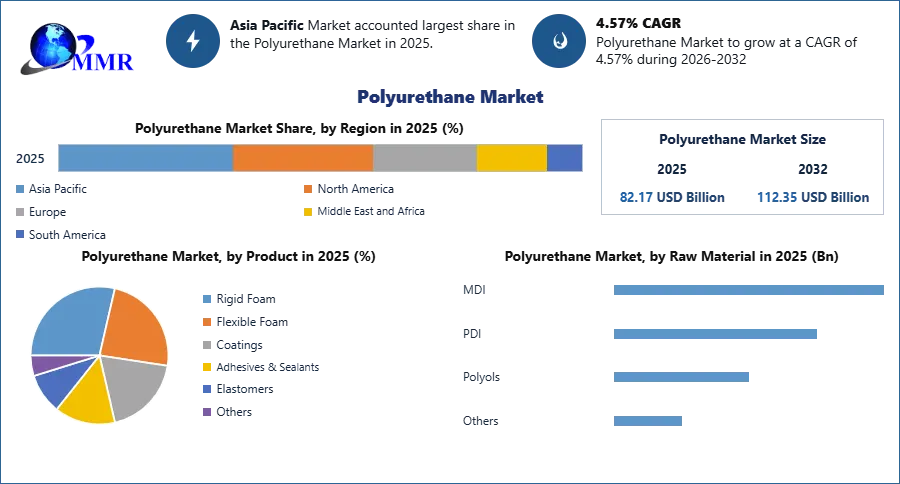
The global MDI, TDI, and polyurethane market recorded a valuation of USD 88.23 billion in 2024. Sustained procurement trends across structural, automotive, and appliance applications ensure long-term expansion. The total revenue for the combined market is projected to reach USD 142.12 billion by 2032, growing at an annualized compound rate of 6.14%.
Polyurethane functions as a versatile thermoplastic polymer defined by its unique urethane linkages, formed by reacting diisocyanates with polyols. The resulting material provides exceptional durability, lightweight properties, and structural flexibility. These mechanical attributes make polyurethanes indispensable across commercial ecosystems. Rigid formulations provide peerless thermal insulation for commercial refrigeration and buildings, while flexible variants anchor the global comfort and seating industries. Elastomers, adhesives, coatings, and sealants round out the material’s comprehensive commercial footprint.
Key Trends Driving Growth
Accelerating global compliance with energy efficiency regulations stands as a dominant macroeconomic driver for volume consumption. Governments worldwide are tightening building codes, mandating superior thermal insulation to curb municipal power loads. Because polyurethane foam provides top-tier thermal resistance per inch, its integration into roofing, wall cavities, and cold-storage infrastructure is accelerating. This regulatory enforcement locks in multi-year procurement baselines for industrial construction buyers.
Simultaneously, the automotive sector’s intense focus on vehicle lightweighting is driving continuous engineering demand. Modern vehicle assembly relies heavily on polyurethanes to strip out dead weight and optimize fuel efficiency. According to historical industry data from the Plastics Europe organization, a 5% reduction in vehicle weight yields an average fuel savings of 3%. This direct correlation motivates automotive original equipment manufacturers (OEMs) to aggressively increase their utilization of lightweight polyurethane components in seating, acoustic paneling, and structural dampening.
The strategic transition from fossil-dependent inputs to bio-renewable raw materials forms the central operational trend. Heavy exposure to crude-linked price spikes has turned petrochemical dependence into a major financial liability. Chemical manufacturers are rapidly adopting bio-based polyols derived from agricultural sources to insulate their supply chains from oil market swings. This development satisfies stringent decarbonization goals while altering the raw material procurement criteria for mainstream chemical buyers.
Segment Insights
Dominant Application Segment: Flexible Foams. This product category held the largest market share at 32.9% in 2024. Growth is anchored by non-discretionary volume demand for high-resilience cushioning across the global furniture, bedding, mattress, and soft-goods manufacturing sectors.
Dominant End-Use Segment: Construction. Holding a commanding 39% market share in 2024, this industrial vertical dictates global consumption patterns. The sector’s reliance on polyurethanes for high-performance building insulation, protective flooring, and specialized roofing systems guarantees its continued dominance.
Fastest-Growing Region: Europe. Driven by urgent energy security mandates and strict environmental standards, the European regional market is projected to expand at a accelerated CAGR of 6.2% through 2032.
Feedstock Constraints: MDI and TDI operate as the foundational basic ingredients for all polyurethane production. Because these molecules face ongoing production bottlenecks and volatile pricing, manufacturers are suffering compressed margins due to an inability to pass total isocyanate cost increases down to end-product buyers.
Regional Growth Story
The global market exhibits a clear divide between large-scale manufacturing hubs and high-growth regulatory territories. The Asia Pacific region commands the highest market share in terms of volume and production capacity. China acts as the primary manufacturing and consumption engine for adhesives, sealants, and rigid insulation foams. India is simultaneously expanding its industrial footprint, with rapid urbanization and targeted government infrastructure initiatives driving local demand. The massive automotive production ecosystem in Asia Pacific secures a captive, high-volume market for flexible foam seating.
Europe represents a highly dynamic, regulation-driven growth corridor, projected to expand at a 6.2% CAGR through 2032. The United Kingdom, Germany, Russia, and France serve as the primary commercial anchors for the continent. European growth is heavily skewed toward high-performance specialty polyurethanes that comply with strict low-VOC and zero-carbon building directives. Developing economies across South America and the Middle East & Africa are also scaling up their consumption, using these thermoplastics to upgrade civil infrastructure, commercial cold chains, and domestic footwear manufacturing.
Competitive Landscape
The global competitive structure is dominated by a select group of highly consolidated chemical conglomerates possessing proprietary isocyanate synthesis technology. Because building and permitting MDI and TDI production facilities requires immense capital and strict regulatory clearance, these established market leaders maintain substantial pricing power. Key market operators driving global strategy include BASF SE, Covestro AG, Dow Inc., and Huntsman Corporation.
These Tier-1 chemical producers compete aggressively on feedstock integration and regional asset positioning. Competitors like LANXESS, DuPont de Nemours, Inc., Coim Group, FXI, Arian Polyurethane JSC, and Chematur Engineering AB are intensely focused on product differentiation. To counter the margin compression caused by rising raw material costs, these firms are systematically pivoting away from basic commodity volumes. They are reallocating capital toward high-margin specialty systems, customized elastomer formulations, and bio-based polyurethane solutions.
𝐃𝐨𝐰𝐧𝐥𝐨𝐚𝐝 𝐏𝐃𝐅 𝐁𝐫𝐨𝐜𝐡𝐮𝐫𝐞 @
Recent Developments
Chemical manufacturers face severe margin compression as the market experiences ongoing supply shortages for critical MDI and TDI isocyanates, outstripping predicted demand volumes.
Leading global producers are executing structural shifts in research and development to replace traditional fossil-based feedstocks with bio-renewable resources to meet global carbon-reduction mandates.
Major multi-national operators are implementing advanced downstream formulations across the adhesives and sealants verticals to secure high-margin supply contracts in emerging civil engineering projects.
Regional capacity adjustments are accelerating across Western Europe, with firms optimizing asset utilization to cope with elevated local energy costs and shifting trade flows.
Strategic Implications
The persistent supply shortage in the MDI and TDI segments signals a profound structural bottleneck for the chemical sector. Companies that operate purely as non-integrated downstream formulators face systemic margin erosion. Because these players cannot match sudden spikes in isocyanate raw material costs with immediate price increases for finished foams and coatings, pricing power has shifted heavily to backward-integrated chemical producers who control the upstream diisocyanate assets.
This structural imbalance explains the massive corporate reallocation of capital toward bio-polyols. By developing bio-based polyurethane alternatives, chemical companies are actively attempting to bypass the hazardous, highly regulated isocyanate supply chain entirely. This transition alters the competitive dynamics of the sector; future market share will belong to firms that successfully de-link their manufacturing lines from crude oil dependencies.
Furthermore, the fast-growing demand for automotive lightweighting and strict building energy codes is changing the nature of supplier-buyer contracts. Auto OEMs and global construction firms are increasingly moving away from transactional spot-market purchasing. They are entering into long-term, specification-locked supply partnerships with integrated polyurethane producers to guarantee volume availability and satisfy rigid regulatory tracking requirements.
Future Outlook
The global polyurethane market will navigate an environment defined by severe feedstock friction and rapid regulatory alignment. Traditional petroleum-dependent manufacturing lines will face escalating carbon penalties and volatile margin profiles. This pressure will accelerate the industry’s structural migration toward green chemistries and bio-renewable feedstock alternatives.
Winning chemical corporations will be those that control localized, vertically integrated production hubs while successfully commercializing high-purity, bio-based polyurethanes. Producers that fail to secure stable isocyanate lines or lag in adopting bio-renewable raw materials will face severe operational disruption and eventual exclusion from premium downstream supply chains.
Analyst Perspective
“The critical bottleneck in global isocyanate supply is forcing a complete tactical re-evaluation of procurement across the entire polyurethane value chain,” stated Ankita Kagawade, Research Analyst at Maximize Market Research. “With downstream automotive and insulation demands expanding faster than current baseline capacities can support, long-term commercial survival now dictates an immediate shift toward bio-renewable raw materials and localized asset integration.”
About Maximize Market Research
Maximize Market Research Pvt. Ltd. (MMR) is a global market research and consulting company that provides reliable, data-focused, and practical business insights. The firm serves a wide range of industries, including healthcare, pharmaceuticals, technology, automotive, electronics, chemicals, personal care, and consumer goods. Through market forecasts, competitive analysis, strategic consulting, and industry impact assessments, MMR helps organizations understand changing market conditions, identify growth opportunities, and make informed business decisions for long-term success.
2nd Floor, Navale IT Park Phase 3
Pune Banglore Highway, Narhe
Pune, Maharashtra 411041, India
+91 9607365656
sales@maximizemarketresearch.com
