Key Highlights
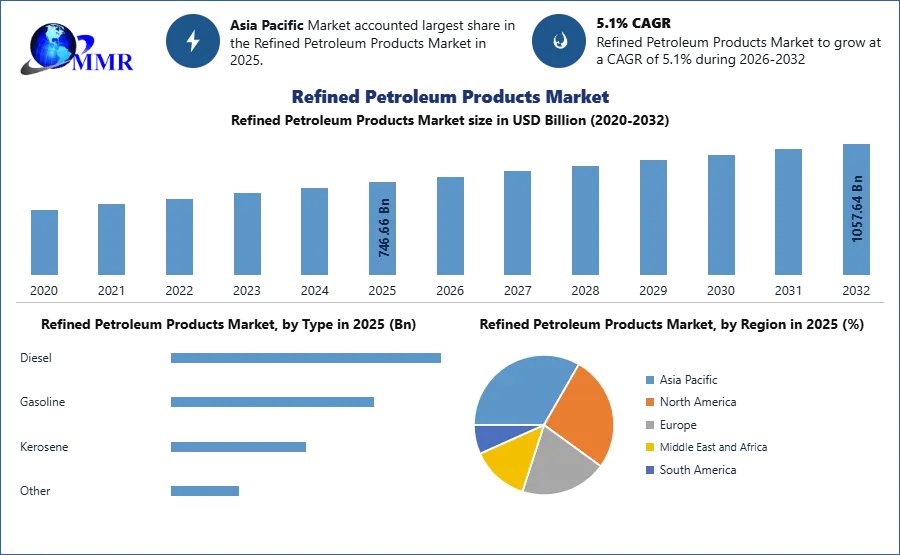
The global refined petroleum products market is projected to expand from USD 746.66 billion in 2025 to USD 1,057.64 billion by 2032, demonstrating a 5.1% CAGR.
Asia Pacific dominated the market with a 30% share in 2025 and is projected to expand at the fastest regional rate of 6.9% CAGR through the forecast period.
Automotive LPG, or autogas, reached 27.2 million tonnes in consumption in 2025, expanding by 1% to become the leading non-blend alternative transport fuel.
Major refining corporations are restructuring capital budgets, focusing investments on emissions abatement projects like the Quest carbon storage venture.
Refining operators are increasing facility utilization rates, with Indian Oil Corporation lifting its refinery run rates close to full capacity.
Why This Matters Now
Volatile crude prices and rigid emissions penalties are forcing global petrochemical manufacturers, procurement leaders, and refinery operators to drastically overhaul their asset investments. Industrial buyers face immediate supply vulnerabilities as refining capacity and carbon compliance dictate the cost structure of downstream inputs.
The immediate pressure stems from a structural shift in consumption. Refiners must fund costly environmental modifications while demand fragments between traditional mobility fuels, alternative transport options, and vital petrochemical feedstocks. In the United States and Europe, strict regulatory mandates and hazardous waste penalties threaten to force the closure of older, non-integrated refining plants. To defend profit margins, operators must systematically optimize their facility utilization and deploy carbon abatement systems to guarantee long-term supply resilience for downstream chemical channels.
Market Overview
The global refined petroleum products market recorded a baseline valuation of USD 746.66 billion in 2025. Industrial utilization across transport, heating, and chemical sectors indicates sustained consumption through the decade. Total market revenue is projected to reach USD 1,057.64 billion by 2032, expanding at a compound annual growth rate of 5.1%.
Refined petroleum products consist of critical crude-derived outputs including gasoline, diesel, kerosene, naphtha, and liquefied petroleum gas (LPG). These materials provide the essential foundation for global mobility and industrial energy. Simultaneously, they function as vital chemical feedstocks, linking downstream manufacturing directly to refinery output profiles. Because these outputs serve both the energy and chemical manufacturing sectors, refiners remain exposed to shifting transportation trends and corporate chemical procurement cycles.
Key Trends Driving Growth
The rising adoption of automotive LPG, or autogas, stands out as a highly visible transport-linked trend. Autogas has established itself as the most widely utilized non-blend alternative to conventional oil-based mobility fuels based on global fleet size. Global autogas consumption hit 27.2 million tonnes in 2025, representing a 1% year-on-year increase. This steady expansion provides refiners with a reliable transport outlet while standard gasoline and diesel face intense policy and electrification pressures.
Concurrently, expanding commercial aviation networks and marine shipping operations are driving significant volume demand. Rising global air traffic directly lifts kerosene-based jet fuel consumption, while heavy maritime duties maintain strong demand for marine diesel and heavy fuel oils. On the industrial side, downstream demand for LPG and naphtha feedstocks links refining operations directly to the manufacturing of plastics, synthetic rubber, fertilizers, and pharmaceuticals.
Technological integration in the form of carbon capture and storage (CCS) constitutes the core operational trend. To mitigate global warming concerns and manage the hazardous waste footprint of refining plants, operators are deploying large-scale emission harvesting equipment. Projects like Quest—a joint venture between Shell, Canada Energy, and Chevron—demonstrate the commercial viability of capturing carbon gases and storing them deep underground. This structural evolution allows proactive refiners to reduce their environmental compliance costs and secure their operating licenses.
Segment Insights
Dominant Regional Segment: Asia Pacific. Holding a 30% global market share in 2025, this region functions as the core operational center for refining capacity and product demand.
Fastest-Growing Segment: Asia Pacific Refining Corridor. Driven by expanding industrial activity, the region is projected to outpace all other territories with a 6.9% CAGR through 2032.
Feedstock and Processing Trends: Severe operational impacts from the pandemic triggered an acute global storage shortage, forcing private producers to reorganize their assets and defer capital spending. Current feedstock monitoring requires strict management during the extraction phase to prevent the formation of scales, wax hydrates, and asphaltenes as crude oil is separated from gas and water.
Product Type Composition: The market remains segmented into gasoline, diesel, kerosene, and other fractions. While environmental mandates restrict conventional fuel expansion, the demand for petrochemical feedstocks is shielding refiners from sudden volume contractions.
Regional Growth Story
The global market reveals a stark contrast between mature, capacity-rationalizing western nations and rapidly expanding Asian refining hubs. The Asia Pacific region commands the global landscape, backed by a 30% market share in 2025. China, India, Japan, and South Korea serve as the primary drivers of refining capacity utilization and regional trade flows. To meet surging domestic demand, Asian processors are running facilities at elevated rates. For example, Indian Oil Corporation raised the run rates of its nine refineries close to full capacity in October, recovering quickly from an 82% average run rate recorded in previous months. This aggressive production rate allows regional refiners to capture downstream market shares and dictates the pricing power of chemical feedstocks across neighboring export zones.
Europe’s refining footprint is shaped by high imported oil dependence and strict regional energy security goals. Germany, France, Italy, Spain, and the United Kingdom are navigating a delicate balance between required refinery investments and stringent environmental compliance. In North America, the market is increasingly defined by export-led opportunities and corporate consolidation. Integrated asset ownership across refining and logistics networks has become the primary source of pricing power for major US oil firms, allowing them to optimize trade flows and protect margins against global price fluctuations.
Competitive Landscape
The competitive arena of the refined petroleum products sector is dominated by heavily capitalized multinational oil corporations and integrated state-owned energy enterprises. Entry barriers are exceptionally high due to the multi-billion-dollar capital requirements for constructing distillation units and complying with strict environmental permits. Leading operators actively defining the global landscape include Shell, Chevron, and ExxonMobil.
Market power is concentrated among players that control fully integrated refining, logistics, and petrochemical complexes. Large-scale producers are utilizing joint ventures, such as the Quest carbon storage partnership between Shell, Canada Energy, and Chevron, to share the massive cost of sustainability upgrades. Pure-play independent refiners face intense margin pressure from these integrated majors, forcing smaller operators to either reallocate spending toward specialized chemical fractions or merge with midstream logistics providers to defend their market positions.
Recent Developments
Global refining corporations are executing major asset reorganizations and adjusting their long-term capital spending to recover from historical pandemic-linked storage shocks.
The Quest carbon capture and storage venture, supported by Shell, Canada Energy, and Chevron, successfully scaled up underground CO2 storage to minimize the atmospheric footprint of modern refining.
Indian Oil Corporation demonstrated high operational flexibility by running its nine domestic refineries at nearly full capacity to meet rapid demand recoveries in the Asian economic corridor.
Widespread environmental policies are forcing the closure of legacy, high-emission petroleum processing plants, benefiting manufacturers who invest in lower-sulfur products and advanced carbon-reduction strategies.
Strategic Implications
The polarization of global refining run rates signals an important structural shift for chemical procurement. With Asian giants like Indian Oil Corporation running assets at maximum capacity, pricing power for basic petrochemical building blocks is shifting toward eastern producers. Downstream buyers who rely on western refining infrastructure face elevated premium costs as local plants face capacity constraints or absorb high carbon-compliance penalties.
This operational reality explains why major players are pouring capital into carbon capture joint ventures. By investing in projects like Quest, integrated energy companies are establishing a regulatory shield around their heavy refining assets. This capability creates an immediate competitive advantage; future procurement contracts from sustainability-minded consumer brands will flow exclusively to refiners that can verify low-carbon production footprints.
Furthermore, the steady expansion of alternative transport fractions like autogas shows that the refined products mix is permanently changing. Refiners can no longer rely on a static, gasoline-heavy production model. To maintain high capacity utilization, companies must configure their distillation units to switch outputs dynamically between mobility fuels and chemical feedstocks based on seasonal pricing and regional policy adjustments.
Future Outlook
The global refined petroleum products market will navigate a bifurcated pathway defined by intense decarbonization mandates and expanding industrial chemical needs. Traditional high-emission refining processes will face mounting legal penalties, driving an industry-wide push for localized carbon capture integration. Fluctuations in crude oil extraction and baseline storage levels will continue to create margin risks for non-integrated operators.
Winning energy corporations will be those that successfully maximize their refinery run rates in high-growth regions while deploying large-scale emissions capture technologies to satisfy international carbon rules. Operators that lag in environmental asset upgrades or rely on legacy fuel configurations face rapid asset stranding and eventual displacement from the global energy mix.
Analyst Perspective
“The decoupling of transport fuel growth from petrochemical feedstock demand is forcing a complete structural re-evaluation of refinery asset utilization,” stated Ankita Kagawade, Research Analyst at Maximize Market Research. “Long-term market leadership no longer depends simply on crude oil access, but on the deployment of integrated carbon capture technologies and the flexibility to maximize run rates in high-demand regional hubs.”
About Maximize Market Research
Maximize Market Research Pvt. Ltd. (MMR) is a global market research and consulting company that provides reliable, data-focused, and practical business insights. The firm serves a wide range of industries, including healthcare, pharmaceuticals, technology, automotive, electronics, chemicals, personal care, and consumer goods. Through market forecasts, competitive analysis, strategic consulting, and industry impact assessments, MMR helps organizations understand changing market conditions, identify growth opportunities, and make informed business decisions for long-term success.
2nd Floor, Navale IT Park Phase 3
Pune Banglore Highway, Narhe
Pune, Maharashtra 411041, India
+91 9607365656
sales@maximizemarketresearch.com
