Key Highlights
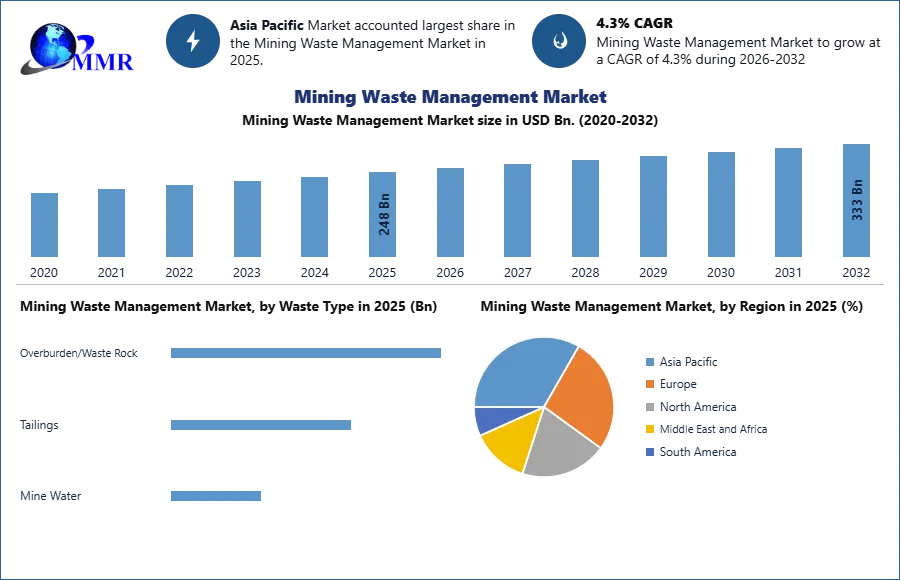
Market volume reached 248 billion tons in 2025 and is projected to expand to 333 billion tons by 2032, maintaining a 4.3% compound annual growth rate.
Surface extraction processes dominate the operational landscape, driving more than 80% of global mine infrastructure and corresponding residue volumes.
The thermal coal metal-extraction category held the largest market segment share in 2025, powered by electrical generation and global cement manufacturing.
Tailings represent the largest waste type segment, forcing investments into dry-stacking storage and underground backfilling methodologies.
China anchors the dominant Asia Pacific market, with its industrial footprint projected to reach 55.3 billion tons individually by 2032 through a 7.8% local CAGR.
Europe positions itself as the second-largest global territory, driven by strict regulatory mandates across the United Kingdom and Germany.
Corporate investments are shifting rapidly toward specialized mineral engineering acquisitions and commercialized rare-earth element extraction from legacy residue ponds.
Why This Matters Now
Industrial chemical processors, mining executives, and global infrastructure procurement leaders face structural disruptions as traditional disposal methods conflict with environmental boundaries. The surge in population and concurrent industrialization has forced a massive acceleration in metal and mineral extraction, creating unprecedented handling challenges for industrial operations. Regulatory compliance pressures are shifting waste management from an operational cost center into a strategic source of secondary raw materials.
What changed? The commercial viability of processing legacy tailings has turned hazardous liabilities into secondary resource reserves. Why now? The accelerating demand for complex mineral concentrations utilized in electric vehicle batteries and electronics, such as cobalt, nickel, and lithium, cannot be met solely by primary extraction. Companies that successfully implement advanced waste handling and chemical reclaiming processes secure direct cost advantages, while laggards face steep escalations in recycling, disposal, and fuel costs.
Market Overview
The global mining waste management market achieved a commercial volume of 248 billion tons in 2025. Driven by ongoing industrial expansion and surging consumer demand for raw commodities, the total volume is anticipated to hit 333 billion tons by 2032. This trajectory reflects a sustained 4.3% CAGR across the forecast timeline.
However, systemic challenges restrict seamless operational execution. Market growth faces headwinds from rising recycling, waste treatment, and gasoline expenses, alongside a lack of suitable collection infrastructure in several underdeveloped extraction zones. Despite these logistical friction points, the sector is expanding due to deepwater oil extraction demands, technology integration, and an industry-wide pivot toward eco-sensitive industrial processes.
Key Trends Driving Growth
Accelerating global populations necessitate unprecedented volumes of basic metals, coking materials, and specialized mineral outputs. This exploration boom generates proportional volumes of hazardous byproduct, driving the adoption of specialized management infrastructure. Deepwater and ultra-deepwater extraction activities add an entirely new layer of technical difficulty to liquid residue and chemical monitoring protocols.
Simultaneously, downstream consumption sectors require stricter carbon accounting throughout their supply chains. The development of advanced filtering, in-situ dewatering, and geochemical stabilization techniques allows processing firms to isolate valuable secondary elements. This trend merges traditional civil waste mitigation with advanced chemical manufacturing feedstocks, establishing a dual-revenue mechanism for forward-looking industrial processors.
Segment Insights
Dominant Method Segment: Surface mining represents the dominant extraction method, with over 80% of global mining facilities utilizing open-pit or open-cut techniques. This structural reliance generates significantly higher waste rock and overburden volumes than underground operations, cementing the surface segment as the primary driver of physical volume requirements.
Dominant Waste Type Segment: Tailings constitute the largest waste type segment by volume. These water-based processing residuals require capital-intensive surface dry-stacking networks or complex underground backfilling operations to mitigate structural containment risks.
Dominant Metal Extraction Segment: Thermal coal processing held the absolute largest market share in 2025. This volume is driven directly by ongoing consumption within global power generation utilities and intensive architectural cement manufacturing plants.
Fastest-Growing Sub-segment: Rare-earth element recovery from existing tailings deposits is emerging as a high-margin growth vector. It is fueled by capital infusions aimed at bypassing traditional high-risk containment infrastructure altogether.
Regional Growth Story
The Asia Pacific region maintains a commanding lead in total volume and asset allocation, backed by China’s dense concentration of active production fields. The Chinese domestic market alone is on track to hit a volume of 55.3 billion tons by 2032. This localized expansion represents a robust 7.8% CAGR from 2026 to 2032, outperforming general global growth rates and demanding massive regional infrastructure investments.
Europe secures the second position within the global hierarchy. Industrial operations across the United Kingdom, Germany, and adjacent manufacturing hubs face strict environmental statutory frameworks. These regional legislative mandates compel extraction entities to integrate highly specialized remediation systems, stabilizing European demand for advanced commercial waste processing technologies.
Competitive Landscape
The competitive environment is shifting away from simple waste containment and toward specialized environmental engineering and mineral chemistry. Established market leaders are expanding their technical service portfolios to secure greater pricing power and capacity utilization. This consolidation isolates smaller operators who lack the capital to install heavy filtering and processing networks.
Strategic capital flows indicate a clear industry trend toward technological consolidation. Companies are actively buying niche engineering competencies to control the life cycle of mining assets from extraction through chemical remediation. This structural evolution allows major service providers to command premium pricing as compliance requirements tighten worldwide.
Recent Developments
On March 5, 2026, Veolia expanded its Bhandup water treatment operation to a 2,000 MLD capacity, deploying advanced filtration setups designed to process large-scale industrial and mining liquid discharges.
On November 12, 2025, CSIRO researchers commercialized a geopolymer concrete technology that uses mine tailings as primary raw materials, cutting concrete CO2 emissions by replacing traditional aggregates.
On August 14, 2025, Phibion introduced its AMC® tailings management technology to the market, utilizing in-situ dewatering and consolidation to shrink the physical footprint of surface dams.
On April 22, 2025, Phoenix Tailings closed a USD 33 million Series B funding round led by Sumitomo Corporation to scale up its proprietary rare-earth reclaiming technology.
On February 18, 2025, SLR Consulting acquired Responsible Mining Solutions Corp. (RMS) to rapidly increase its mine waste engineering footprint and compliance advisory capacity across North American and African regions.
Strategic Implications
The acquisition of Responsible Mining Solutions Corp. by SLR Consulting demonstrates how Tier-1 consulting firms are preparing for stricter regulatory oversights in North America and Africa. By absorbing specialized mine waste engineering capabilities, service providers strengthen their corporate pricing power, positioning themselves as essential partners for high-risk tailings dam remediation. Phibion’s deployment of AMC® dewatering technology highlights an industry shift toward reducing long-term liability costs through mechanical volume reduction, which optimizes land use and improves safety.
Concurrently, Sumitomo Corporation’s USD 33 million investment in Phoenix Tailings indicates that major trading houses view legacy mine waste as a viable alternative source for critical rare-earth metals. This move challenges traditional upstream mining economics by transforming waste management into a processing source for high-value tech materials. Furthermore, Veolia’s 2,000 MLD Bhandup industrial wastewater installation shows that large-scale fluid handling is crucial for maintaining water security in drought-prone extraction regions. Finally, CSIRO’s geopolymer concrete commercialization bridges the gap between mining waste and building material manufacturing, proving the economic viability of circular industrial supply chains.
Future Outlook
Looking forward, the global mining waste management market will depend on the successful integration of chemical reprocessing and automated mechanical handling systems. Pure-play extraction companies that fail to adopt advanced tailings stabilization and water recycling loops face increasing operational risks, higher regulatory fines, and limited access to capital. Conversely, industrial manufacturers that utilize recovered minerals as secondary feedstocks will shield their operations from primary raw material price swings. Capital will flow toward advanced recovery methods that eliminate legacy tailings storage risks while isolating valuable mineral byproducts. Winners will be defined by their ability to transform bulk geological waste into certified, carbon-neutral downstream chemical inputs.
Analyst Perspective
“The transition toward advanced raw material circularity is transforming the global mining waste management market from a basic municipal hauling sector into an essential segment of the chemical supply chain,” states Ankita Kagawade, Research Analyst at Maximize Market Research. “As primary mineral grades decline and regulatory scrutiny intensifies across major manufacturing hubs, the commercial focus has shifted from simple waste storage to advanced chemical extraction. Organizations that integrate technologies like geopolymer conversion and closed-loop wastewater filtration will secure a clear competitive edge, transforming environmental liabilities into predictable, high-value raw material streams.”
About Maximize Market Research
Maximize Market Research Pvt. Ltd. (MMR) is a global market research and consulting company that provides reliable, data-focused, and practical business insights. The firm serves a wide range of industries, including healthcare, pharmaceuticals, technology, automotive, electronics, chemicals, personal care, and consumer goods. Through market forecasts, competitive analysis, strategic consulting, and industry impact assessments, MMR helps organizations understand changing market conditions, identify growth opportunities, and make informed business decisions for long-term success.
2nd Floor, Navale IT Park Phase 3
Pune Banglore Highway, Narhe
Pune, Maharashtra 411041, India
+91 9607365656
sales@maximizemarketresearch.com
