Key Highlights
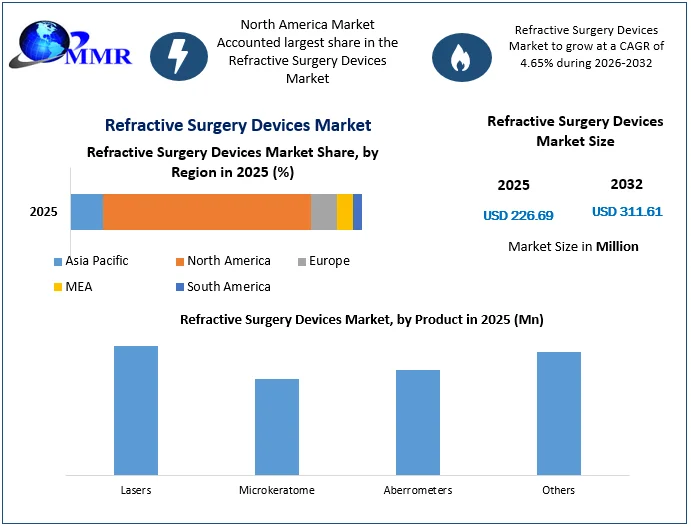
- Global market valued at USD 226.69 million in 2025.
- Forecast to reach USD 311.61 million by 2032.
- Expected CAGR of 4.65% during 2026–2032.
- North America remains the largest regional market.
- Advanced laser platforms continue to dominate product demand.
- Rising myopia prevalence increases demand for corrective procedures.
- FDA approvals and AI-enhanced surgical platforms accelerate product innovation.
- High equipment costs remain the industry’s primary adoption challenge.
Why This Matters Now
Vision correction is shifting toward precision-guided, minimally invasive procedures supported by advanced laser platforms and diagnostic technologies. As myopia cases rise worldwide and patients seek permanent alternatives to glasses and contact lenses, ophthalmology providers are investing in next-generation refractive surgery systems. Manufacturers capable of delivering safer, faster, and more personalized procedures are strengthening their competitive position despite capital-intensive equipment costs.
Market Overview
The Refractive Surgery Devices Market Size includes laser platforms, diagnostic systems, microkeratomes, and supporting ophthalmic equipment used to correct refractive disorders including myopia, hyperopia, astigmatism, and presbyopia.
Demand continues to increase as patients pursue long-term vision correction rather than lifelong dependence on spectacles or contact lenses. Growing awareness of laser-assisted procedures, improving clinical outcomes, and shorter recovery times continue to support procedural volumes globally.
Technology remains the industry’s primary growth engine. Wavefront-guided treatment planning, femtosecond laser systems, high-speed eye tracking, and customized corneal mapping have significantly improved surgical precision while reducing complications.
Market expansion is balanced by high capital expenditure. Premium excimer laser systems often require investments exceeding USD 100,000, limiting adoption among smaller ophthalmology clinics and hospitals. Equipment affordability remains a major purchasing consideration, particularly across developing healthcare systems.
An aging global population, increasing screen exposure, rising myopia prevalence, and expanding private healthcare investment continue to strengthen long-term demand for refractive surgery technologies.
Key Trends Driving Growth
Artificial intelligence and digital imaging are transforming refractive surgery planning. Advanced wavefront-guided diagnostics and high-frequency eye-tracking systems enable surgeons to perform customized treatments with greater accuracy, improving visual outcomes while reducing retreatment rates.
Laser technology continues to evolve rapidly. Femtosecond lasers, excimer platforms, and minimally invasive refractive procedures increasingly replace traditional surgical methods by improving precision, shortening recovery periods, and enhancing patient satisfaction.
Regulatory approvals are expanding treatment eligibility. Recent FDA approvals for implantable collamer lenses broaden the addressable patient population, allowing manufacturers to access new revenue opportunities while increasing adoption of lens-based correction alternatives.
Hospitals and ophthalmology clinics continue investing in premium surgical systems despite rising equipment costs because improved procedural efficiency increases patient throughput and long-term profitability.
Growing demand for personalized eye care is increasing adoption of aberrometers and advanced diagnostic systems that enable customized treatment planning based on each patient’s unique corneal profile.
Medical tourism across Asia Pacific is creating additional procedure demand as international patients seek high-quality refractive surgery at competitive treatment costs.
Explore detailed analysis, insights, and growth opportunities
Segment Insights
Dominant Segment: Lasers
Laser systems remain the largest product category because they represent the foundation of modern refractive surgery. Excimer lasers and femtosecond lasers deliver exceptional precision while minimizing tissue damage and improving visual recovery.
Continuous improvements in ablation accuracy, eye-tracking capabilities, and customized treatment algorithms reinforce laser systems as the preferred technology across hospitals and specialty ophthalmology clinics.
Business impact: Manufacturers developing higher-speed, AI-assisted laser platforms gain stronger pricing power while healthcare providers benefit from greater surgical efficiency and improved patient outcomes.
Fastest-Growing Segment: Aberrometers
Aberrometers are recording strong growth as customized vision correction becomes standard clinical practice. These diagnostic devices accurately measure optical aberrations before surgery, allowing surgeons to personalize treatment plans for every patient.
Growing emphasis on premium visual outcomes and precision medicine is driving wider adoption across advanced refractive surgery centers.
Business impact: Diagnostic technology increasingly differentiates premium surgical providers by improving treatment accuracy and reducing postoperative complications.
Additional Segment Insights
Myopia remains the largest application segment due to its rapidly increasing global prevalence, particularly among younger populations exposed to prolonged digital screen usage. This trend continues to expand the addressable patient population for laser correction procedures.
Hyperopia and astigmatism remain important treatment categories supported by specialized laser algorithms and toric intraocular lenses that improve correction accuracy.
Presbyopia represents one of the fastest-growing opportunities as aging populations seek independence from reading glasses. Multifocal intraocular lenses and innovative corneal technologies continue expanding treatment options.
Hospitals maintain the largest end-user share because they possess the financial resources and specialized infrastructure required for high-value surgical equipment investments. Dedicated ophthalmology clinics continue expanding rapidly through specialization and premium patient care services.
Regional Growth Story
North America leads the global market due to advanced healthcare infrastructure, widespread adoption of premium ophthalmic technology, favorable reimbursement systems, and strong patient awareness. The United States continues driving innovation through leading manufacturers, regulatory approvals, and significant ophthalmology research investments.
Europe remains a mature market supported by established healthcare systems, strong clinical expertise, and rapid adoption of advanced laser technologies such as LASIK and SMILE. Germany, the United Kingdom, France, and Italy continue investing in next-generation ophthalmic equipment.
Asia Pacific represents the fastest-growing regional opportunity. China, India, Japan, and South Korea are experiencing rising demand driven by urbanization, increasing disposable income, expanding healthcare infrastructure, and growing awareness of permanent vision correction procedures. Medical tourism further strengthens regional procedure volumes.
Middle East, Africa, and South America continue expanding gradually as private healthcare investment increases and specialized ophthalmology services become more widely available.
Regional competition increasingly favors countries investing in advanced ophthalmic training, digital healthcare infrastructure, and premium surgical technologies capable of attracting international patients.
Competitive Landscape
Competition is increasingly focused on technology leadership rather than product volume. Companies investing in precision laser systems, advanced diagnostics, and premium intraocular lenses are strengthening their market position through differentiated clinical outcomes.
Leading manufacturers including Visx, Topcon Corporation, Essilor, Refractec, HOYA Corporation, Aaren Scientific Inc., OPHTEC BV, HumanOptics AG, STAAR, Avedro, Nidek, Lensar, iVIS Technologies, Carl Zeiss AG, and Lumenis Ltd. continue expanding their product portfolios through innovation, regulatory approvals, and strategic acquisitions.
Recent product launches demonstrate an industry shift toward integrated treatment ecosystems combining diagnostics, surgical planning, laser treatment, and postoperative assessment. Companies capable of offering complete ophthalmic solutions are increasingly preferred by hospitals and specialty clinics seeking operational efficiency.
Strategic acquisitions are also strengthening regional market access while enabling manufacturers to expand elective vision correction services into high-growth healthcare markets.
Recent Developments
- February 2026: Carl Zeiss Meditec announced organizational restructuring and increased localization of ophthalmic product development to improve resilience against geopolitical uncertainty.
- February 2026: STAAR Surgical received FDA approval expanding the eligible age range for EVO and EVO+ Visian Implantable Collamer Lenses to patients aged 21–60 years.
- March 2026: SMS Healthcare acquired LASERSIGHT Australia, expanding its presence in advanced elective vision correction services.
- April 2026: Alcon introduced Clareon TruPlus monofocal and toric intraocular lenses featuring Opti-Balance technology to improve depth of focus.
- April 2026: Bausch + Lomb presented clinical data validating the precision and safety of its Technolas Teneo 317 Model 2 Excimer Laser Platform using advanced 1740 Hz eye-tracking technology.
Future Outlook
Manufacturers that combine AI-enabled diagnostics, premium laser platforms, and integrated ophthalmic treatment ecosystems will capture the greatest competitive advantage as personalized vision correction becomes the global standard of care.
About Maximize Market Research
Maximize Market Research Pvt. Ltd. (MMR) is a global market research and consulting company that provides reliable, data-focused, and practical business insights. The firm serves a wide range of industries, including healthcare, pharmaceuticals, technology, automotive, electronics, chemicals, personal care, and consumer goods. Through market forecasts, competitive analysis, strategic consulting, and industry impact assessments, MMR helps organizations understand changing market conditions, identify growth opportunities, and make informed business decisions for long-term success.
Contact Us :
2nd Floor, Navale IT Park Phase 3
Pune Banglore Highway, Narhe
Pune, Maharashtra 411041, India
+91 9607365656
sales@maximizemarketresearch.com
