Key Highlights
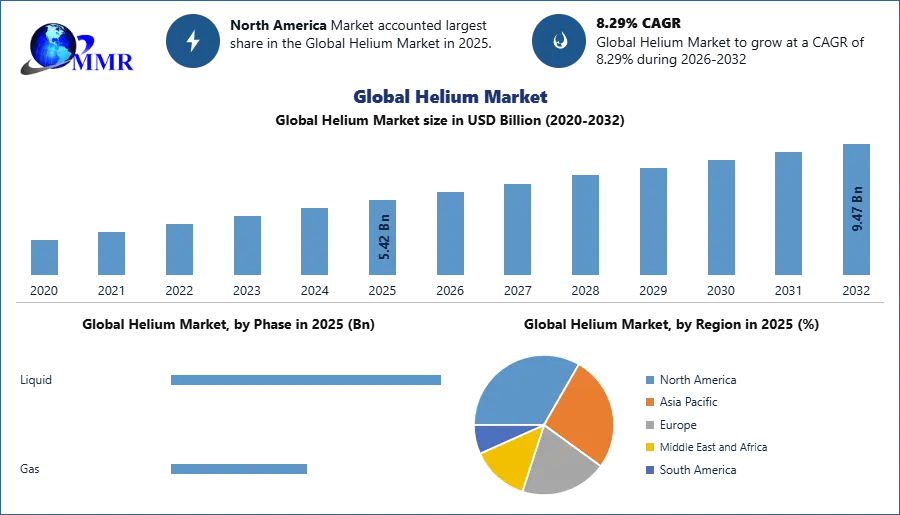
The global helium market achieved an established commercial valuation of USD 5.42 billion in 2025.
Total market revenue is projected to expand at an 8.29% compound annual growth rate from 2026 through 2032.
Market records indicate the total global sector value is on track to reach USD 9.47 billion by the conclusion of 2032.
The healthcare segment holds the dominant end-user market share, controlling more than 34% of total market revenue.
The cryogenics application segment represents the primary functional application, commanding 28% of overall revenue.
Why This Matters Now The complete privatization of the United States Federal Helium Reserve has permanently eliminated the historical public safety net for industrial gas procurement, exposing global buyers to immediate market volatility. Helium operates as a non-renewable, strategically critical asset with high thermal conductivity that cannot be chemically duplicated or substituted in advanced manufacturing. Industrial procurement managers who fail to secure long-term, private take-or-pay supply contracts face severe assembly line stoppages as the high-tech electronics sector enters a prolonged structural deficit.
The simultaneous expansion of sub-2nm semiconductor fabrication facilities has increased the global demand for ultra-high purity gas, creating an ongoing imbalance across traditional distribution networks. This supply-demand gap forces medical imaging centers, aerospace contractors, and fabrication plants to either invest in local reclamation technology or accept soaring spot market prices.
Market Overview The global Helium Market covers the exploration, extraction, cryogenic liquefaction, and international distribution of elemental helium across specialized commercial sectors. Characterized by its unique physical properties—including an exceptionally low boiling point of -269°C and high thermal conductivity—helium is essential for maintaining stable temperatures in superconducting systems and protecting sensitive chemical reactions. The structural architecture of this industry includes deep-well extraction fields, regional gas processing facilities, and specialized high-vacuum trans-filling logistics nodes.
Data models show the global helium market reached a baseline valuation of USD 5.42 billion in 2025. Driven by intense high-tech and clinical demand, total market revenue is expanding at an 8.29% compound annual growth rate through the 2026 to 2032 forecast period. This trajectory will lift the total value of the international sector to USD 9.47 billion by 2032. This development marks a transition from a natural gas byproduct model to primary, dedicated helium exploration.
Key Trends Driving Growth The primary driver of market growth is the rapid expansion of the global electronics and semiconductor industry, where helium is necessary for temperature regulation during wafer production. As integrated circuitry shrinks toward advanced sub-2nm nodes, maintaining precise thermal control during plasma etching and chemical vapor deposition becomes critical to preventing wafer warping. Helium efficiently transfers heat away from the silicon substrate, providing the process control required to sustain next-generation chip manufacturing.
Simultaneously, the global rollout of high-performance data centers and fiber-optic networks has established a reliable downstream demand loop. Helium is essential for the high-speed manufacturing of thin optical fibers and serves as an inert shielding gas in automated component assembly. Without its high thermal dissipation capability, the production speed of modern communication hardware would drop significantly, delaying international data infrastructure installations.
Furthermore, a significant sustainability trend is emerging through the deployment of helium recovery and liquefaction systems. Driven by spot pricing volatility, major medical facilities and research labs are shifting toward a circular helium model by installing closed-loop recycling skids on site. This operational shift reduces a facility’s reliance on bulk liquid deliveries, creating a growing market segment for localized gas purification and recycling equipment.
Segment Insights
Healthcare (Dominant End-User Segment): Capturing more than 34% of overall market revenue, this segment is anchored by the continuous consumption of liquid helium to cool superconducting magnets in magnetic resonance imaging systems.
Cryogenics (Dominant Application Segment): Holding a 28% market share, this segment relies on liquid helium’s -269°C boiling point to support particle accelerators, large hadron colliders, and nuclear magnetic resonance spectroscopy.
Ultra-High Purity Grade (Fastest-Growing Segment): Driven by the sub-2nm chip sector and advanced quantum computing research, this high-purity division is seeing the fastest demand acceleration.
Industrial Grade Gas: This segment maintains steady volume across traditional metal arc welding shield applications and aerospace leak detection protocols.
Regional Growth Story North America accounted for the largest portion of the global helium market, with the United States alone controlling 30% of global consumption. The massive footprint of the U.S. electronics market, combined with a high concentration of biomedical research institutions, drives this continuous regional demand. The privatization of domestic reserves has shifted regional supply dynamics toward new primary extraction operations across Saskatchewan and adjacent Canadian basins.
The Asia-Pacific region is experiencing the fastest growth rate, fueled by major semiconductor manufacturing investments in Taiwan, South Korea, Japan, and China. China’s growing electronics assembly infrastructure and expanding healthcare networks have increased its reliance on imported liquid helium cylinders. Meanwhile, India’s expanding petrochemical and industrial manufacturing sectors, backed by state initiatives, are creating new demand pathways for specialized industrial-grade process gases.
Competitive Landscape The global helium market is highly consolidated, led by major industrial gas corporations alongside specialized exploration firms. Key industry players include Helium Evolution Incorporated, New Era Helium Inc., Pulsar Helium Inc., Helium One Global Ltd., Air Products and Chemicals Inc., Linde plc, and Air Liquide.
Competition is focused on securing proven geographic assets, optimizing cryogenic liquefaction logistics, and advancing purification technologies. Leading companies are investing heavily in primary helium extraction fields—where helium is the main target rather than a natural gas byproduct—to decouple their supply chains from fossil fuel volatility. This strategy allows producers to command premium pricing from high-tech buyers who require guaranteed, long-term delivery contracts.
Recent Developments
On February 25, 2025, Helium Evolution Incorporated optimized its regional drilling assets to accelerate primary helium production and support agricultural and chemical processing clients.
On April 09, 2025, New Era Helium Inc. advanced its logistics infrastructure to supply high-purity helium to the North American semiconductor fabrication sector.
On May 29, 2025, Pulsar Helium Inc. expanded its exploratory footprint to develop high-grade primary deposits, reducing dependence on older, depleting natural gas fields.
On June 10, 2025, Helium One Global Ltd. expanded its international distribution agreements to strengthen liquid helium trade flows to fast-growing Asian technology hubs.
Strategic Implications The transition of the helium market to a fully privatized model means that procurement managers can no longer rely on state-backed reserves to buffer against sudden supply disruptions. The concentration of global production within a few primary extraction zones means that regional transport issues or geopolitical shifts can rapidly trigger supply deficits.
To hedge against this risk, electronics and healthcare conglomerates are shifting from spot market purchasing to long-term take-or-pay contracts. Additionally, the growing adoption of local recycling skids indicates that future market expansion will depend on a company’s ability to provide integrated reclamation services alongside bulk gas deliveries.
Future Outlook The global helium market is positioned for sustained revenue expansion as semiconductor fabrication plants scale up production to meet advanced computing and artificial intelligence demands. Long-term commercial success will belong to industrial gas suppliers that secure independent primary extraction assets while providing closed-loop recycling systems to shield clients from spot market volatility.
Analyst Perspective “The global helium market has entered a new era defined by private asset control and strict purity requirements for advanced manufacturing,” states Ankita Kagawade, Lead Analyst at Maximize Market Research. “With the United States driving nearly a third of global consumption and Asian fabrication hubs expanding rapidly, industrial buyers must prioritize long-term supply commitments and local recycling technologies to mitigate volatile price spikes.”
About Maximize Market Research
Maximize Market Research Pvt. Ltd. (MMR) is a global market research and consulting company that provides reliable, data-focused, and practical business insights. The firm serves a wide range of industries, including healthcare, pharmaceuticals, technology, automotive, electronics, chemicals, personal care, and consumer goods. Through market forecasts, competitive analysis, strategic consulting, and industry impact assessments, MMR helps organizations understand changing market conditions, identify growth opportunities, and make informed business decisions for long-term success.
2nd Floor, Navale IT Park Phase 3
Pune Banglore Highway, Narhe
Pune, Maharashtra 411041, India
+91 9607365656
sales@maximizemarketresearch.com
