Key Highlights
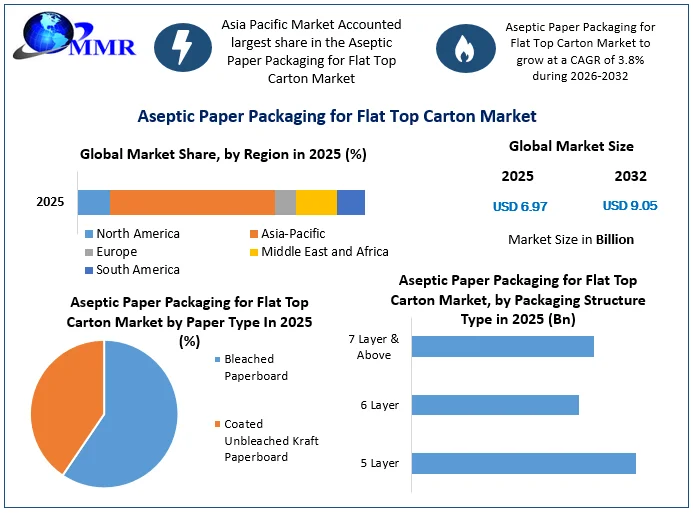
Market Forecast: Expected to reach US$ 9.05 Billion by 2032.
Growth Trajectory: Projected CAGR of 3.8% during the forecast period.
Dominant Market Segment: Dairy and liquid dairy-alternative products.
Fastest-Growing Segment: Premium, eco-certified barrier-coated cartons.
Strategic Pivot: Integration of renewable, fiber-based materials to replace traditional multi-layer plastics.
Why This Matters Now
Consumer preference is shifting toward clean-label products and sustainable packaging at an unprecedented rate. For procurement leaders and industrial manufacturers, the aseptic flat top carton is no longer just a commodity container—it is a critical tool for maintaining shelf life without chemical preservatives while meeting strict ESG (Environmental, Social, and Governance) targets. Companies that prioritize high-performance, renewable paperboard solutions are capturing market share from traditional plastic and glass alternatives.
Market Overview
Aseptic paper packaging for flat top cartons provides a sterile, long-term storage solution for liquid food and beverages. By combining paperboard with specialized protective layers, the packaging preserves product integrity without the need for refrigeration. Growing at a CAGR of 3.8%, the Aseptic Paper Packaging for Flat Top Carton Market is steadily expanding its footprint, particularly as emerging economies improve their cold-chain logistics and demand for on-the-go nutrition increases. This growth represents a pivot toward packaging solutions that minimize food waste while optimizing logistics through lightweight, stackable designs.
Key Trends Driving Growth
Barrier Technology Upgrades: Manufacturers are investing in next-generation, high-barrier coatings that maintain oxygen and light protection while remaining easily separable during the recycling process.
Circular Economy Adoption: There is a sector-wide push to increase the share of renewable fibers in carton construction, aligning with regulatory requirements across Europe and North America to curb single-use plastic waste.
On-the-Go Convenience: Fast-paced urban lifestyles are driving demand for compact, easy-to-open, and shelf-stable formats, particularly for health-conscious beverages and plant-based milks.
Segment Insights
Dominant Segment (Dairy & Liquid Foods): This segment remains the primary revenue driver, as the inherent shelf-stability of aseptic cartons is indispensable for dairy supply chains.
Fastest-Growing Segment (Sustainable Eco-Coated Cartons): Innovations in bio-based and renewable-content barrier layers are seeing the fastest adoption as brands seek to appeal to environmentally conscious, premium-segment consumers.
Regional Growth Story
The Asia-Pacific region remains the most critical market, supported by rapid urbanization and the expansion of modern retail in China and India. The surging demand for pre-packaged milk and juice beverages has forced regional players to aggressively scale their production capacity. Meanwhile, North America and Europe are leading the transition toward higher recyclability standards, forcing regional suppliers to modernize existing manufacturing lines to meet non-plastic-centric regulatory mandates.
Competitive Landscape
The market is characterized by intense competition between legacy giants and agile regional players. Strategic acquisitions remain common as major manufacturers seek to control proprietary barrier-coating technologies or expand their footprint in developing markets. Pricing power is increasingly tied to a supplier’s ability to offer “turn-key” sustainability solutions—where the carton design, material, and recovery capability are bundled as a single value proposition.
Recent Developments
Renewable Material Partnerships: Leading carton manufacturers have entered into long-term supply agreements with forestry companies to secure FSC-certified, sustainable paperboard.
Infrastructure Investment: Increased capital allocation toward high-speed, flexible production lines that allow manufacturers to rapidly pivot between standard and premium carton designs.
Regulatory Alignment: Major industry players are proactively updating their product portfolios to comply with tightening EPR (Extended Producer Responsibility) schemes in key chemical manufacturing hubs, ensuring long-term supply chain stability.
Strategic Implications
The aseptic paper market is evolving into a high-tech sector where material science dictates competitive advantage. Procurement teams must look beyond unit costs and evaluate “total cost of compliance.” Manufacturers who successfully integrate renewable polymers and thin-film barrier technologies that are optimized for standard pulping streams will capture the premium tier of the market. Conversely, those tied to older, multi-layer formats that are difficult to recycle will face increasing “green-tax” pressures.
Future Outlook
Winners in the aseptic flat top carton market will be defined by their ability to provide high-barrier protection through circular, fiber-heavy material designs that satisfy both shelf-life requirements and global recyclability mandates. The sector is moving toward a future where material traceability and carbon-neutral production become the baseline requirements for entry into major retail supply chains, creating an environment where only technologically agile players will thrive.
Analyst Perspective
“The aseptic paper packaging sector for flat top cartons is currently balancing a complex trade-off between preservation-heavy barrier requirements and the immediate demand for circularity. We are witnessing a clear transition where sustainable, fiber-centric innovation is becoming the primary driver of capital investment. Suppliers that can effectively monetize their high-barrier, easily-recyclable packaging assets will lead the market through 2032.”
— Ankita Kagawade, Analyst, Maximize Market Research
About Maximize Market Research
Maximize Market Research Pvt. Ltd. (MMR) is a global market research and consulting company that provides reliable, data-focused, and practical business insights. The firm serves a wide range of industries, including healthcare, pharmaceuticals, technology, automotive, electronics, chemicals, personal care, and consumer goods. Through market forecasts, competitive analysis, strategic consulting, and industry impact assessments, MMR helps organizations understand changing market conditions, identify growth opportunities, and make informed business decisions for long-term success.
2nd Floor, Navale IT Park Phase 3
Pune Banglore Highway, Narhe
Pune, Maharashtra 411041, India
+91 9607365656
sales@maximizemarketresearch.com
