Key Highlights
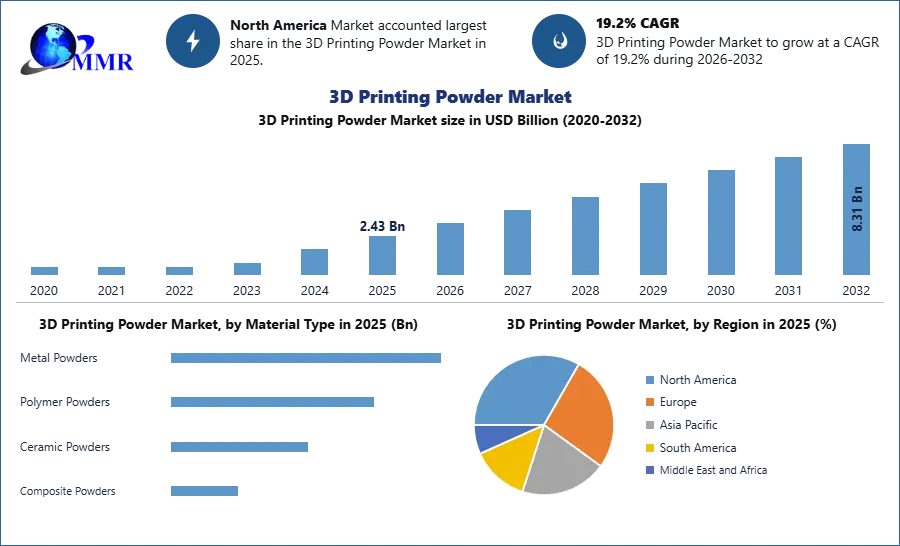
Market Trajectory: Valuation of USD 2.43 billion in 2025, forecasted to hit USD 8.31 billion by 2032.
Dominant Material: Metal powders lead due to their role in high-stress aerospace and automotive applications.
Dominant Application: Aerospace & Defense remains the largest consumer, prioritizing toughness and weight reduction.
Regional Leader: North America continues to hold the largest market share, driven by infrastructure investment and R&D concentration.
Strategic Barrier: Consistency and purity of powder composition represent the primary operational risk to scaling additive manufacturing.
Why This Matters Now
The urgency for industrial buyers stems from the critical reliance of modern aerospace and medical device production on specialized, defect-free powders. As the technology moves toward bioprinting complex tissues and organ models, the requirements for quality control will only intensify. Companies that do not secure supply lines for high-purity titanium, nickel-based alloys, and advanced polymers face the risk of costly production defects, which ultimately compromises the integrity of high-stakes manufactured parts.
Market Overview
3D printing powder serves as the raw foundation for additive manufacturing. The 3D Printing Powder Market encompasses a diverse array of ceramics, metals, polymers, and composites. These materials are processed through techniques like laser sintering and binder jetting to create intricate, layer-by-layer objects. The current market dynamic is characterized by a “high-precision, high-stakes” requirement; as additive manufacturing replaces traditional casting or milling, the standard for feedstock quality has escalated, creating a market where material chemistry is as important as the printing technology itself.
Key Trends Driving Growth
Composite Evolution: There is a marked transition toward metal matrix composites and carbon fiber-reinforced polymers. These materials offer an optimized strength-to-weight ratio, which is essential for lightweighting in aerospace and high-performance automotive machinery.
Medical Personalization: The healthcare sector is shifting toward on-demand production of orthopedic implants and even potential bioprinting of tissues. This creates a high-margin, consistent demand for biocompatible powders that meet stringent regulatory standards.
Technology Integration: The adoption of DMLS and SLS technologies is scaling rapidly, as they allow for the production of geometrically complex parts that cannot be created through traditional manufacturing.
Segment Insights
Dominant Material Segment: Metal Powders. These dominate due to their indispensable role in high-performance industrial components where structural durability is paramount. Titanium, aluminum, and nickel-based alloys have become the industry standard for aerospace and automotive structural parts.
Fastest-Growing Technology: Direct Metal Laser Sintering (DMLS) and Selective Laser Sintering (SLS). These technologies represent the majority of the market share, providing the accuracy required for high-stress applications in defense and aviation.
Dominant Application: Aerospace & Defense. The segment prioritizes extreme performance and reliability, utilizing additive manufacturing to optimize engine parts and defense equipment, which contributes significantly to global revenue.
Regional Growth Story
North America remains the epicenter of the 3D printing powder market, anchored by a robust ecosystem of aerospace and healthcare OEMs. The region’s focus on R&D, coupled with a dense concentration of additive manufacturing infrastructure, provides a competitive moat that other regions are currently closing. However, the Asia-Pacific region is experiencing a surge in demand, fueled by rapid industrialization in China and India. As these countries scale their manufacturing bases, the shift of volume production toward the APAC region is likely to influence global pricing for common alloy powders.
Competitive Landscape
The market is defined by a select group of major suppliers, including companies such as Carpenter, Sandvik, Erasteel, and LPW Technology. The competitive battleground is shifting from simple capacity expansion to technological differentiation and quality control. Established players are focusing on vertical integration—securing the raw metallic and ceramic sources to guarantee purity—while newer entrants are carving out niches in specialized composite formulations. This concentration indicates that pricing power is increasingly held by those who can guarantee the lowest defect rates and the highest repeatability in powder composition.
Recent Developments
Scaling Production: Major manufacturers are investing heavily in new production facilities for titanium and nickel-based powders to meet the surge in demand for aerospace components.
Quality Assurance Protocols: Companies are adopting more rigorous impurity-testing technologies to ensure consistency, which is vital as the industry moves away from prototyping toward serialized manufacturing.
Process Efficiency: New initiatives are underway to streamline the additive manufacturing process—specifically aiming to reduce the cost and time required for building large-scale titanium components.
Strategic Implications
The transition of 3D printing powder from a specialized material to an industrial commodity requires a rethinking of procurement strategies. Industrial buyers should move toward long-term supply agreements that prioritize material consistency over short-term price fluctuations. Investors should look for companies that demonstrate strong R&D pipelines in material science, as the ability to develop proprietary composite powders will serve as a significant competitive advantage over firms offering only standard-grade materials.
Future Outlook
The 3D printing powder market is poised for significant structural change as the industry shifts from prototyping toward full-scale industrial integration. The winners will be those who can navigate the high-barrier requirements of quality control and specialized material development, while the losers will be firms that fail to differentiate in a market that is rapidly rewarding precision over pure volume. Success will hinge on the ability to standardize high-purity feedstock for critical-path applications in the aerospace and healthcare sectors.
Analyst Perspective
“The 3D printing powder market is evolving into a high-barrier environment where material integrity serves as the primary currency,” says Ankita Kagawade, Analyst at Maximize Market Research. “For manufacturers, the focus has shifted from simple availability to ensuring that the chemical consistency of the powder can withstand the rigors of mission-critical industrial use, setting the stage for a period of rapid technical innovation and strategic consolidation.”
About Maximize Market Research
Maximize Market Research Pvt. Ltd. (MMR) is a global market research and consulting company that provides reliable, data-focused, and practical business insights. The firm serves a wide range of industries, including healthcare, pharmaceuticals, technology, automotive, electronics, chemicals, personal care, and consumer goods. Through market forecasts, competitive analysis, strategic consulting, and industry impact assessments, MMR helps organizations understand changing market conditions, identify growth opportunities, and make informed business decisions for long-term success.
2nd Floor, Navale IT Park Phase 3
Pune Banglore Highway, Narhe
Pune, Maharashtra 411041, India
+91 9607365656
sales@maximizemarketresearch.com
