Key Highlights
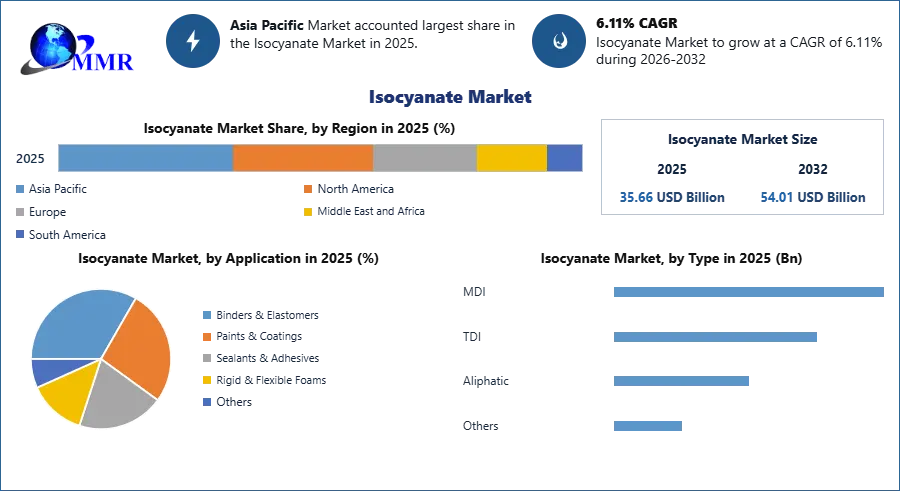
Market Valuation: Valued at USD 35.66 billion in 2025; projected to reach USD 54.01 billion by 2032.
Growth Trajectory: Compounded Annual Growth Rate (CAGR) of 6.11% from 2026–2032.
Dominant Type: Methylene Diphenyl Diisocyanate (MDI) holds a 36% market share.
Dominant Application: Rigid and flexible foams represent 43% of total application demand.
Regional Hub: Asia-Pacific remains the primary market, commanding 43% of the global share.
Strategic Pivot: Rapid acceleration toward bio-based isocyanates and recycling integration to counter regulatory and health-related headwinds.
Why This Matters Now
Chemical manufacturers and industrial procurement leaders are operating in a volatile landscape where isocyanate demand is climbing, yet regulatory pressure is at a decade-high. With the market path trending toward a USD 54.01 billion valuation by 2032, the cost of inaction regarding supply chain resilience and environmental compliance is rising. Companies that fail to modernize their production infrastructure or integrate sustainable alternatives now risk being sidelined by tightening OSHA and EPA standards that fundamentally alter operating margins.
Market Overview
The Isocyanate Market, centered on the production of MDI, TDI, and aliphatic compounds, is currently undergoing a structural realignment. Valued at USD 35.66 billion in 2025, the sector is driven by the indispensable role of polyurethane (PU) in modern industrial applications. From lightweight automotive components to essential thermal insulation in construction, the chemistry of the (-NCO) group remains a cornerstone of material science. However, the reliance on crude oil, benzene, and aniline necessitates a pivot toward process efficiency and alternative feedstocks to ensure long-term viability.
Key Trends Driving Growth
Demand is currently sustained by two primary vectors: urban infrastructure expansion and the automotive lightweighting trend. In Southeast Asia, China, and India, the massive deficit in properly insulated building stock is creating long-term, predictable demand for rigid PU foams. Simultaneously, the automotive sector is utilizing isocyanate-derived polymers to reduce vehicle weight, thereby lowering emissions and increasing fuel efficiency. These sectors are the backbone of the 6.11% CAGR projection, forcing manufacturers to rethink production capacities to match localized industrial surges.
Segment Insights
Dominant Type (MDI): With a 36% market share, MDI is the primary driver. Its critical role in rigid foam for coolers, freezers, and structural automotive components makes it the most essential category for growth.
Fastest-Growing/Dominant Application (Foams): Rigid and flexible foams hold 43% of the market. This segment is growing aggressively due to the surging need for cushioning, bedding, and packaging materials, as well as critical thermal insulation in the building industry.
Paints & Coatings: These remain a stable segment, vital for protection against corrosion and UV radiation in heavy industrial and architectural projects.
Regional Growth Story Asia-Pacific acts as the engine of the global market, controlling 43% of the total share in 2025. China’s role as both the largest manufacturer and user of PU products remains the primary stabilizing force. Conversely, North America and Europe are experiencing slower demand growth, a direct consequence of increased regulatory scrutiny over MDI and TDI environmental and health impacts. For global players, this necessitates a bifurcated strategy: aggressive volume expansion in Asia-Pacific, coupled with high-cost, high-compliance technical optimization in Western markets.
Competitive Landscape The market is characterized by intense capital expenditure and strategic consolidation. Leading players like BASF SE, Covestro AG, and Wanhua Chemical Group are no longer competing on commodity scale alone; they are competing on operational intelligence and circularity. Investments in digital centers and bio-based partnerships indicate a shift toward reducing operational complexity and insulating the value chain from volatile raw material pricing. Regional leaders like Kumho Mitsui Chemicals are expanding capacity while integrating recycling, signaling that future pricing power will belong to those who master the environmental cost-to-production ratio.
Recent Developments
BASF SE (January 2026): Opened a global digital center in Hyderabad, India, to drive AI integration and optimize its global isocyanate value chain.
Covestro AG (December 2025): Finalized a strategic partnership with XRG (ADNOC) with a €1.17 billion capital increase to accelerate circular economy investments.
Kumho Mitsui Chemicals (December 2025): Authorized a 100,000-ton MDI capacity expansion at its Yeosu facility, targeting a 710,000-ton annual output by 2027.
P2 Science and Algenesis (November 2025): Launched a strategic collaboration for the commercial production of 100% bio-based polyurethane materials.
Dow Inc. (May 2025): Commissioned a new 300,000 metric tons/year isocyanate facility in Freeport, Texas, securing the North American supply chain for construction and automotive demand.
Strategic Implications
The transition toward bio-based isocyanates is the single most important long-term strategic opportunity. Manufacturers must move beyond standard phosgene-based production methods to avoid future regulatory obsolescence. Procurement leaders should prioritize suppliers who demonstrate capacity for vertical integration—specifically those who control their feedstock inputs and possess robust recycling infrastructure. The market structure is shifting from a reliance on simple volume to a premium on sustainability-linked security of supply.
Future Outlook
The move toward sustainable isocyanate alternatives is no longer a peripheral corporate social responsibility goal; it is a fundamental requirement for market entry. As feedstock costs fluctuate and regulatory bodies tighten exposure standards, the winners in this USD 54 billion landscape will be the companies that successfully deploy bio-based feedstocks and closed-loop recycling without sacrificing the material performance metrics demanded by automotive and construction OEMs.
Analyst Perspective
“The isocyanate industry is at a crossroads. While the demand for high-performance polyurethanes is stronger than ever, the license to operate is being redefined by ESG standards and circularity requirements. Companies that are aggressively integrating digital operational efficiency with bio-based innovation will effectively capture the significant revenue expansion forecast through 2032.” — Ankita Kagawade, Analyst, Maximize Market Research.
About Maximize Market Research
Maximize Market Research Pvt. Ltd. (MMR) is a global market research and consulting company that provides reliable, data-focused, and practical business insights. The firm serves a wide range of industries, including healthcare, pharmaceuticals, technology, automotive, electronics, chemicals, personal care, and consumer goods. Through market forecasts, competitive analysis, strategic consulting, and industry impact assessments, MMR helps organizations understand changing market conditions, identify growth opportunities, and make informed business decisions for long-term success.
2nd Floor, Navale IT Park Phase 3
Pune Banglore Highway, Narhe
Pune, Maharashtra 411041, India
+91 9607365656
sales@maximizemarketresearch.com
