Key Highlights
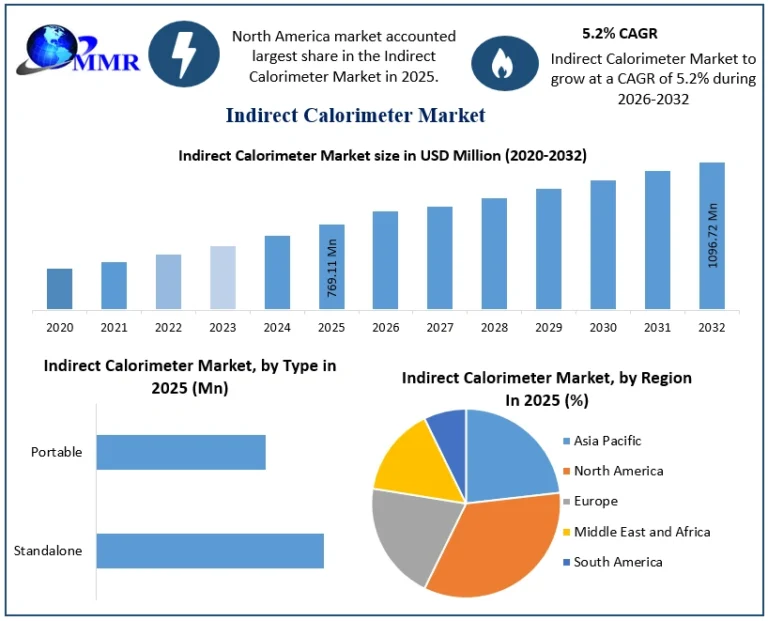
- Market valued at USD 769.11 million in 2025.
- Forecast to reach USD 1.10 billion by 2032.
- Expected CAGR of 5.2% during 2026–2032.
- Standalone systems lead overall market revenue.
- Hospitals account for the largest end-user segment.
- North America remains the largest regional market.
- Portable and wireless devices are expanding new clinical applications.
- AI-enabled analytics and cloud connectivity are improving metabolic assessment accuracy.
- Rising obesity, burn injuries, and personalized nutrition are creating new demand.
Why This Matters Now
Healthcare providers are placing greater emphasis on precision nutrition and individualized metabolic assessment to improve clinical outcomes. Indirect calorimetry has become an essential tool for managing critically ill patients, obesity, burn injuries, and sports performance. At the same time, manufacturers are introducing portable systems and AI-enabled software that extend metabolic testing beyond intensive care units into outpatient clinics, fitness centers, and remote healthcare settings.
Market Overview
The Indirect Calorimeter Market Size includes medical devices that measure oxygen consumption and carbon dioxide production to determine resting energy expenditure and metabolic activity. These systems support nutritional planning, respiratory care, obesity management, clinical research, and athletic performance evaluation.
Demand continues to expand as healthcare providers adopt evidence-based nutrition strategies for critically ill patients. Rising obesity prevalence, increasing burn injuries, aging populations, and growing interest in personalized healthcare are strengthening utilization across hospitals and specialized clinics.
Supply-side competition is increasingly driven by innovation in portable devices, software integration, and cloud-based data management. Manufacturers are improving ease of use while reducing testing complexity, enabling broader deployment outside traditional hospital environments.
Macroeconomic factors such as healthcare infrastructure investment, research funding, digital healthcare adoption, and growing awareness of preventive medicine continue to support market expansion. However, high equipment costs and limited availability in resource-constrained healthcare systems remain important barriers to wider adoption.
Key Trends Driving Growth
Portable Metabolic Monitoring Expands Clinical Access
Demand is shifting toward portable and wireless indirect calorimeters that enable metabolic assessment in outpatient clinics, rehabilitation centers, sports facilities, and remote healthcare settings. Greater mobility increases testing accessibility while reducing operational constraints.
Artificial Intelligence Improves Clinical Decision-Making
Manufacturers are integrating AI-powered analytics, predictive modeling, and cloud-based software into metabolic assessment platforms. These capabilities simplify workflow, improve interpretation accuracy, and support personalized nutritional interventions.
Growing Role in Obesity and Lifestyle Disease Management
Healthcare providers are increasingly using indirect calorimetry to optimize nutritional strategies for obesity, diabetes, and metabolic disorders. Personalized calorie recommendations improve treatment effectiveness while supporting preventive healthcare initiatives.
Clinical Standardization Strengthens Market Confidence
Industry organizations are introducing standardized testing protocols and data normalization frameworks that improve consistency across clinical research and routine patient care. Standardization enhances data quality and supports broader adoption by healthcare institutions.
Pricing Remains a Key Market Constraint
Although technological innovation continues, high acquisition costs for metabolic carts and advanced diagnostic systems remain a significant challenge, particularly for smaller healthcare providers and emerging markets.
Explore detailed analysis, insights, and growth opportunities
Segment Insights
Dominant Segment: Standalone Indirect Calorimeters
Standalone systems account for the largest market share because they deliver highly accurate metabolic measurements required in hospitals, intensive care units, and clinical research laboratories. Their advanced analytical capabilities and integration with hospital information systems make them the preferred solution for complex patient management.
This leadership supports premium pricing opportunities for manufacturers while reinforcing demand among tertiary healthcare institutions requiring high-precision metabolic assessment.
Fastest-Growing Segment: Portable Indirect Calorimeters
Portable indirect calorimeters are expected to record the fastest adoption as healthcare shifts toward decentralized patient care and mobile diagnostics. Lightweight devices enable rapid metabolic testing across sports science, outpatient clinics, bariatric centers, and home healthcare.
Manufacturers focusing on compact, wireless, and cloud-connected systems are positioned to capture expanding demand beyond traditional hospital environments.
Additional Key Sub-Segments
Hospitals
Hospitals remain the largest end-user segment due to widespread use of indirect calorimetry for intensive care, burn management, respiratory diseases, and clinical nutrition planning. Growing emphasis on precision nutritional therapy continues to increase equipment utilization.
Research Institutes
Research institutions continue expanding adoption as metabolic research, obesity studies, and translational medicine gain greater funding. Standardized protocols are improving collaboration across international research networks.
Sports and Fitness Applications
Sports performance centers are increasingly adopting indirect calorimeters to optimize athlete training, recovery, and nutritional planning. Growing consumer interest in personalized fitness creates additional commercial opportunities for portable systems.
Regional Growth Story
North America
North America maintains market leadership due to advanced healthcare infrastructure, high obesity prevalence, significant R&D investment, and widespread adoption of critical care technologies. Strong manufacturer presence and early adoption of digital healthcare continue to reinforce regional competitiveness.
Europe
Europe remains an important innovation hub supported by established medical device manufacturers, advanced research institutions, and increasing investment in precision nutrition. Clinical standardization initiatives are expected to improve adoption across healthcare systems.
Asia-Pacific
Asia-Pacific is expected to experience steady growth as healthcare infrastructure expands and governments invest in advanced medical technologies. Rising obesity rates, increasing burn injuries, and growing aging populations are strengthening demand for metabolic assessment devices.
Middle East, Africa, and South America
These regions continue to present long-term opportunities as healthcare modernization increases demand for advanced diagnostic technologies. However, equipment affordability and limited specialist infrastructure remain key adoption challenges.
Competitive Landscape
Competition is increasingly centered on portability, software intelligence, and clinical integration. KORR Medical Technologies differentiates itself through affordable portable systems designed for broader clinical accessibility, while COSMED, MGC Diagnostics, and Maastricht Instruments BV compete through advanced research-grade platforms and integrated software ecosystems.
Companies with comprehensive product portfolios, global distribution capabilities, and continuous software innovation are strengthening competitive positions. Industry participants are increasingly investing in cloud connectivity, AI-powered analytics, and standardized metabolic data platforms to improve customer value and expand clinical applications.
Recent Developments
- February 2026: MGC Diagnostics introduced the Fenom Flo™ point-of-care respiratory diagnostic device featuring an advanced six-second breath test protocol.
- February 2026: Steno Diabetes Center Aarhus convened an international collaboration to standardize whole-room indirect calorimetry methodologies.
- November 2025: MGC Diagnostics launched the Meridian Series™ Cardiorespiratory Diagnostic Systems integrated with the Ascent™ software platform.
- September 2025: The International Indirect Calorimetry Consensus Committee published standardized operational guidelines for preclinical indirect calorimetry research.
Future Outlook
Manufacturers that combine portable hardware, AI-enabled metabolic analytics, and clinically validated precision nutrition solutions will secure the strongest competitive advantage as personalized healthcare becomes central to metabolic disease management.
Analyst Perspective – Komal Patil
The Indirect Calorimeter Market is evolving from a niche clinical diagnostic segment into a broader precision health platform driven by personalized nutrition, critical care optimization, and metabolic disease management. Advances in portable devices, AI-enabled analytics, and cloud-connected diagnostic systems are expanding adoption beyond hospitals into research institutes, sports science, and outpatient care. Companies that focus on improving affordability, workflow integration, and data-driven metabolic insights while addressing accessibility challenges in emerging markets are expected to strengthen their competitive position over the forecast period.
About Maximize Market Research
Maximize Market Research Pvt. Ltd. (MMR) is a global market research and consulting company that provides reliable, data-focused, and practical business insights. The firm serves a wide range of industries, including healthcare, pharmaceuticals, technology, automotive, electronics, chemicals, personal care, and consumer goods. Through market forecasts, competitive analysis, strategic consulting, and industry impact assessments, MMR helps organizations understand changing market conditions, identify growth opportunities, and make informed business decisions for long-term success.
Contact Us :
2nd Floor, Navale IT Park Phase 3
Pune Banglore Highway, Narhe
Pune, Maharashtra 411041, India
+91 9607365656
sales@maximizemarketresearch.com
