Key Highlights
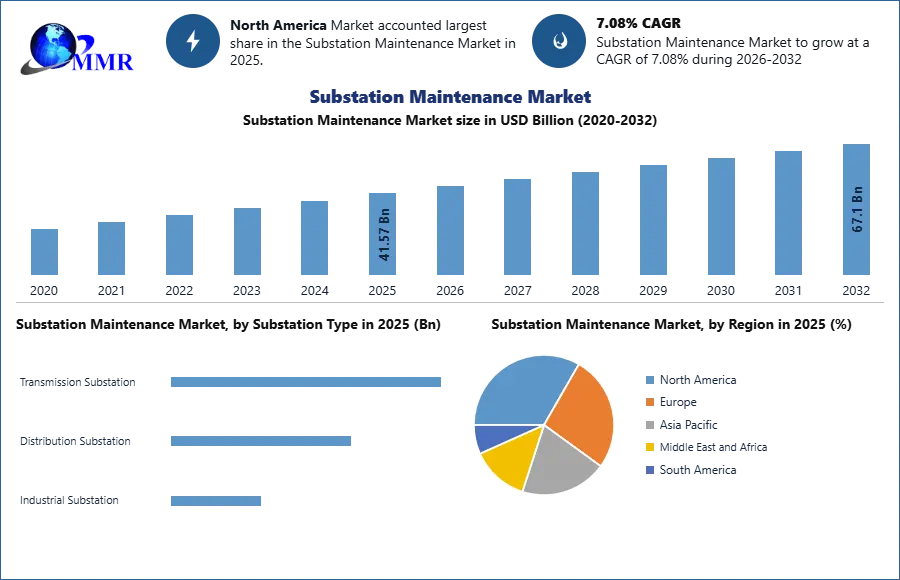
Market Valuation: Valued at USD 41.57 billion in 2025, reaching USD 67.1 billion by 2032.
Growth Trajectory: Projected CAGR of 7.08% from 2026 to 2032.
Dominant Segment: 220–500 kV voltage range, accounting for 40.12% of the market share.
Fastest-Growing Industry: Transportation sector, projected to grow at a CAGR of 8.12%.
Leading Industry Segment: Utilities, maintaining a dominant 62.56% market share.
Strategic Pivot: Rapid transition from scheduled preventive maintenance to AI-powered predictive and condition-based monitoring.
Why This Matters Now
The global energy grid is at a breaking point. With infrastructure in many developed nations exceeding 40 years of service, the risk of catastrophic failure is forcing a radical reassessment of maintenance budgets and operational strategies. For chemical manufacturers and industrial procurement leaders, this creates a volatile supply environment where downtime is the ultimate cost. The market’s path to USD 67.1 billion by 2032 is not just about repairs; it is about the digital transformation of power delivery systems.
Market Overview
The Substation Maintenance Market is the silent backbone of the modern industrial economy. As renewable energy integration and rapid electrification in Asia-Pacific place unprecedented stress on transmission nodes, the “fix-on-fail” model has become obsolete. The market is defined by a shift toward high-voltage stability, particularly in the 220–500 kV range, which serves as the primary artery for intercity and industrial power distribution. Utilities are now prioritizing asset health monitoring as a risk-mitigation strategy to ensure consistent uptime for manufacturing and urban centers.
Key Trends Driving Growth
Grid modernization is the primary catalyst. Governments worldwide are linking renewable energy targets to the necessity of dynamic grid control, which requires substations to handle variable power flows from wind and solar sources. This complexity is driving the adoption of digital twins, thermal imaging, and AI-based analytics. Furthermore, the push toward “smart grids” necessitates ongoing maintenance of hardware—transformers, circuit breakers, and relays—while simultaneously integrating fiber-optic communication networks and SCADA systems to enable real-time response.
Segment Insights
Dominant Segment (Voltage): The 220–500 kV segment maintains a 40.12% share. These nodes are critical for national transmission networks, requiring the most rigorous and frequent maintenance to prevent large-scale outages.
Dominant Segment (Industry): The Utility sector dominates with a 62.56% share, as these organizations manage the bulk of national transmission and distribution assets.
Fastest-Growing Segment: The Transportation industry is the rising star, with a CAGR of 8.12%. Increased electrification of rail and public transit systems is creating a surge in demand for reliable, specialized maintenance services for traction substations.
Regional Growth Story
Asia-Pacific is the undisputed growth engine, expected to be the fastest-growing region with a CAGR of 8.05% through 2032. Rapid industrialization and urbanization in China and India have made grid stability a top-tier national security priority. In North America and Europe, the focus remains on retrofitting aging 30-to-40-year-old infrastructure. While growth rates in Western markets appear more moderate, the sheer volume of investment in smart-grid upgrades ensures sustained revenue opportunities for service providers and hardware vendors.
Competitive Landscape
The market remains highly concentrated, with industry titans such as ABB Ltd., Siemens AG, General Electric (GE Grid Solutions), Hitachi Energy, and Schneider Electric setting the competitive pace. These companies are shifting their business models from simple equipment supply to comprehensive service agreements. By packaging sensors, predictive software, and long-term maintenance contracts, these players are creating high-barrier “sticky” relationships with utility providers. This shift signals a move toward higher-margin service revenue at the expense of one-off commodity equipment sales.
Recent Developments
Smart Grid Missions: India’s national mission targeting 120+ cities is driving billion-dollar investments into automated substation management.
Automation Deployments: The State Grid Corporation has accelerated the implementation of global-scale substation automation, setting a benchmark for predictive maintenance integration.
Predictive Analytics Adoption: Major utilities are increasingly moving away from manual preventive checks to AI-driven asset health monitoring, reducing downtime by as much as 40%.
Strategic Implications
Procurement leaders must recognize that substation maintenance is no longer a peripheral expense but a core operational pillar. The integration of predictive analytics and condition-based monitoring provides a window into asset failure that was previously opaque, allowing for precision maintenance that saves millions in downtime. For investors, the opportunity lies in vendors that have successfully transitioned from hardware-only models to comprehensive, technology-enabled service providers. Failure to modernize infrastructure is no longer a risk—it is a guaranteed liability.
Future Outlook
Winners in this sector will be the utilities and vendors that successfully bridge the gap between legacy hardware and modern digital control systems. Those who master the predictive maintenance cycle through AI and robotics will dominate, while those clinging to manual, reactive maintenance will face inevitable margin erosion and asset obsolescence.
Analyst Perspective
“The substation maintenance market has entered a phase of permanent disruption. We are seeing a complete pivot from scheduled maintenance to a predictive-first ecosystem. This transition is not merely a technological upgrade—it is a fundamental survival requirement for any utility or industrial operator facing the pressures of a complex, renewable-heavy grid. The companies that effectively integrate sensor data with actionable service delivery will capture the lion’s share of this growth by 2032.” — Ankita Kagawade, Analyst, Maximize Market Research.
About Maximize Market Research
Maximize Market Research Pvt. Ltd. (MMR) is a global market research and consulting company that provides reliable, data-focused, and practical business insights. The firm serves a wide range of industries, including healthcare, pharmaceuticals, technology, automotive, electronics, chemicals, personal care, and consumer goods. Through market forecasts, competitive analysis, strategic consulting, and industry impact assessments, MMR helps organizations understand changing market conditions, identify growth opportunities, and make informed business decisions for long-term success.
2nd Floor, Navale IT Park Phase 3
Pune Banglore Highway, Narhe
Pune, Maharashtra 411041, India
+91 9607365656
sales@maximizemarketresearch.com
