Key Highlights
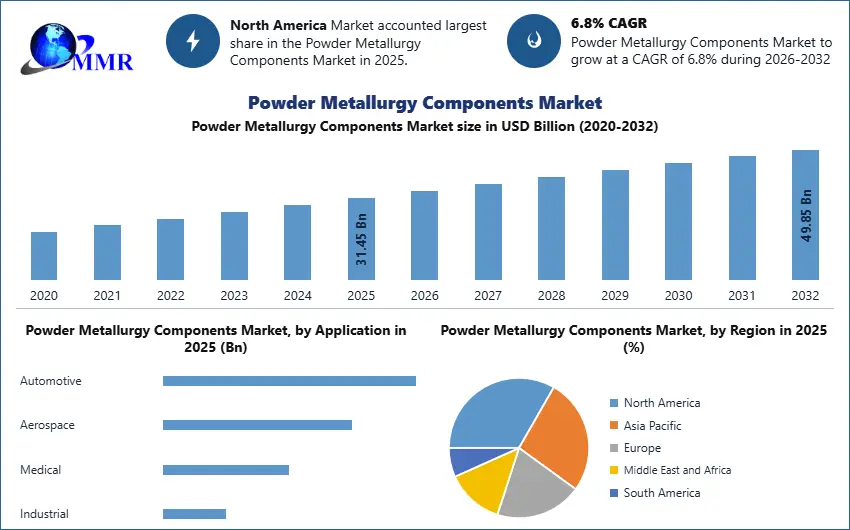
Market Valuation: Valued at USD 31.45 billion in 2025, projected to reach USD 49.85 billion by 2032.
Growth Trajectory: CAGR of 6.8% throughout the 2026–2032 forecast period.
Dominant Segment (Product): Ferrous metals (iron and steel) command the largest market share due to cost-efficiency and volume demand.
Fastest-Growing Segment: Additive manufacturing (3D printing) is accelerating, driven by the need for complex, high-performance geometries.
Leading Application: Automotive, utilizing the process for engines, transmission systems, and structural parts.
Strategic Pivot: Massive shift toward sustainability through material waste reduction (near-net-shape) and energy-efficient sintering.
Why This Matters Now
The manufacturing landscape is undergoing a brutal efficiency reset. As global supply chains face extreme cost pressures, the ability to produce complex, high-strength parts with near-zero material waste is shifting from a competitive advantage to a prerequisite for survival. With the Powder Metallurgy Components Market set to reach USD 49.85 billion by 2032, industrial procurement leaders can no longer view this as a niche production method; it is now a primary solution for the automotive and aerospace industries’ urgent lightweighting mandates.
Market Overview
Powder metallurgy (PM) is transitioning from its traditional role in high-volume, low-complexity automotive parts to the forefront of advanced engineering. Valued at USD 31.45 billion in 2025, the market is undergoing a structural expansion. The process—compacting and sintering metal powders—allows manufacturers to hit performance specifications that traditional machining simply cannot reach, particularly when dealing with intricate internal geometries. As the market grows at a 6.8% CAGR, the focus is squarely on integrating these components into high-value electric vehicle (EV) drivetrains and lightweight aerospace structural assemblies.
Key Trends Driving Growth
The most potent driver is the automotive sector’s mandate for fuel efficiency and range optimization. Because PM parts are lightweight and can be manufactured with near-net-shape precision, they are replacing heavier cast or forged components. Furthermore, the push for circular economy standards is forcing a reduction in raw material waste; PM processes can achieve utilization rates of up to 97%, significantly higher than subtractive machining. Simultaneously, the integration of digital, AI-monitored sintering furnaces is boosting throughput, allowing manufacturers to maintain tight tolerances at higher volumes.
Segment Insights
Dominant Segment (Product): Ferrous metals—specifically iron and steel—remain the dominant segment. Their cost-efficiency and ability to handle high mechanical loads in transmission synchronizers, cam lobes, and oil pump gears make them the industry benchmark for volume production.
Fastest-Growing Segment (Process): Additive manufacturing is the fastest-growing process. Its ability to create complex shapes that are impossible via conventional pressing is making it essential for high-performance aerospace and medical applications where design flexibility and weight reduction are paramount.
Regional Growth Story
North America currently leads the market, underpinned by deep-rooted automotive manufacturing and aerospace innovation. However, the Asia-Pacific region is emerging as a critical growth engine. Countries like India and China are seeing a rise in disposable income and a simultaneous surge in vehicle production and electrical device manufacturing. This shift is fueling local capacity expansions, with companies in these hubs aggressively upgrading their sintering capabilities to capture the increasing demand for high-strength, precision-engineered structural parts.
Competitive Landscape
The market features a concentrated mix of established giants like Stackpole International, Sumitomo Electric, and Miba AG, alongside specialized powder suppliers like Carpenter Technology. The current trend of M&A activity signals a shift toward vertical integration; manufacturers are acquiring smaller, high-tech additive manufacturing firms to secure proprietary design capabilities. This consolidation gives the top-tier players massive pricing power and technical dominance, making it increasingly difficult for smaller firms to compete on anything other than hyper-niche, custom-alloy components.
Recent Developments
Capacity Expansion: Major players are heavily investing in large-scale sintering facilities to support the rapid growth of EV drivetrain components.
Regulatory Adaptation: New environmental policies in Europe and North America are incentivizing the transition toward powder metallurgy due to its lower carbon footprint compared to traditional melting and casting.
Technological Integration: The industry is witnessing a shift toward “smart” powder production, where automated sensors monitor atomization processes to ensure higher consistency and purity of feedstock powders.
Strategic Implications
For procurement officers and boardroom decision-makers, the message is clear: diversify your supplier base now to include partners that are scaling additive manufacturing alongside traditional pressing. The shift toward specialized, high-performance alloys is creating a supply chain bottleneck for non-ferrous materials. Firms that secure long-term contracts for high-purity metal powders today will be the ones that navigate the anticipated pricing volatility of the next decade. Relying solely on conventional machining is no longer a viable long-term strategy for high-volume, lightweight component requirements.
Future Outlook
Market winners will be defined by their ability to scale the “complexity-to-cost” ratio, effectively leveraging additive manufacturing to solve design challenges that were previously deemed impossible. The biggest risk is a failure to modernize; companies that cling to traditional, labor-heavy manufacturing processes will inevitably lose their competitive edge as the global supply chain shifts toward higher precision, lower-waste powder metallurgy solutions.
Analyst Perspective
“The powder metallurgy industry has reached a pivotal threshold. The combination of high-volume ferrous production and the explosive, high-margin potential of additive manufacturing is creating a dual-speed market. We are watching the automotive sector in particular move from viewing PM as an ‘alternative’ to making it the standard for structural components. By 2032, the firms that integrate these high-precision technologies into their primary production workflows will define the competitive baseline for the global materials sector.” — Ankita Kagawade, Analyst, Maximize Market Research.
About Maximize Market Research
Maximize Market Research Pvt. Ltd. (MMR) is a global market research and consulting company that provides reliable, data-focused, and practical business insights. The firm serves a wide range of industries, including healthcare, pharmaceuticals, technology, automotive, electronics, chemicals, personal care, and consumer goods. Through market forecasts, competitive analysis, strategic consulting, and industry impact assessments, MMR helps organizations understand changing market conditions, identify growth opportunities, and make informed business decisions for long-term success.
2nd Floor, Navale IT Park Phase 3
Pune Banglore Highway, Narhe
Pune, Maharashtra 411041, India
+91 9607365656
sales@maximizemarketresearch.com
