Key Highlights
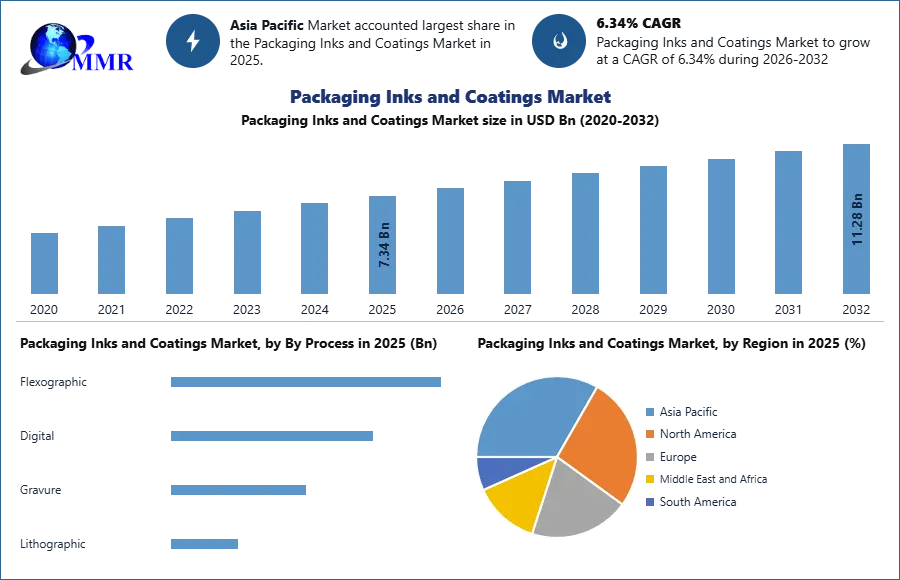
Market Valuation: Valued at USD 7.34 billion in 2025, projected to reach USD 11.28 billion by 2032.
Growth Trajectory: CAGR of 6.34% during the forecast period.
Primary Drivers: Rising consumer demand for aesthetic product appeal, stringent sustainability regulations, and the need for enhanced shelf-life protection.
Technological Shift: Rapid adoption of radiation-curable and water-based formulations to minimize environmental impact.
Strategic Focus: Expansion into high-performance barrier coatings and anti-counterfeiting applications.
Why This Matters Now
The packaging industry is no longer just about containment; it is about performance, protection, and planetary impact. For chemical manufacturers and industrial procurement leaders, the transition to high-barrier, sustainable inks and coatings is a critical pivot point that defines future market relevance. With the Packaging Inks and Coatings Market scaling to USD 11.28 billion by 2032, those who fail to align their chemical portfolios with these regulatory and consumer-driven shifts risk rapid obsolescence.
Market Overview
Packaging inks and coatings serve as the final, vital layer of product identity and preservation. As consumer demand for visual aesthetics intersects with the rigid requirement for sustainability, the market is undergoing a fundamental restructuring. Valued at USD 7.34 billion in 2025, the industry is moving away from traditional solvent-heavy formulations toward smarter, eco-friendly alternatives. This is not merely a change in ingredients; it is a shift toward a “circular-ready” manufacturing model where packaging components must be easily separable or biodegradable without compromising the integrity of the contents.
Key Trends Driving Growth
The core driver of growth is the duality of consumer expectation: packaging must be both “shelf-ready” and “earth-friendly.” Brands are increasingly utilizing specialized coatings to act as active barriers against moisture, oxygen, and UV light, which directly translates to extended shelf life and reduced food waste. Simultaneously, the rise of digital printing technology is enabling personalized, shorter-run packaging, which demands faster-curing, high-consistency inks that traditional mechanical processes cannot support. Regulatory compliance, particularly regarding migration limits in food contact materials, is further forcing a move toward low-VOC and radiation-curable formulations.
Segment Insights
Dominant Segment: Water-based ink formulations currently maintain the dominant market share. Their inherent compatibility with stringent environmental regulations and safety standards for food-contact applications makes them the benchmark for large-scale packaging operations.
Fastest-Growing Segment: Radiation-curable (UV-curable) coatings and inks are seeing the fastest adoption rates. Their ability to cure almost instantaneously, combined with superior durability and excellent adhesion to a variety of substrates, makes them indispensable for high-speed, modern packaging lines that require immediate downstream processing.
Regional Growth Story
North America currently leads the market, shaped by an intense focus on environmental health, consumer transparency, and high-quality digital printing adoption. However, the Asia-Pacific region is emerging as the most significant growth frontier. Rapid urbanization in India and China, combined with a burgeoning middle class and an exploding e-commerce sector, is driving massive investment into automated, high-output packaging infrastructure. For global manufacturers, the regional strategy centers on localized production that addresses both the high-volume demand of Asia and the high-performance, regulatory-heavy demands of Western markets.
Competitive Landscape
The competitive field is dominated by global chemical conglomerates that are currently doubling down on M&A activity to secure proprietary “green” chemistry. Recent acquisitions and partnerships across the sector signal a clear intent to consolidate supply chains and secure intellectual property in bio-based pigments and high-barrier polymers. This consolidation provides these firms with significant pricing power, as they move beyond commodity ink supply to provide bundled services—including technical support, digital integration, and compliance consulting—that lock in utility and retail customers.
Recent Developments
Strategic R&D: Heavy investment in bio-based feedstocks for printing inks to decouple production from crude oil price volatility.
Process Automation: Manufacturers are integrating AI-driven monitoring systems into printing lines to optimize ink transfer and coating uniformity, reducing material waste by up to 15%.
Regulatory Alignment: A surge in the commercialization of low-migration, food-safe coatings to meet the tightening standards of EU and North American packaging directives.
Strategic Implications
For procurement leads, the era of buying on price alone is over. The volatility of traditional petrochemical feedstocks makes long-term supply stability a priority. Procurement strategies must now account for the “total cost of compliance,” where the use of environmentally compliant, high-performance coatings significantly reduces the downstream risk of recalls or brand damage. Companies that invest early in closed-loop, recyclable packaging chemistries will secure a structural cost advantage as carbon taxes and plastic-waste levies become standard global practice.
Future Outlook
Market winners will be defined by their ability to harmonize technical performance with radical sustainability—specifically, those who successfully scale radiation-curable and bio-based systems will capture the premium tier of the market, while those failing to pivot toward low-migration and circular-ready formulations face an inevitable contraction in market share.
Analyst Perspective
“The packaging inks and coatings market is in the midst of a profound transformation, moving from a commodity-driven segment to one defined by high-performance chemistry and regulatory precision. The jump to USD 11.28 billion by 2032 is not just a reflection of volume growth, but a measure of how critical these materials have become to the integrity and sustainability of the entire global supply chain. The firms that treat ‘eco-friendly’ as a core design parameter, rather than a marketing add-on, will set the terms for the next decade.” — Ankita Kagawade, Analyst, Maximize Market Research.
About Maximize Market Research
Maximize Market Research Pvt. Ltd. (MMR) is a global market research and consulting company that provides reliable, data-focused, and practical business insights. The firm serves a wide range of industries, including healthcare, pharmaceuticals, technology, automotive, electronics, chemicals, personal care, and consumer goods. Through market forecasts, competitive analysis, strategic consulting, and industry impact assessments, MMR helps organizations understand changing market conditions, identify growth opportunities, and make informed business decisions for long-term success.
2nd Floor, Navale IT Park Phase 3
Pune Banglore Highway, Narhe
Pune, Maharashtra 411041, India
+91 9607365656
sales@maximizemarketresearch.com
