Key Highlights
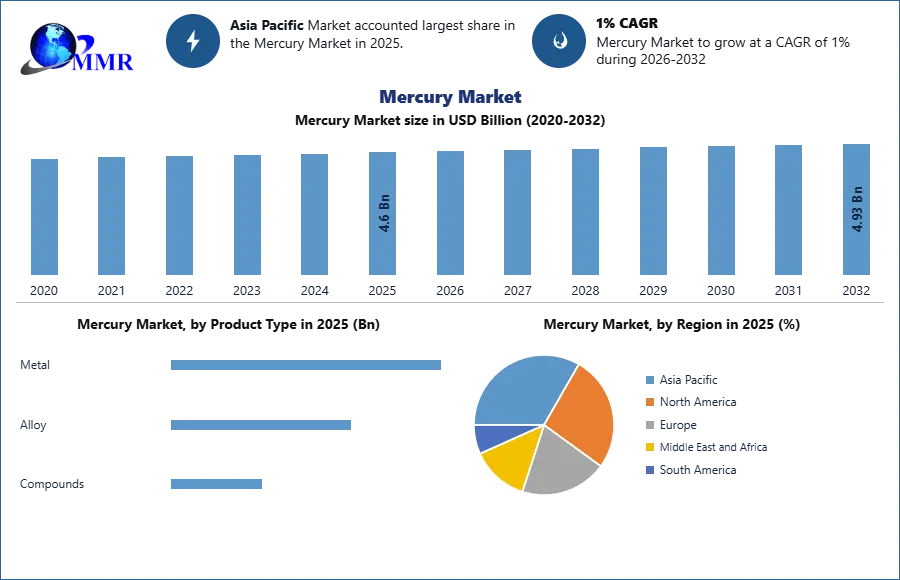
Market Valuation: Valued at USD 4.6 billion in 2025, projected to reach USD 4.93 billion by 2032.
Growth Trajectory: Projected CAGR of 1% from 2026 to 2032.
Dominant Segment: Healthcare and Pharmaceuticals, driven by specialized medical applications.
Regional Powerhouse: Asia-Pacific dominates, anchored by massive production and consumption in China.
Strategic Shift: Transition from primary extraction to high-value recovery and closed-loop recycling technologies.
Why This Matters Now
The Mercury Market is no longer a volume-growth industry; it is a regulatory-compliance minefield. For chemical manufacturers and industrial procurement leaders, the primary risk is not lack of supply but the cascading impact of environmental legislation on operational continuity. With the market moving at a near-flat 1% CAGR, value creation is shifting away from extraction and toward specialized, high-security handling and remediation services.
Market Overview
Mercury, or hydragyrum, remains a critical but controversial industrial element. Valued at USD 4.6 billion in 2025, its market is currently characterized by stabilization rather than expansion. Its unique properties—liquid state at room temperature and high electrical conductivity—ensure its continued use in essential sectors such as medical instrumentation, chemical catalysis, and precision sensors. However, the shadow of toxicity and the global push toward environmental decontamination are limiting its footprint. The forecast growth to USD 4.93 billion by 2032 reflects a market adjusting to a new equilibrium of controlled, high-value consumption.
Key Trends Driving Growth
Growth in this sector is driven by niche industrial necessity. While general use is declining, mercury remains indispensable for catalytic processes in coal-based vinyl chloride monomer (VCM) production, particularly in China. Additionally, the increasing demand for specialized medical and analytical equipment continues to support a baseline level of consumption. The most significant trend, however, is the technological shift toward “mercury-free” alternatives. As global mandates tighten, the market is incentivizing investment in recovery technologies that capture mercury from legacy systems and industrial waste streams rather than relying on new mine production.
Segment Insights
Dominant Segment (Industry): The Healthcare and Pharmaceutical segment holds the largest market share. The need for precise instrumentation and specialized chemical catalysts in medical diagnostics ensures that mercury remains a critical, albeit heavily regulated, component in this space.
Fastest-Growing Segment: Industrial Electrical and Lighting applications, while under pressure to phase out, continue to see demand for highly specialized switches and relays where no reliable substitute exists, sustaining a narrow but essential growth path.
Regional Growth Story
Asia-Pacific remains the undisputed center of the mercury market, controlling a significant portion of global mine production and reserves. China, in particular, acts as both the largest producer and consumer, leveraging mercury in large-scale coal-based chemical manufacturing. While Western markets in North America and Europe are prioritizing the phase-out of mercury in favor of safer alternatives, the Asia-Pacific region maintains the global supply chain, making it the focal point for both regulatory policy shifts and the development of new recycling infrastructure.
Competitive Landscape
The competitive landscape is defined by consolidation and a pivot toward compliance-driven services. Traditional producers are increasingly morphing into environmental service providers, focusing on the secure disposal and recovery of mercury-containing waste. Strategic partnerships are being formed between chemical conglomerates and specialized waste-management firms to secure “cradle-to-grave” control over the material. This shift suggests that pricing power in the future will not belong to the largest extractor, but to the entity that can provide the most robust, compliant, and cost-effective lifecycle management.
Recent Developments
Expansion of Recovery Tech: Major industry participants are investing in closed-loop recycling technologies to mitigate environmental liability.
Supply Chain Control: Increased focus on documentation and trade compliance has raised the barrier to entry, favoring large, established players over smaller, unregulated entities.
Shift in Mining Dynamics: Artisanal and Small-Scale Gold Mining (ASGM) continues to be a major source of demand, though global initiatives are slowly steering these operations toward safer, mercury-free techniques.
Strategic Implications
For procurement leaders, mercury is now a high-risk material. Companies must prioritize transparency in their supply chain, as any association with non-compliant mercury sources can result in significant legal and reputational damage. The strategic imperative is to secure reliable, recycled, or recovered mercury supplies while simultaneously accelerating the internal R&D required to switch to non-toxic alternatives. The era of low-cost, easy-access mercury procurement is over; the future is one of high-cost, high-compliance, and specialized logistics.
Future Outlook
Market success will be limited to those firms that master the circularity of the mercury lifecycle. The risk of stranded assets due to sudden regulatory bans remains high, while the opportunity lies in providing the essential analytical and remedial technologies that the industry requires to transition toward a zero-mercury future.
Analyst Perspective
“The mercury market is a prime example of an industry in the late stages of a structural transition. The marginal 1% growth rate is not a sign of stagnation, but of a managed contraction where essential applications remain protected while toxic leakage is ruthlessly curtailed. Winning in this space will not be about selling more mercury, but about owning the technology that allows the industry to use it safely and recover it efficiently until such time as the last industrial application is phased out.” — Ankita Kagawade, Analyst, Maximize Market Research.
About Maximize Market Research
Maximize Market Research Pvt. Ltd. (MMR) is a global market research and consulting company that provides reliable, data-focused, and practical business insights. The firm serves a wide range of industries, including healthcare, pharmaceuticals, technology, automotive, electronics, chemicals, personal care, and consumer goods. Through market forecasts, competitive analysis, strategic consulting, and industry impact assessments, MMR helps organizations understand changing market conditions, identify growth opportunities, and make informed business decisions for long-term success.
2nd Floor, Navale IT Park Phase 3
Pune Banglore Highway, Narhe
Pune, Maharashtra 411041, India
+91 9607365656
sales@maximizemarketresearch.com
