Key Highlights
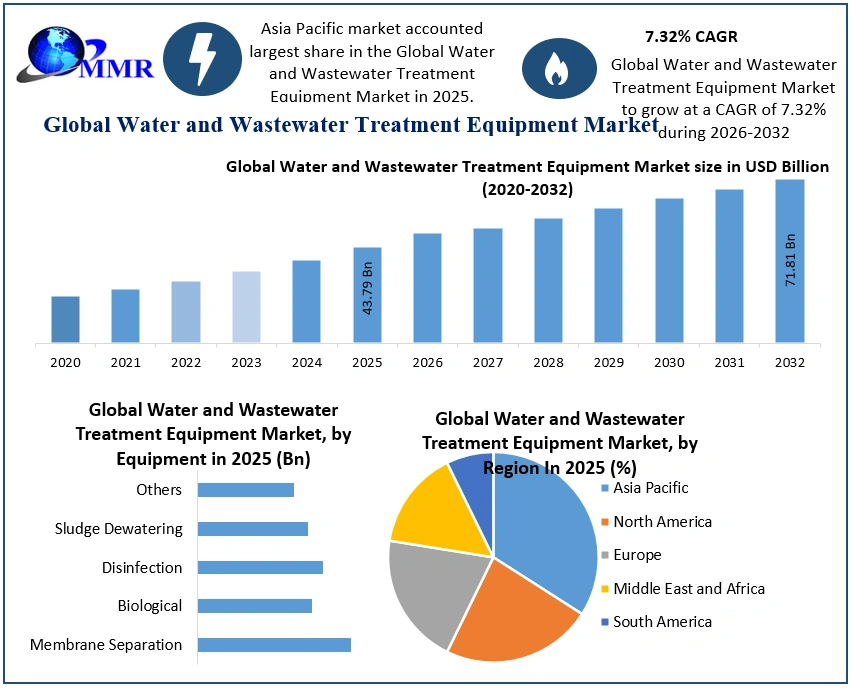
Membrane separation equipment commands the primary asset share within the global industrial water treatment distribution landscape.
Advanced biological treatment systems represent the fastest-growing technology segment by baseline market valuation.
The industrial manufacturing sector maintains the largest current volume acceleration rate across processing nodes.
Strict per- and polyfluoroalkyl substances (PFAS) remediation rules require high-performance adsorption and filtration arrays.
The Asia-Pacific region controls the largest combined equipment manufacturing capacity and downstream installation footprint.
Why This Matters Now
Industrial buyers and chemical manufacturing leaders face an immediate operational crisis as local regulatory bodies globally enact unprecedented limits on hazardous effluent disposal. Legacy wastewater treatment setups can no longer handle the complex chemical matrices generated by modern high-density manufacturing plants without exposing operators to heavy fines and legal liabilities. Procurement managers who fail to secure long-term system delivery contracts for advanced purification hardware risk localized closure orders as municipal utilities tighten their industrial intake rules.
This ongoing compliance tension forces environmental engineering executives to quickly redesign their baseline capital infrastructure plans. Companies must either install modern on-site recycling loops or face skyrocketing costs for hazardous liquid haulage and off-site processing. The margin for error is shrinking rapidly as downstream chemical processors enforce strict resource circularity audits on raw material suppliers.
Market Overview
The global Water and Wastewater Treatment Equipment Market covers the engineering, assembly, distribution, and maintenance of specialized hardware configurations designed to extract chemical, biological, and physical pollutants from process water streams. This industry is split into primary clarification equipment, secondary biological modules, and advanced tertiary purification hardware. Primary setups utilize mechanical screens, grit chambers, and automated oil-water separators, while secondary modules rely on activated sludge systems, bioreactors, and clarification skids. Tertiary purification integrates ultrafiltration membranes, reverse osmosis arrays, ion exchange columns, and ultraviolet disinfection systems to achieve high-purity water outputs.
The manufacturing sector operates under strict engineering tolerances where minor component defects or membrane fouling lead to immediate drop-offs in permeate quality and overall processing throughput. To minimize these operational risks, leading global equipment suppliers are engineering integrated, modular skid units that allow automated, local adjustments to match changing influent pollution loads.
Key Trends Driving Growth
The primary catalyst for system re-engineering is the rapid transition toward zero liquid discharge policies across heavy industrial zones, where processing plants must recycle up to 95 percent of their total intake water. Heavy chemical processors are replacing basic open-loop discharge systems with integrated multi-stage evaporators and crystallizers to eliminate liquid waste streams entirely. This engineering transition shifts bulk capital procurement budgets away from simple settling tanks toward complex mechanical vapor recompression systems that reclaim high-purity water while generating dry crystal solids for chemical harvesting.
Concurrently, the global rollout of advanced semiconductor fabs and green hydrogen electrolyzer plants has created a highly predictable, high-volume consumption loop for ultra-pure water systems. Modern chip fabrication nodes operate under strict contamination limits that require water completely free of dissolved ions, silica, and organic carbon compounds to prevent micro-wafer damage. This technical standard drives continuous demand for continuous electrodeionization units, sub-micron cartridge filters, and degasification systems, limiting the available supply of specialized equipment for lower-margin industrial projects.
Furthermore, a significant manufacturing optimization trend is emerging through the rapid commercial adoption of automated biological aerated filters equipped with real-time dissolved oxygen sensors. Advanced dissolved oxygen control systems adjust blower speeds in real time, allowing treatment plant operators to cut energy usage and maximize nutrient removal rates. This shift drives the development of specialized carrier media designed to optimize biofilm density and improve the volumetric treatment capacity of existing tank footprints.
Segment Insights
Membrane Separation (Dominant Segment): Holding the largest overall market value, this classification remains the foundational technology for global reverse osmosis systems, ultrafiltration loops, and desalination infrastructure.
Biological Treatment (Fastest-Growing Segment): Driven by strict nitrogen and phosphorus discharge rules and high organic chemical loads, this micro-organism-driven division is seeing the fastest capital acceleration.
Industrial Manufacturing (Dominant End-User Segment): This sector consumes the highest total volume of purification hardware to secure critical processing lines against raw water quality changes.
Disinfection Systems: This division maintains steady volume expansion as modern municipal and industrial operators phase out elemental chlorine in favor of advanced ozone and ultraviolet radiation arrays.
Regional Growth Story
The Asia-Pacific region maintains absolute dominance over the global wastewater treatment equipment manufacturing footprint, with China, India, Japan, and South Korea controlling major fabrication yards and membrane casting lines. China’s massive expansion of domestic chemical complexes and strict environmental enforcement mandates create an intensely concentrated regional consumption loop, prompting international equipment suppliers to form local system engineering alliances. India is experiencing rapid industrial demand growth, fueled by state-directed investments in clean water infrastructure and expanding zero liquid discharge requirements across textile and pharmaceutical hubs.
North America continues to see strategic procurement realignments, driven by new PFAS remediation projects and domestic supply chain mandates in the United States. This regulatory framework encourages industrial EPC firms to secure long-term filtration vessel volumes from domestic fabrication shops to isolate project timelines from cross-border shipping delays. Meanwhile, Germany leads Europe’s technical development, focusing heavily on integrating advanced anaerobic digestion modules into municipal treatment networks to generate renewable biogas and meet regional carbon reduction goals.
Competitive Landscape
The competitive architecture of the global water and wastewater treatment equipment market is highly consolidated, with a limited group of integrated engineering conglomerates controlling key membrane patents and biological treatment designs. Key industry participants include Suez S.A., Veolia Environnement S.A., Xylem Inc., DuPont de Nemours, Inc., Evoqua Water Technologies LLC, Pentair plc, and Ecolab Inc.
Market competition centers on securing high-flux membrane materials, optimizing automated energy recovery systems, and patenting low-fouling surface chemistries. Top-tier equipment producers are investing heavily in dedicated digital twin software and remote diagnostic systems to decouple their core service revenues from localized labor constraints. This strategy allows integrated manufacturers to secure long-term operations and maintenance agreements with major industrial buyers who prioritize system uptime and consistent effluent quality over low initial equipment costs.
Recent Developments
Equipment manufacturers have optimized their automated membrane casting lines to accelerate high-flux reverse osmosis element manufacturing for advanced industrial water recycling systems.
System fabricators have advanced their domestic distribution networks to supply pre-engineered biological treatment skids directly to North American industrial corridors.
Engineering groups have expanded their exploratory test centers to develop next-generation ceramic membrane modules for high-temperature chemical process separations.
Specialty separation companies have expanded their regional distribution agreements to secure long-term stainless steel vessel components for fast-growing Asian desalination projects.
Strategic Implications
The transition toward highly automated, zero-discharge water treatment footprints means industrial project management teams can no longer view purification hardware as a basic peripheral purchase. The concentration of advanced membrane casting and system integration expertise within a small number of production nodes means that unexpected plant shutdowns or regional trade barriers can quickly disrupt global supply flows. This structural vulnerability forces industrial operators to move completely away from transactional spot-market sourcing toward strategic, multi-year engineering partnerships with integrated equipment suppliers.
To protect production margins against volatile component prices, major chemical manufacturing firms are requiring equipment suppliers to establish fixed-price spare parts and membrane replacement contracts. This operational requirement forces material producers to improve their internal polymer recycling rates and invest in advanced manufacturing technologies to stabilize baseline fabrication costs.
Future Outlook
The global water and wastewater treatment equipment market is positioned for sustained commercial expansion as industrial water recycling targets tighten and international manufacturing facilities face stricter chemical pollution rules. Long-term profitability will belong to integrated equipment and material suppliers that invest in localized assembly assets near expanding industrial clusters while integrating digital optimization services to shield industrial clients from operational downtime.
Analyst Perspective
“The global water and wastewater treatment equipment market has graduated from a basic civil engineering sector into a highly technical industrial solutions division defined by strict purity metrics and resource recovery standards,” states Ankita Kagawade, Lead Analyst at Maximize Market Research. “With the chemical processing and advanced electronics sectors requiring massive volumes of recycled water, equipment suppliers must secure local assembly assets to satisfy strict regional supply chain requirements.”
About Maximize Market Research
Maximize Market Research Pvt. Ltd. (MMR) is a global market research and consulting company that provides reliable, data-focused, and practical business insights. The firm serves a wide range of industries, including healthcare, pharmaceuticals, technology, automotive, electronics, chemicals, personal care, and consumer goods. Through market forecasts, competitive analysis, strategic consulting, and industry impact assessments, MMR helps organizations understand changing market conditions, identify growth opportunities, and make informed business decisions for long-term success.
2nd Floor, Navale IT Park Phase 3
Pune Banglore Highway, Narhe
Pune, Maharashtra 411041, India
+91 9607365656
sales@maximizemarketresearch.com
