Key Highlights
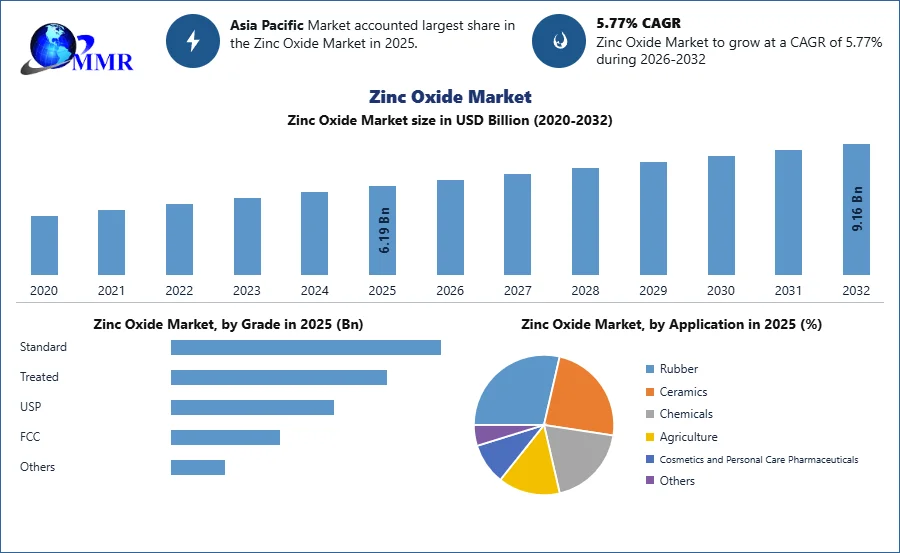
Market Valuation: Valued at USD 6.19 billion in 2025, reaching USD 9.16 billion by 2032.
Growth Trajectory: Projected CAGR of 5.77% from 2026 to 2032.
Dominant Application: Rubber, which accounts for 50–60% of total consumption.
Dominant Grade: Standard grade, favored for its high purity and performance in rubber and ceramics.
Leading Region: Asia-Pacific, holding over half of global demand.
Strategic Pivot: Massive investment in recycled zinc oxide for sustainable agriculture and feed applications.
Why This Matters Now
The manufacturing world is tightening its supply requirements, and zinc oxide is at the center of this shift. As automotive and construction sectors struggle with supply chain volatility, the ability to secure high-purity vulcanization agents is becoming a distinct competitive advantage. With the Zinc Oxide Market scaling to USD 9.16 billion by 2032, procurement leads who ignore the shift toward high-grade, sustainable zinc oxide production risk production delays and inferior product quality.
Market Overview
Zinc oxide (ZnO) is an odorless, white inorganic powder that serves as a fundamental building block in modern industrial processes. Currently valued at USD 6.19 billion, the market’s growth is anchored by its unique chemical properties: wide band gap, high electron mobility, and powerful antimicrobial and UV-stabilizing characteristics. While its role in rubber vulcanization—specifically for tires—remains the primary volume driver, its increasing use in semiconductors and advanced electronics is creating a new, high-margin revenue stream.
Key Trends Driving Growth
Rapid urbanization across China, India, and Southeast Asia is the primary engine behind this market expansion. As these regions accelerate infrastructure development, demand for rubber-based construction seals and corrosion-resistant ceramics is surging. Furthermore, the automotive sector’s cyclical recovery is driving renewed interest in optimized rubber vulcanization. Manufacturers are now prioritizing grades that offer superior heat resistance and durability, as modern vehicles require more robust components to handle higher thermal stresses.
Segment Insights
Dominant Segment (Application): The Rubber segment dominates with a 50–60% market share. Its use as a critical vulcanization activator remains irreplaceable for producing durable, heat-resistant, and abrasive-resistant rubber products.
Dominant Segment (Grade): The Standard grade segment leads the market and is projected to maintain the highest CAGR. With 99–99.5% purity, this grade is the industry standard for lightweight, corrosion-resistant, and thermally stable products in the rubber and ceramic industries.
Regional Growth Story
Asia-Pacific commands the global market, accounting for over 50% of demand. The region’s dominance is bolstered by its massive industrial base in China and the rapid expansion of the personal care and cosmetics sectors in Southeast Asia. Conversely, in North America and Europe, the focus has shifted toward high-tech applications, including advanced UV-stabilized coatings and high-performance electronics, reflecting the region’s maturity in specialized chemical manufacturing.
Competitive Landscape
The market is characterized by a mix of regional giants and specialized producers. Players such as U.S. Zinc, Zochem, and Zinc Nacional demonstrate a clear strategic intent to navigate trade tensions by localizing production and pivoting toward high-value rubber-grade outputs. Recent corporate actions—such as Rubamin’s scaling of recycled zinc oxide—signal that the industry is actively decoupling itself from primary mining reliance. This shift not only hedges against raw material price volatility but also serves to neutralize the environmental impact, a critical requirement for Tier-1 automotive and industrial suppliers today.
Recent Developments
Sustainable Feedstock Scaling: Rubamin successfully increased recycled zinc oxide output in 2025, targeting the sustainable agriculture and animal feed segments to reduce reliance on virgin mineral extraction.
Strategic Pivot in Mexico: Zinc Nacional shifted its supply focus to Brazil’s growing automotive market to offset tariff-related disruptions in U.S.-China trade corridors.
Capacity Upgrades: Investment in high-purity production lines is accelerating, as manufacturers look to meet the stringent demands of the semiconductor and UV-blocking skincare markets.
Strategic Implications
For procurement leaders, the primary takeaway is the necessity of “sustainable security.” As regulatory pressures regarding mining footprints intensify, companies must prioritize suppliers who have successfully implemented circular recovery models. Furthermore, the volatility in the automotive tire sector dictates a need for diversified supplier portfolios. Organizations that secure long-term agreements with producers holding high-purity “standard” grade capacities will minimize their exposure to the price fluctuations currently plaguing the commodity mineral space.
Future Outlook
Market leaders will be the companies that successfully bridge the gap between traditional industrial volumes and the growing demand for sustainable, high-purity ZnO. The winners will be those who treat zinc oxide not as a simple commodity, but as a performance-critical additive that can be sourced through robust, circular supply chains.
Analyst Perspective
“The zinc oxide market is currently undergoing a structural reset. We are seeing a clear transition from simple volume-based growth to a model defined by grade-purity and supply-chain sustainability. The expansion to USD 9.16 billion by 2032 reflects the material’s increasing criticality in everything from advanced rubber vulcanization to the next generation of semiconductors. Suppliers who can demonstrate high-purity consistency while integrating recycled feedstocks will dictate the competitive rhythm of the next decade.” — Ankita Kagawade, Analyst, Maximize Market Research.
About Maximize Market Research
Maximize Market Research Pvt. Ltd. (MMR) is a global market research and consulting company that provides reliable, data-focused, and practical business insights. The firm serves a wide range of industries, including healthcare, pharmaceuticals, technology, automotive, electronics, chemicals, personal care, and consumer goods. Through market forecasts, competitive analysis, strategic consulting, and industry impact assessments, MMR helps organizations understand changing market conditions, identify growth opportunities, and make informed business decisions for long-term success.
2nd Floor, Navale IT Park Phase 3
Pune Banglore Highway, Narhe
Pune, Maharashtra 411041, India
+91 9607365656
sales@maximizemarketresearch.com
