Key Highlights
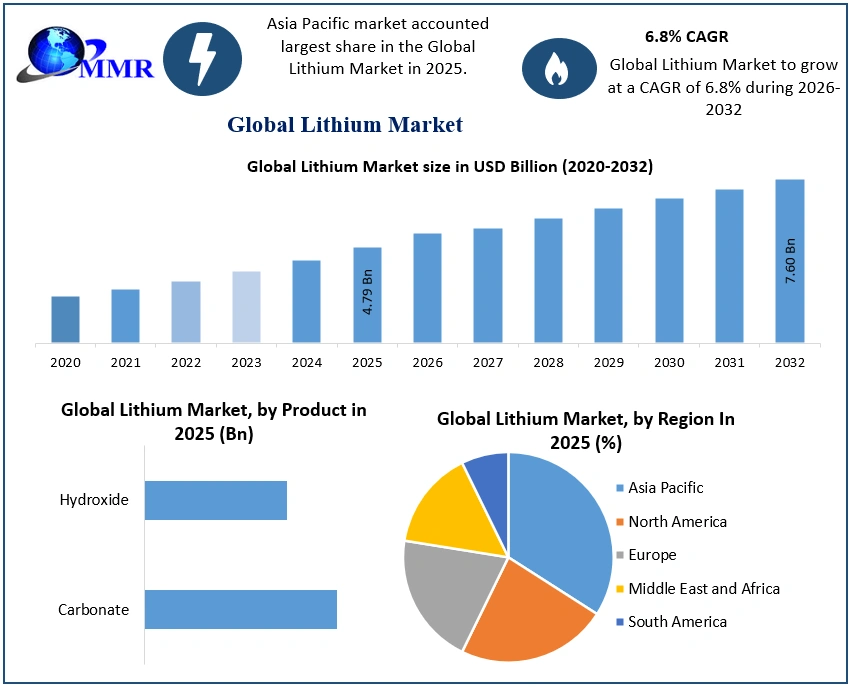
The global lithium market reached a valuation of USD 4.79 Billion in 2025 and will expand to USD 7.60 Billion by 2032.
Lithium carbonate held a dominant 68% product market share in 2025 due to its superior chemical stability.
Brines remain the leading feedstock extraction source, commanding a 57% market share in 2025.
The battery segment serves as the primary application driver, controlling 28% of the market in 2025 and growing at a 7% CAGR.
The Asia Pacific region maintains absolute market dominance, capturing a 58% share of global revenue in 2025.
China controls 70% of the world’s lithium-ion cell manufacturing capacity, cementing its upstream procurement power.
Why This Matters Now
Volatile feedstock supplies and stringent government emissions mandates are forcing chemical manufacturers and automotive procurement leaders to fundamentally restructure their raw material pipelines. Industrial buyers face sharp risks from localized extraction constraints and severe environmental pressures that threaten historical extraction volumes. Western and Asian chemical companies must navigate a highly consolidated processing ecosystem where capacity deficits translate immediately into production halts. Mitigating these choke points requires aggressive investments in downstream processing assets, localized sourcing, and next-generation refining technologies to protect baseline operational margins.
Market Overview
The Lithium Market Size serves as the fundamental building block for modern energy storage and advanced material manufacturing due to its lightweight, highly reactive, and soft lustrous properties. Beyond standard energy storage, specific lithium oxides purify enclosed air supplies, while lithium fluoride remains irreplaceable for specialized high-end telescopes. This highly reactive metal requires strict vacuum storage or submersion in inert liquids to prevent hazardous combustion during chemical processing. Industrial application relies heavily on converting raw extractions into stable intermediates like carbonate and hydroxide to feed downstream manufacturing.
The transition toward global electrification has permanently altered the consumption trajectory of this chemical commodity. The market stood at USD 4.79 Billion in 2025, underpinned by structural shifts in the automotive and energy storage infrastructure sectors. As industrial demand intensifies, the total revenue will advance at a 6.8% CAGR to hit USD 7.60 Billion by 2032. This projected growth reflects a permanent upward shift in baseline industrial consumption, forcing chemical producers to rapidly scale chemical refining infrastructures to match downstream purchase commitments.
Key Trends Driving Growth
Accelerating adoption of hybrid and fully electric vehicles (EVs) combined with rigid international emission standards forms the primary catalyst driving raw volume requirements. Technological breakthroughs across commercial transport networks—including electric buses, heavy-duty trucks, electric bikes, and inner-city rickshaws—are compounding the volumetric strain on the global lithium-ion battery supply chain. Major automotive OEMs are actively embedding large-scale lithium procurement directly into their multi-year corporate sustainability roadmaps. This deep integration ensures a baseline consumption floor that prevents long-term demand degradation for upstream chemical refiners.
Simultaneously, massive capital deployment into large stationary energy storage applications is creating a secondary demand vector that competes directly with automotive procurement. Beyond industrial electrification, the medical sector relies heavily on lithium carbonate as an antimanic agent and mood stabilizer to regulate abnormal brain activity in patients diagnosed with bipolar disorder, schizophrenia, and depression. However, severe environmental friction places a material restraint on aggregate capacity expansion. High-volume brine extraction causes critical water depletion and regional pollution, releasing toxic chemicals into local soil and air networks, while high recycling costs and low collection rates limit secondary circular economy recovery.
Segment Insights
Dominant Product Segment: Lithium Carbonate captured a 68% market share in 2025, operating as the premier baseline formulation for industrial chemical processing. Its position as the most chemically stable compound allows it to be converted efficiently into pure lithium metal or battery-grade lithium hydroxide, making it the preferred chemical input for automotive battery assembly and specialized bipolar medications.
Fastest-Growing Product Segment: Lithium Hydroxide is growing at a 3.4% CAGR, driven by escalating consumption in high-performance lubricating greases and specialized breathing gas purification systems.
Dominant Source Segment: Brine extraction commanded a 57% market share in 2025, utilizing massive solar evaporation pans to concentrate salt brines harvested from natural lakes and seawater before chemical conversion into lithium carbonate.
Fastest-Growing Source Segment: Hard Rock mining is expanding at a 3.45% CAGR, favored by industrial operators because spodumene concentrate extraction yields a significantly lower production cost per ton compared to traditional brine facilities.
Dominant Application Segment: The Batteries application dominated the landscape with a 28% market share in 2025 and is projected to expand at a 7% CAGR through 2032. This sector splits between primary non-rechargeable cells used in calculators, watches, cameras, and electronic games, and high-capacity secondary rechargeable cells powering laptops, mobile phones, cordless industrial tools, and electric cars.
Alternative Industrial Applications: Ceramics and Glass applications are advancing at a 4.1% CAGR, utilizing lithium to minimize thermal expansion, preserve color consistency, and accelerate melt rates in fire-resistant glass-ceramic cooktops. Lubricants are tracking a 3.6% CAGR, as thicker semi-solid lithium greases are widely deployed to protect industrial machinery components and high-speed automotive conveyors.
Regional Growth Story
The Asia Pacific region maintains an absolute stranglehold on the global market, controlling a 58% share of total revenue in 2025. This geographical dominance stems from immense domestic raw reserves, unmatched battery cell production infrastructure, and rapid industrial growth across its automotive and consumer electronics sectors. Within this ecosystem, China serves as the primary global hub, commanding a 70% share of entire global lithium-ion cell manufacturing capacity. This heavy concentration of downstream processing gives Chinese chemical manufacturers immense pricing power over international buyers, while Australia functions as a critical upstream asset provider, retaining its status as one of the largest raw lithium producers worldwide.
Conversely, the European market is carving out an independent growth trajectory, expanding at a 3.3% CAGR through the 2032 timeline. This regional development is anchored by aggressive infrastructure investments spanning the Information and Communications Technology (ICT), automotive, and healthcare sectors. To provide commercial stability amidst volatile pricing, the London Metal Exchange launched six cash-settled futures contracts covering batterymetal lithium and aluminum scrap. This institutional financial framework is designed to mitigate transactional risk, attracting fresh corporate capital from organizations looking to hedge against carbon emissions and capture value from structural automotive recycling initiatives.
Competitive Landscape
The global lithium market is highly consolidated, with a core group of tier-one chemical conglomerates dictating global supply baselines, extraction velocities, and spot market pricing. Upstream leaders like Albemarle Corporation, Ganfeng Lithium Co., Ltd., and Tianqi Lithium dominate global supply capacity through extensive asset ownership spanning South American brines and Australian hard-rock operations. Specialized entities including General Lithium Corp, LITHIUM EXPLORATION GROUP, LSC Lithium Corporation, Neo Lithium Corporation, and U.S. Lithium Corp focus on locating and scaling next-generation mining reserves. Meanwhile, regional state-backed firms like Yacimientos de Litio Bolivianos work to commercialize massive unexploited domestic deposits to reshape historical trade flows.
Concurrently, a secondary tier of diversified chemical suppliers and exploration specialists—including Altura Mining, Avalon Advanced Materials Inc., Corporation Lithium Elements Critiques, FMC Corporation, Galaxy Resources Limited, Lithium Americas Corp., Nemaska Lithium, and Novo Litio Ltd—are aggressively expanding their production assets to capture unallocated downstream market share. Market power is increasingly defined by a company’s ability to execute massive capital expenditures while navigating intensifying environmental scrutiny. Corporate entities that fail to secure vertical integration from raw brine or hard-rock feedstock up to battery-grade chemical outputs risk becoming marginalized by the dominant market leaders.
Recent Developments
Albemarle Corporation deployed USD 700 Million to construct its advanced Kemerton Hydroxide Plant to capture high-margin downstream chemical contracts. The specialized facility delivers a dedicated production capacity of 1,000 tons of premium battery-grade lithium hydroxide per year, signaling a major corporate pivot toward high-purity automotive inputs.
IBM engineered a revolutionary heavy-metal-free battery technology designed specifically to bypass the intense humanitarian and environmental issues associated with standard cathode materials. This proprietary chemical design is entirely free of nickel and cobalt, shifting downstream focus heavily onto alternative lithium compound configurations to reduce manufacturing emissions.
The London Metal Exchange officially launched six cash-settled futures contracts for lithium and aluminum scrap to establish a transparent global pricing benchmark. This financial mechanism helps downstream chemical procurement leaders protect multi-million-dollar budgets against unpredictable raw material spot price swings.
Strategic Implications
Albemarle’s USD 700 Million Kemerton hydroxide plant investment underscores a broader industry consolidation around high-value downstream chemical refining. By building out capacity for 1,000 tons of premium battery-grade hydroxide annually, the company is positioning itself to capture the stricter purity requirements mandated by next-generation EV manufacturers. This move signals that future market dominance will not belong to companies that merely mine raw ore, but to those capable of executing complex chemical purifications. For smaller, non-integrated mining firms, this trend presents a clear risk of margin compression as tier-one chemical players lock up long-term downstream purchasing agreements.
Concurrently, IBM’s development of nickel- and cobalt-free battery alternatives proves that downstream chemical architectures remain highly dynamic. Chemical producers must ensure their processing lines maintain flexibility to shift outputs between lithium carbonate and lithium hydroxide as cathode technologies adapt. Furthermore, the introduction of the London Metal Exchange’s futures contracts marks the maturity of lithium from a niche specialty chemical into a highly liquid global commodity. This institutionalization gives global procurement leaders the tools to execute long-term hedging strategies, stabilizing input costs and reducing the pricing power historically held by opaque upstream extraction monopolies.
Future Outlook
Strategic victory in the lithium market will belong exclusively to chemical enterprises that successfully insulate their supply lines from environmental water-depletion constraints while simultaneously building out dedicated battery-grade conversion capacities.
Analyst Perspective
“The global lithium market has transitioned from a cyclical specialty chemical sector into a permanent pillar of modern industrial infrastructure,” stated Ankita Kagawade, Lead Analyst at Maximize Market Research. “As battery-grade requirements tighten and environmental compliance costs escalate, securing low-cost spodumene or brine feedstocks while maintaining flexible, high-purity chemical refining capacity will distinguish the long-term industrial victors from vulnerable market participants.”
About Maximize Market Research
Maximize Market Research Pvt. Ltd. (MMR) is a global market research and consulting company that provides reliable, data-focused, and practical business insights. The firm serves a wide range of industries, including healthcare, pharmaceuticals, technology, automotive, electronics, chemicals, personal care, and consumer goods. Through market forecasts, competitive analysis, strategic consulting, and industry impact assessments, MMR helps organizations understand changing market conditions, identify growth opportunities, and make informed business decisions for long-term success.
2nd Floor, Navale IT Park Phase 3
Pune Banglore Highway, Narhe
Pune, Maharashtra 411041, India
+91 9607365656
sales@maximizemarketresearch.com
