Key Highlights
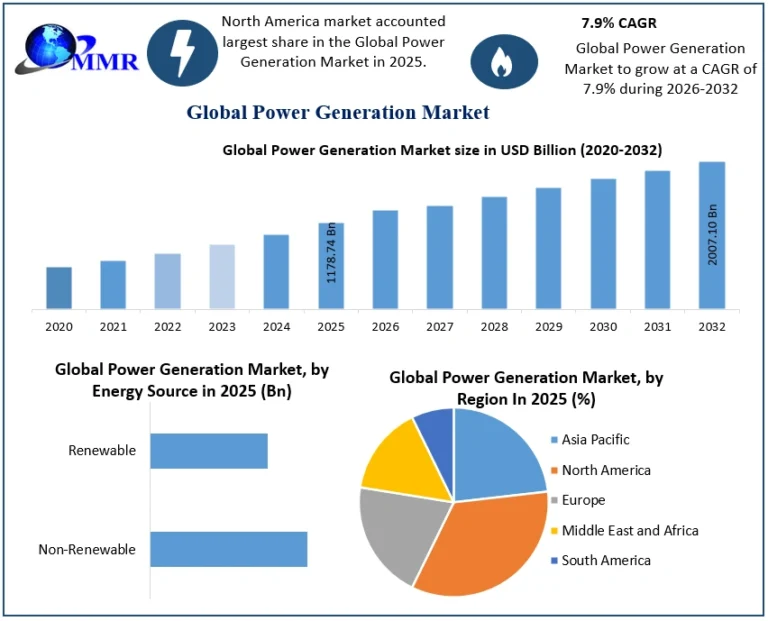
- Market valued at USD 1,178.74 billion in 2025.
- Forecast to reach USD 2,007.10 billion by 2032.
- CAGR estimated at 7.9% during 2026–2032.
- North America remains the leading regional market.
- Asia Pacific is the fastest-growing region.
- Wind energy dominates by power generation source.
- Transmission infrastructure represents the largest power infrastructure segment.
- Renewable energy investment continues to reshape electricity generation worldwide.
Why This Matters Now
Power systems are entering a period of structural transformation as governments pursue energy security, decarbonization, and electrification simultaneously. Rising electricity demand from industries, electric vehicles, artificial intelligence, and digital infrastructure requires significant investments in generation capacity and grid modernization. Utilities capable of expanding renewable generation while strengthening transmission networks will gain long-term strategic advantages.
Market Overview
The Power Generation Market Size covers electricity production from renewable and conventional energy sources alongside supporting infrastructure required to transmit and distribute electricity.
Demand continues to increase as urbanization, industrial expansion, population growth, and digitalization accelerate electricity consumption across developed and emerging economies.
Governments are investing heavily in new power plants, renewable energy projects, transmission corridors, and distribution upgrades to improve grid reliability while reducing carbon emissions.
Supply dynamics are shifting toward renewable electricity generation as declining technology costs, supportive policy frameworks, and private investment encourage utilities to diversify generation portfolios beyond fossil fuels.
Policy uncertainty and changing regulatory incentives remain investment risks, particularly where renewable subsidies or pricing mechanisms evolve rapidly.
Key Trends Driving Growth
Renewable energy investment continues to dominate capital allocation. Wind, solar, hydroelectric, and geothermal projects are expanding as utilities seek cleaner generation assets with lower long-term operating costs.
Grid modernization is becoming equally important. Transmission expansion enables utilities to integrate renewable electricity from remote generation sites into national power systems while improving network reliability.
Industrial electrification is creating sustained electricity demand. Manufacturing facilities, data centers, electric vehicles, and digital infrastructure require stable power supplies, supporting long-term investment across generation assets.
Government policy remains a major market influence. National decarbonization targets, renewable portfolio standards, and infrastructure funding continue directing capital toward low-carbon electricity generation.
Global supply chains for turbines, transformers, and grid equipment continue expanding despite periodic commodity price fluctuations. Manufacturers increasingly localize production to reduce project delays and improve energy security.
Explore detailed analysis, insights, and growth opportunities
Segment Insights
Dominant Segment: Wind Electricity
Wind energy remains the largest power generation segment because it combines mature technology, competitive generation costs, and strong policy support across developed and emerging markets.
Large-scale wind projects provide utilities with reliable renewable electricity while helping governments meet emissions reduction targets. Continuous improvements in turbine efficiency are increasing power output and improving project economics.
For equipment manufacturers and utilities, expanding wind capacity generates long-term investment opportunities across construction, maintenance, transmission, and grid integration.
Fastest-Growing Segment: Renewable Energy
Renewable energy continues recording the strongest growth across all energy sources.
Solar, wind, geothermal, biomass, and hydroelectric projects benefit from declining technology costs, supportive government incentives, and growing investor preference for sustainable infrastructure.
The shift reduces long-term exposure to fuel price volatility while strengthening national energy security by diversifying electricity generation portfolios.
Additional Key Sub-Segments
Transmission Infrastructure remains the dominant infrastructure segment because expanding electricity generation requires stronger transmission networks capable of moving power efficiently between production centers and demand hubs.
Distribution Networks are emerging as one of the fastest-expanding infrastructure segments as urban growth, electrification, and decentralized renewable generation require more flexible electricity delivery systems.
Among end users, the Industrial Sector remains a major electricity consumer due to expanding manufacturing capacity, automation, mining, and heavy industrial operations. Residential and commercial sectors continue benefiting from increasing electrification and smart energy solutions.
Regional Growth Story
North America leads the global market through established utility infrastructure, advanced transmission systems, and significant investments in renewable electricity generation. Utilities continue replacing aging infrastructure while expanding clean energy capacity.
Asia Pacific represents the fastest-growing region. China, India, and Southeast Asian economies continue building generation capacity to support industrialization, urban expansion, and rising electricity consumption. Large-scale renewable deployment and transmission investments strengthen regional competitiveness.
Europe maintains global leadership in renewable energy transition. Aggressive climate targets, carbon reduction policies, and offshore wind investments continue accelerating power sector transformation while reducing dependence on conventional generation.
South America, the Middle East, and Africa continue investing in new generation facilities, transmission infrastructure, and renewable projects to improve electricity access, strengthen grid reliability, and support long-term economic development.
Competitive Landscape
Competition spans integrated utilities, independent power producers, equipment manufacturers, and grid operators.
Siemens AG, ABB Ltd., and General Electric Company continue strengthening their positions through advanced power equipment, grid technologies, and digital energy management solutions supporting utility modernization.
NextEra Energy, Inc., Enel SpA, Ørsted A/S, Iberdrola S.A., and Engie SA maintain competitive advantages through diversified renewable energy portfolios and continued investment in wind and solar generation assets.
Major utilities including Electricite de France S.A., NTPC Ltd, Tokyo Electric Power Company Holding Inc., Dominion Energy, Inc., Duke Energy Corporation, Exelon Corporation, E.ON SE, China Energy Investment Corporation Limited, National Grid plc, and State Grid Corporation of China continue expanding transmission infrastructure, integrating renewable assets, and modernizing electricity networks to strengthen long-term market positions.
The competitive landscape increasingly favors companies capable of combining renewable generation, digital grid technologies, and large-scale transmission investment within integrated electricity systems.
Recent Developments
- Dubai Electricity and Water Authority (DEWA) announced plans to develop 4 GW of renewable energy projects through Independent Power Producer (IPP) partnerships.
- Utilities globally continue expanding transmission infrastructure to improve renewable energy integration and grid resilience.
- Governments across major economies are increasing investment in renewable power generation and electricity network modernization.
- Industrial electrification and rising electricity demand continue driving investment in new generation capacity and distribution infrastructure.
Future Outlook
Utilities and infrastructure providers that accelerate renewable generation while modernizing transmission networks will secure the strongest competitive position as global electricity demand and decarbonization targets continue to converge.
Analyst Perspective – Komal Patil
Komal Patil, Market Research Analyst: “The Power Generation Market is undergoing a structural transition as utilities balance rising electricity demand with global decarbonization goals. Companies investing in renewable energy capacity, grid modernization, and digital power infrastructure will be better positioned to improve operational resilience, strengthen energy security, and capture long-term growth opportunities as electricity systems become increasingly electrified and decentralized.
About Maximize Market Research
Maximize Market Research Pvt. Ltd. (MMR) is a global market research and consulting company that provides reliable, data-focused, and practical business insights. The firm serves a wide range of industries, including healthcare, pharmaceuticals, technology, automotive, electronics, chemicals, personal care, and consumer goods. Through market forecasts, competitive analysis, strategic consulting, and industry impact assessments, MMR helps organizations understand changing market conditions, identify growth opportunities, and make informed business decisions for long-term success.
Contact Us :
2nd Floor, Navale IT Park Phase 3
Pune Banglore Highway, Narhe
Pune, Maharashtra 411041, India
+91 9607365656
sales@maximizemarketresearch.com
