Key Highlights
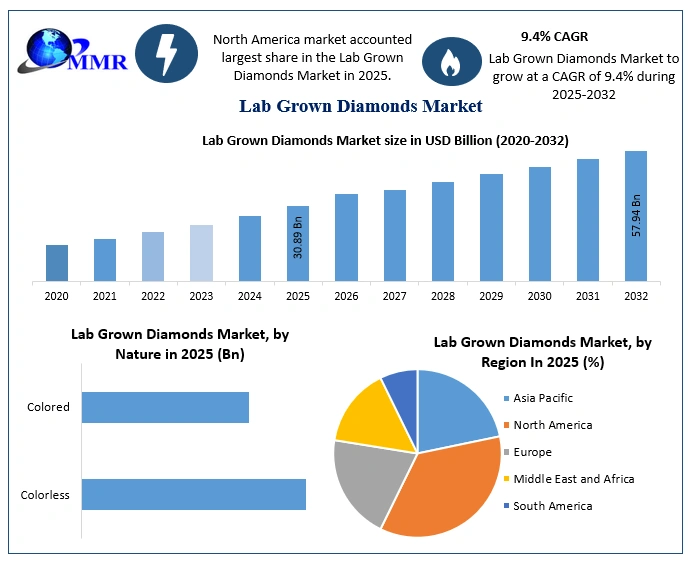
Market Valuation: Global market size reached USD 30.89 Billion in 2025 and is projected to expand to USD 57.94 Billion by 2032, exhibiting a compound annual growth rate (CAGR) of 9.4% over the forecast period.
Cost and Market Share: Synthetic alternatives cost approximately 40% less than naturally mined counterparts, allowing them to rapidly capture roughly 10% of the total global diamond market.
Dominant Processing: The fashion application sector along with the “Below 2 carat” sizing bracket represent the highest market volume shares due to consumer affordability and mass-retail integration.
Fastest-Growing Technology: Chemical Vapor Deposition (CVD) is emerging as the fastest-growing manufacturing method, prized for its superior purity control and lower defect density.
Geographic Production Hubs: India produces 3 million lab-grown stones annually, capturing a 15% share of global output, while China maintains dominant volume scaling capabilities.
Why This Matters Now
Disruption in global diamond supply chains has shifted from a threat to an operational reality for materials engineers and luxury procurement executives. Natural diamond reserves face structural depletion, forcing industrial buyers and retail networks to secure reliable, infinite feedstock alternatives. Production technology has advanced to a point where synthesizing structurally flawless carbon lattices is repeatable at commercial scale. This eliminates upstream mining volatility, lowers costs by 40%, and guarantees a conflict-free provenance. For chemical processors, equipment suppliers, and downstream consumer brands, investing in synthetic infrastructure is no longer a niche hedge—it is the prerequisite for securing future supply chain resilience.
Market Overview
The global Lab Grown Diamonds Market reached a valuation of USD 30.89 Billion in 2025. It is on a trajectory to hit USD 57.94 Billion by 2032, expanding at a steady 9.4% CAGR. These man-made structures match natural gems atom-for-atom, replicating their exact physical, optical, and chemical properties. By decoupling diamond synthesis from territorial mining, manufacturers have unlocked a supply curve limited only by laboratory footprint, chemical precursor availability, and energy access.
This supply elasticity has altered market economics. Man-made stones currently command roughly 10% of the total diamond sector. This share is expanding as commercial operations scale across key global industrial zones. This rapid volume growth introduces near-term pricing uncertainty, requiring upstream producers to continuously lower processing costs to preserve operational margins.
Key Trends Driving Growth
Unbounded feedstock availability is reshaping the upstream economics of the synthetic diamond industry. Unlike finite mineral reserves, the core inputs for laboratory synthesis are highly accessible, enabling uninterrupted production scaling. Consumers seeking budget-conscious luxury are increasingly migrating to engineered options, which offer greater clarity and larger carat sizes at a 40% discount compared to mined equivalents.
Simultaneously, mainstream retail consolidation is accelerating commercial adoption. High-volume jewelry brands are actively converting their supply chains to 100% synthetic material to meet consumer demand for conflict-free, environmentally friendly luxury. This shift provides long-term demand visibility, prompting manufacturers to invest heavily in advanced reactor technology to optimize synthesis cycles and scale throughput.
Segment Insights
Dominant Application — Fashion: This segment held the largest market share in 2025 and is projected to maintain a high CAGR. Structural transformation is underway as major global jewelry retailers shift away from mined sources toward sustainable alternatives. Synthetic stones currently account for 9% of the specialty jewelry market.
Dominant Size — Below 2 Carat: This category holds the leading market volume share. Growth is sustained by high consumer demand for affordable, accessible components utilized in everyday jewelry applications such as pendants, earrings, and rings.
Fastest-Growing Method — Chemical Vapor Deposition (CVD): This technique is projected to record the highest CAGR during the forecast period. The process gives engineers tighter control over the carbon growth environment, resulting in high-quality crystals with minimal chemical impurities.
Regional Growth Story
North America leads global consumer adoption, with the United States driving more than 50% of total diamond demand in 2025. This consumption includes a major share of synthetic alternatives. This dominant market position is sustained by intense research and development activity, continuous processing technology upgrades, and a high concentration of primary sector operators.
In the Asia-Pacific region, targeted state policy is rapidly transforming production capacity. India has established itself as a leading global manufacturing hub, producing approximately 3 million synthetic diamonds annually to secure a 15% share of global output. To accelerate this momentum, the Indian government reduced custom duties on seed diamonds and established specialized research grants at the Indian Institutes of Technology (IIT). China continues to expand its market share through massive industrial-scale synthesis facilities, positioning the broader Asia-Pacific region as the primary supplier for global downstream markets.
Competitive Landscape
The competitive environment is highly fragmented and capital-intensive, defined by rapid technology iterations and aggressive infrastructure scaling. Major players are investing heavily in research and development to optimize crystal synthesis and minimize structural defects. The market structure is shifting as firms transition from simple product manufacturing into integrated distribution agreements and audited sustainability systems.
To protect long-term margins against pricing pressure, dominant producers are utilizing certified environmental standards to differentiate their products. Commercial partnerships between synthesis labs and regional distributors are expanding market access in underdeveloped retail zones, while technical collaborations with research institutes aim to increase macro-sized crystal yields.
Recent Developments
Pandora Strategic Pivot: Pandora, the world’s largest jewelry corporation, announced a complete cessation of mined diamond procurement, transitioning its entire product portfolio to sustainable, lab-created alternatives to align with circular economy objectives.
WD Lab Grown Diamonds Distribution Expansion: WD Lab Grown Diamonds secured a strategic partnership with Australia-based JC Jewels Pty Ltd for authorized distribution across Australia and New Zealand. This expansion builds on WD’s position as a certified sustainable, 100% climate-neutral producer.
New Diamond Technology Collaboration Focus: New Diamond Technology has ramped up its collaborative research projects with international scientific institutes, focusing on innovative synthesis processes to improve consistency and purity across large-carat production runs.
Strategic Implications
For chemical manufacturing leaders and industrial procurement executives, the rapid rise of synthetic diamond production alters long-term investment strategies. The capacity to grow high-purity crystals at commercial scale shifts diamonds from a luxury commodity to an accessible, high-performance industrial material. This structural evolution requires raw material suppliers to secure stable, low-cost supply chains for specialized carbon precursors, seed crystals, and ultra-high-purity gases.
Upstream chemical and equipment suppliers must adjust to this scaling demand by developing advanced, high-efficiency synthesis systems. As production volumes rise and push down wholesale gem prices, long-term profitability will rely on processing efficiency, energy optimization, and building specialized capabilities in high-margin sectors like CVD processing.
Future Outlook
Market consolidation will favor high-output manufacturers that utilize advanced CVD synthesis and secure direct, integrated retail distribution agreements. Upstream operations that rely on older, energy-intensive processes face margin compression as scaling volumes reduce baseline market pricing. Success in this evolving landscape will belong to producers that combine low-cost energy access with audited climate neutrality to capture premium downstream demand.
Analyst Perspective
“The lab-grown diamond market has passed its initial validation phase and is now entering an era of industrial scaling. By removing raw material supply limitations and offering a 40% cost reduction, technological innovation has fundamentally shifted the economics of the diamond industry. The long-term winners will be companies that can successfully scale up production capacity while maintaining strict quality standards and minimizing energy use.” — Ankita Kagawade, Materials & Chemicals Research Analyst, Maximize Market Research
About Maximize Market Research
Maximize Market Research Pvt. Ltd. (MMR) is a global market research and consulting company that provides reliable, data-focused, and practical business insights. The firm serves a wide range of industries, including healthcare, pharmaceuticals, technology, automotive, electronics, chemicals, personal care, and consumer goods. Through market forecasts, competitive analysis, strategic consulting, and industry impact assessments, MMR helps organizations understand changing market conditions, identify growth opportunities, and make informed business decisions for long-term success.
2nd Floor, Navale IT Park Phase 3
Pune Banglore Highway, Narhe
Pune, Maharashtra 411041, India
+91 9607365656
sales@maximizemarketresearch.com
