Key Highlights
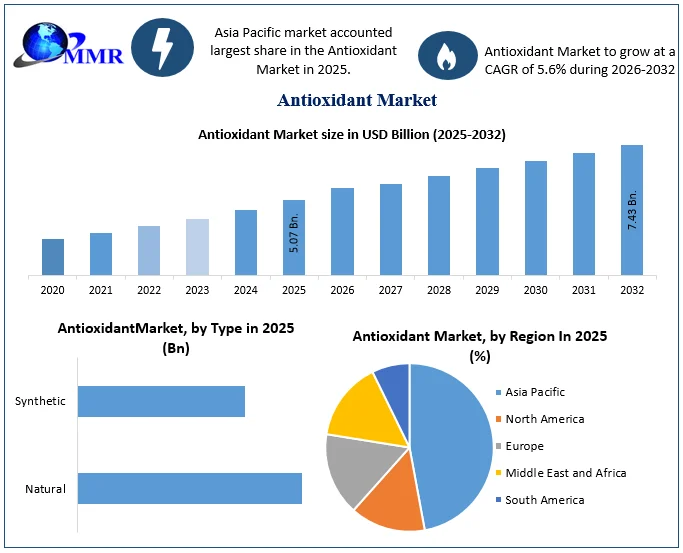
Market Valuation: Valued at USD 5.07 billion in 2025, with a projected reach of USD 7.43 billion by 2032.
Growth Trajectory: Projected 5.6% CAGR during the 2026–2032 forecast period.
Dominant Region: Asia-Pacific accounts for a 42% market share as of 2025, driven by industrial and food processing expansion.
Dominant Application: Plastic, rubber, and latex additives remain highly profitable, preventing thermo-oxidative degradation.
Strategic Shift: Rising consumer preference for “clean-label” and natural ingredients is forcing a re-evaluation of synthetic antioxidant portfolios.
Why This Matters Now
The global Antioxidant Market is no longer a peripheral niche; it is a critical component of material integrity and shelf-life economics. As chemical manufacturers face tightening environmental regulations and shifting consumer preferences, the ability to balance synthetic performance with natural, bio-based alternatives is now a competitive mandate. For investors and procurement leaders, the transition from simple preservation to high-value functional stabilization represents a significant opportunity to capture premium margins in an expanding global supply chain.
Market Overview
Antioxidants are the silent workhorses of the modern chemical and food industries. Valued at USD 5.07 billion in 2025, the market provides essential stabilization that prevents oxidation in everything from automotive tires and high-performance polymers to packaged foods and personal care products. The forecast of USD 7.43 billion by 2032 highlights a structural necessity: as global populations urbanize and consumer expectations for durability and quality rise, the demand for antioxidants that can perform under increasingly demanding conditions is intensifying.
Key Trends Driving Growth
The most potent driver is the convergence of health awareness and industrial modernization. In the food sector, rapid urbanization in developing economies is driving a demand for processed foods, necessitating higher volumes of antioxidants to maintain freshness. Concurrently, in the industrial sector, the shift toward longer-lasting materials is pushing manufacturers to adopt advanced stabilization technologies that can withstand thermo-mechanical stress. Furthermore, the push for “clean labels” in the cosmetic and food sectors is accelerating the adoption of plant-based and biotechnology-derived antioxidants.
Segment Insights
Dominant Segment (Plastic & Rubber Additives): These applications command a dominant share due to the global demand for polymers that can resist harsh oxidation and thermal degradation. These antioxidants significantly extend the lifecycle of essential components, from automotive gaskets to consumer electronics.
Fastest-Growing Segment (Natural Antioxidants): While synthetic options remain efficient, the fastest-growing demand is for natural alternatives, such as tocopherols and plant-based extracts. This segment is bolstered by the global trend toward organic and clean-label formulations in food and personal care.
Regional Growth Story
Asia-Pacific holds a firm 42% market share as of 2025, acting as the primary hub for production and consumption. This dominance is linked to the region’s massive role in global manufacturing, where antioxidants are crucial for the automotive and power production industries. Meanwhile, North America is witnessing significant growth through the aerospace and defense sectors, which demand specialized, high-durability antioxidant mixtures. Manufacturers in these hubs are increasingly investing in proprietary technologies to maintain a competitive edge in a crowded field.
Competitive Landscape
The competitive landscape is consolidated among industry leaders such as BASF SE, Archer Daniels Midland, Eastman Chemical Company, and Kemin Industries. These players are shifting from basic commodity supply to value-added R&D. Recent competitive moves, including vertical integration into raw material sourcing and strategic partnerships with biotechnology startups, signal a broader push toward securing long-term supply chain resilience. Pricing power is increasingly tied to the ability to offer customized formulations that meet specific performance criteria, moving the market away from a “one-size-fits-all” pricing model.
Recent Developments
Bio-based Formulation Investments: Major manufacturers are shifting R&D focus toward renewable, bio-sourced raw materials to capture the premium segment of the clean-label market.
Technological Integration: Advances in micro-encapsulation are enabling more stable and controlled release of antioxidants in both food and industrial applications.
Regional Capacity Expansions: Leading firms are aggressively expanding production in Southeast Asia and India to capitalize on low-cost feedstock availability and the rising regional demand for processed consumer goods.
Strategic Implications
For chemical procurement leaders, the market is entering a phase of technical complexity. The reliance on legacy synthetic formulations is becoming a liability as regulatory pressure mounts. Strategic procurement now requires a dual-track approach: maintaining low-cost synthetic volumes for industrial rubber and plastic applications while aggressively diversifying into natural and specialty antioxidant chains. The winners will be those who can optimize their portfolio for both cost-efficiency in heavy industry and high-margin, sustainable product placement.
Future Outlook
Market winners will be those that successfully pivot their supply chains to support the “clean-label” revolution without compromising the durability required for industrial applications. Firms that fail to innovate within the natural segment will face significant margin pressure, while early movers in bio-based stabilization technology are positioned to capture the next era of high-performance materials.
Analyst Perspective
“The antioxidant market is currently navigating a significant structural pivot from commodity preservatives to high-performance, functional additives. As we project toward 2032, the real value creation will occur at the intersection of material science and natural ingredient sourcing. Manufacturers who treat antioxidants as an investment in lifecycle stability—rather than a mere operational cost—will lead the market into this next growth cycle.” — Ankita Kagawade, Analyst, Maximize Market Research.
About Maximize Market Research
Maximize Market Research Pvt. Ltd. (MMR) is a global market research and consulting company that provides reliable, data-focused, and practical business insights. The firm serves a wide range of industries, including healthcare, pharmaceuticals, technology, automotive, electronics, chemicals, personal care, and consumer goods. Through market forecasts, competitive analysis, strategic consulting, and industry impact assessments, MMR helps organizations understand changing market conditions, identify growth opportunities, and make informed business decisions for long-term success.
2nd Floor, Navale IT Park Phase 3
Pune Banglore Highway, Narhe
Pune, Maharashtra 411041, India
+91 9607365656
sales@maximizemarketresearch.com
