Key Highlights
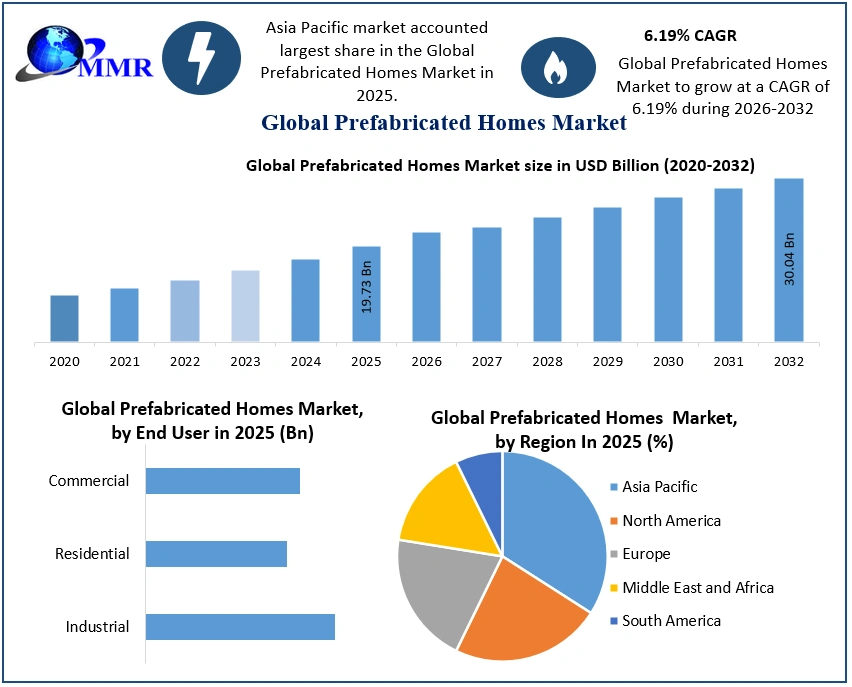
Market Valuation: Global market scale rises from USD 19.73 Billion in 2025 to a projected USD 30.04 Billion by 2032, sustained by a stable 6.19% CAGR.
Dominant Architecture: Panel systems command the largest market share as of 2025 due to rapid installation speeds and production cost efficiencies.
Regional Stronghold: Asia Pacific controls the global landscape, with China representing more than 50% of the total regional market share.
Capital Infusion: Industrial scaling is accelerating via massive infrastructure allocations, led by China’s USD 8.2 Billion investment in prefab manufacturing hubs.
Material Shift: Downstream demand is shifting toward advanced composites, eco-friendly materials, and zero-energy building components.
Why This Matters Now
Volatile traditional building material costs and severe labor shortages are forcing real estate developers to abandon on-site wet construction. For chemical manufacturers, insulation suppliers, and engineered material producers, this structural migration changes how products are bought and sold. Instead of selling to fragmented local contractors, material producers must now secure high-volume, standardized contracts with industrialized prefabrication factories.
The compression of construction timelines requires a corresponding transformation in raw material performance. Factory assembly lines require fast-curing structural adhesives, ultra-lightweight composite paneling, and high-performance thermal insulation that can withstand transportation stress. Chemical companies that fail to adapt their distribution strategies to service off-site manufacturing hubs risk losing volume to vertically integrated modular builders.
Market Overview
The global Prefabricated Homes Market Size is undergoing a major transition from an alternative building niche into a core component of industrial infrastructure. Valued at USD 19.73 Billion in 2025, the market is on track to reach USD 30.04 Billion by 2032, expanding at a steady 6.19% CAGR. This growth pattern reflects an intentional effort to address global housing deficits through factory-controlled precision engineering.
This rapid expansion directly impacts the chemicals and materials sector. Traditional construction depends heavily on concrete, on-site mortar, and field-applied sealants. In contrast, prefabricated modular construction relies on engineered polymers, protective coatings, specialized insulation, and precision-manufactured structural elements. As factory throughput increases, raw material demand is shifting from commodity bulk chemicals toward specialized, high-performance formulations.
Key Trends Driving Growth
Rapid global urbanization is the primary catalyst driving volume growth in the prefabricated housing sector. As metropolitan housing prices climb faster than average incomes, developers are using off-site manufacturing to lower holding costs and speed up project delivery. Prefabricated structures move from factory floors to final occupancy much faster than traditional builds, protecting project capital from prolonged high-interest environments.
Concurrently, the premiumization of modular architecture is altering the underlying material mix. Consumer demand for customization, architectural design, and energy efficiency has led to the adoption of advanced engineering tools like 3D printing and AI-driven structural modeling. This shift requires raw materials with strict technical tolerances. To achieve zero-energy building certification, manufacturers are increasing their consumption of high-R-value polyurethane insulation, specialized vapor barriers, and durable exterior composite coatings.
Segment Insights
Panel Systems (Dominant Segment): Holding the highest prefabricated homes market share by 2025, panel systems serve as the primary growth engine for the mass market. Their dominance stems from their versatility across single-family and multi-story commercial projects, offering an optimal balance between low transportation volume and rapid on-site assembly. This high-volume segment drives steady, predictable demand for structural adhesives, anti-corrosive fasteners, and uniform insulation boards.
Modular & Innovative Lifestyles (Fastest-Growing Segment): Driven by tiny home trends and targeted urban developments, fully volumetric modular units are growing at the fastest rate through 2032. This rapid growth alters procurement patterns by concentrating purchasing power within highly automated factories. These production lines require advanced, fast-curing chemical sealants and lightweight structural composites to ensure entire room modules can be safely transported over long distances.
Regional Growth Story
The Asia Pacific region functions as the primary manufacturing and demand engine for the global prefabricated housing industry. This regional leadership is anchored by immense state-supported investments, highlighted by China’s multi-billion dollar funding allocations to establish large-scale prefab manufacturing complexes. China controls over 50% of the Asia Pacific market, utilizing prefabricated components for rural revitalization projects, metropolitan affordable housing initiatives, and disaster relief infrastructure.
Beyond China, established industrial economies like Japan and South Korea have fully integrated prefabricated modules into their commercial and residential real estate sectors. In Japan, the market focus emphasizes seismic resilience and disaster-resistant temporary structures. Meanwhile, India is integrating prefabricated technologies into its national “Housing for All” initiative to accelerate affordable urban housing construction. This widespread regional activity creates strong export and import flows for performance materials, driving structural consumption of advanced polymers across these key manufacturing hubs.
Competitive Landscape
Market participants are actively investing in digital integration and advanced materials to consolidate their market positions and gain pricing power. Companies are shifting away from basic assembly to position themselves as technology-driven platform providers, optimizing factory floor efficiency to reduce material waste.
A review of recent corporate strategies reveals a clear push toward product differentiation based on energy efficiency and smart technology integration:
Katerra introduced an AI-driven design platform tailored for rapid prefab customization, setting a benchmark for shorter design cycles and improved factory floor efficiency.
Lennar Corporation launched its “NextGen” series, anchoring its market differentiation on high-efficiency, energy-saving prefabricated configurations.
Nippon Koei deployed its “ZEH Prefab” zero-energy house design, accelerating the commercial adoption of green building components and advanced insulation systems.
Blu Homes expanded its geographic footprint into dense urban centers by introducing modular apartment complexes designed to address metropolitan density.
Champion Homes introduced its “Innovation Series,” incorporating smart home features directly into factory floor sub-assemblies to capture higher margins.
These moves signal a structural shift in the industry. As major players scale up, commodity material suppliers face margin compression unless they offer specialized, performance-matched chemical products that integrate cleanly into automated production lines.
Recent Developments
Industrial scale-up was accelerated by China’s direct allocation of an USD 8.2 Billion investment specifically targeted at expanding regional prefabricated manufacturing infrastructure.
Corporate design portfolios shifted heavily toward environmental performance, evidenced by Nippon Koei’s deployment of zero-energy designs requiring advanced thermal insulation materials.
High-end consumer demographics are increasingly targeted via smart-home integrated modules, such as Champion Homes’ tech-enabled structural series.
Urban multi-family building segments gained traction through Blu Homes’ commercial launch of dense, multi-story modular apartment designs.
Strategic Implications
For chemical and material executives, the growth of the prefabricated housing market requires a fundamental realignment of commercial strategy. Volume sales are moving away from traditional on-site delivery toward centralized factory contracts. This consolidation of buying power gives prefab manufacturers greater leverage, allowing them to demand specialized material packaging, strict quality tolerances, and just-in-time delivery schedules.
Sustainability and circular economy regulations will also shape future material choices. Prefabricated builders use factory environments to minimize raw material waste, and they expect the same efficiency from their suppliers. Material providers who formulate easily recyclable composites, bio-based polyurethane insulation, and low-VOC (volatile organic compound) structural adhesives will position themselves as preferred partners as green building regulations tighten globally.
Future Outlook
The global prefabricated homes market will navigate a clear transition between 2025 and 2032, driven by automated manufacturing and stricter building efficiency regulations. While lingering consumer preconceptions regarding modular quality present a temporary hurdle, the cost advantages of factory-controlled production will continue to drive adoption. Market dominance will belong to advanced material suppliers and integrated modular builders who successfully combine automated factory systems with high-performance insulation and sustainable chemical formulations.
Analyst Perspective
“The shift toward prefabrication is rewriting the procurement rules for structural materials. Suppliers are no longer just selling bulk components to job sites; they are integrating specialized formulations directly into highly automated factory production lines where speed, precision, and thermal performance are non-negotiable.” — Ankita Kagawade, Lead Analyst, Chemicals & Materials, Maximize Market Research
About Maximize Market Research
Maximize Market Research Pvt. Ltd. (MMR) is a global market research and consulting company that provides reliable, data-focused, and practical business insights. The firm serves a wide range of industries, including healthcare, pharmaceuticals, technology, automotive, electronics, chemicals, personal care, and consumer goods. Through market forecasts, competitive analysis, strategic consulting, and industry impact assessments, MMR helps organizations understand changing market conditions, identify growth opportunities, and make informed business decisions for long-term success.
2nd Floor, Navale IT Park Phase 3
Pune Banglore Highway, Narhe
Pune, Maharashtra 411041, India
+91 9607365656
sales@maximizemarketresearch.com
