Key Highlights
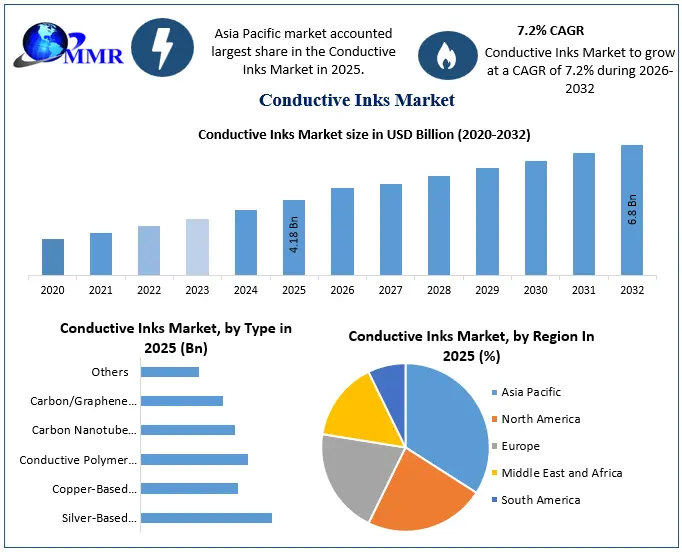
Market Valuation: The market was valued at USD 4.18 Bn in 2025.
Revenue Projection: Revenue is expected to reach USD 6.8 Bn by 2032.
Growth Rate: A steady CAGR of 7.2% is anticipated from 2026 to 2032.
Dominant Type: Silver-based conductive inks hold the largest market share due to superior conductivity.
Fastest-Growing Application: The Photovoltaic (PV) segment led the market in 2025, capturing roughly 23% of total revenue.
Regional Hub: Asia-Pacific stands as the dominant region, anchored by China, India, and Japan.
Why This Matters Now
Traditional electronic assembly lines are rapidly becoming bottlenecks for high-speed, high-density device manufacturing. Chemical manufacturers and industrial buyers who fail to integrate printable electronic solutions are effectively choosing higher capital expenditure over the scalability offered by current conductive ink technology.
Market Overview
The global Conductive Inks Market represents a critical intersection between specialty chemical formulation and high-tech electronic manufacturing. In 2025, the market reached a valuation of USD 4.18 Bn. This sector is defined by specialized formulations—typically embedding silver, copper, or carbon nanoparticles—that enable the creation of circuits, sensors, and antennas directly onto flexible or rigid substrates. Looking ahead, the market is forecast to maintain a CAGR of 7.2%, reaching a projected USD 6.8 Bn by 2032.
Key Trends Driving Growth
The transition toward the Internet of Things (IoT) and the electrification of the automotive sector remain the primary drivers. Manufacturers are shifting from bulky, traditional PCB assembly to printed circuitry, which offers significant reductions in weight and form factor. Simultaneously, the renewable energy sector—specifically photovoltaic (PV) manufacturing—demands increasingly conductive, efficient, and cost-effective ink solutions for solar cell interconnects.
Sustainability is no longer an optional overlay but a core design constraint. Manufacturers are facing intense pressure to migrate away from hazardous chemical compositions, with regulations such as REACH (Registration, Evaluation, Authorisation and Restriction of Chemicals) in Europe and global RoHS compliance forcing a pivot toward safer, eco-friendly formulations. Companies that effectively balance high-performance electrical properties with these stringent environmental compliance standards are gaining a structural competitive advantage.
Segment Insights
Dominant Segment (Type): Silver-based conductive inks maintain market leadership. Their proven track record for high conductivity and reliability makes them the standard for critical consumer electronics and automotive applications.
Dominant Segment (Application): The Photovoltaic (PV) segment captured approximately 23% of total revenue in 2025. The global ramp-up in clean-energy infrastructure, particularly in China and India, continues to drive volume for printable, high-efficiency busbars.
Emerging Segments: Copper-based inks are gaining traction as a cost-effective alternative to silver, while conductive polymers are essential for the burgeoning field of wearable electronics and smart textiles.
Regional Growth Story
Asia-Pacific serves as the undisputed epicenter of the conductive inks market. The region’s dominance is underpinned by a robust ecosystem of electronics manufacturing in China, India, and Japan. China’s aggressive expansion in photovoltaic capacity acts as a primary volume driver. Meanwhile, Taiwan remains a critical hub for high-end PCB fabrication, focusing on material autonomy to secure supply chains.
North America remains a focal point for R&D-led innovation, particularly in smart packaging and advanced automotive components. Europe continues to lead in the adoption of sustainable manufacturing practices, with industrial clusters focused on regulatory compliance and eco-conscious formulation development.
Competitive Landscape
The competitive structure is currently characterized by a pursuit of technical differentiation. Industry leaders like DuPont (United States) and Henkel AG & Co. KGaA (Germany) dominate through high-performance silver-based solutions and strong patent portfolios. Mitsubishi Chemical Corporation (Japan) focuses on nanoparticle innovation to improve printability, while Sun Chemical Corporation (United Kingdom) is aggressively pursuing cost-effective, eco-friendly formulations. NovaCentrix (United States) occupies a critical niche with photonic curing technologies that enable high-throughput processing on heat-sensitive materials.
Recent Developments
Strategic R&D: Major players are prioritizing the development of bio-based conductive inks to circumvent environmental regulations and raw material supply volatility.
Technological Integration: The industry is moving toward “systems-level” solutions, where ink manufacturers partner directly with equipment providers to optimize curing processes for 5G and aerospace applications.
Capacity Expansions: Leading firms are aligning production capacities with the shift in PV manufacturing geography, establishing localized supply chains in key markets to mitigate trade tariff impacts.
Strategic Implications
The market is shifting from commodity pricing to value-based competition. For procurement leaders, the volatility in silver pricing represents the single largest risk to margins. Consequently, the ability to qualify alternative formulations, such as copper or carbon-based inks, is a critical strategic imperative.
Manufacturing capacity utilization is now intrinsically linked to the ability to support high-speed additive manufacturing. Companies that successfully bridge the gap between traditional printing techniques and high-performance electronics will capture the greatest value. The barrier to entry remains high, centered on proprietary formulations and the ability to navigate complex regulatory landscapes without compromising product performance.
Future Outlook
The future of the conductive inks market belongs to providers who can deliver high-performance, environmentally compliant formulations that integrate seamlessly with high-throughput, flexible manufacturing processes. The winners will be firms that effectively hedge raw material exposure while diversifying into the high-growth photovoltaic and wearable electronics segments, while the primary risk remains the failure to adapt to evolving, stringent chemical safety regulations.
Analyst Perspective
“The conductive inks market is moving past the experimental phase and into a period of industrial maturity,” says Ankita Kagawade, Analyst at Maximize Market Research. “Strategic growth now depends on the ability to balance the high conductivity requirements of the automotive and PV sectors with the growing demand for sustainable, cost-optimized chemical formulations.”
About Maximize Market Research
Maximize Market Research Pvt. Ltd. (MMR) is a global market research and consulting company that provides reliable, data-focused, and practical business insights. The firm serves a wide range of industries, including healthcare, pharmaceuticals, technology, automotive, electronics, chemicals, personal care, and consumer goods. Through market forecasts, competitive analysis, strategic consulting, and industry impact assessments, MMR helps organizations understand changing market conditions, identify growth opportunities, and make informed business decisions for long-term success.
2nd Floor, Navale IT Park Phase 3
Pune Banglore Highway, Narhe
Pune, Maharashtra 411041, India
+91 9607365656
sales@maximizemarketresearch.com
